|
27 Crown Quay Lane / Water Lane in 1851
Sittingbourne
The pub changed name to the "Barge"
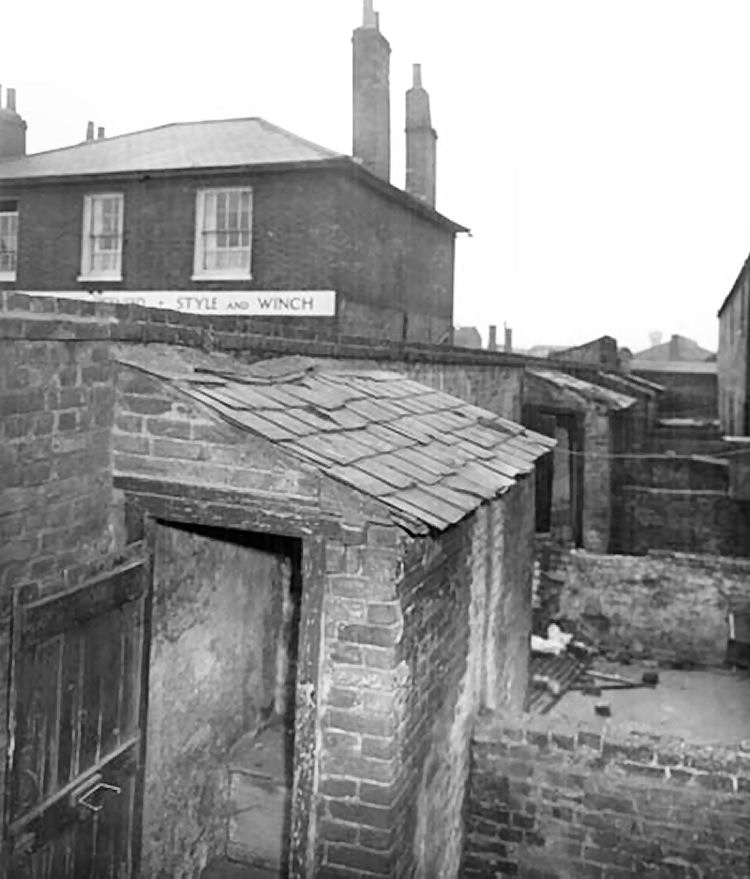
date unknown. The building has now been demolished, again date unknown but
after 2005.
|
From the Kentish Gazette, February 1814.
EXTRAORDINARY SALE.
A few days since, the following extraordinary sale took place at the
"White Hart," Sittingbourne.
A woman by the name of Coveney, was led by a halter into one of the
rooms, and sold to the highest bidder, with her five children, a horse
and cart, and all her household furniture.
A man at Newington was the purchaser, for the sum of ten pounds.
|
|
From the Kentish Gazette, 14 February 1843.
WHITE HART, SITTINGBOURN.
JOHN BROOK,
HAVING taken the above House and Bowling Green, leading to Crown Quay,
takes leave to inform the Public and Subscribers to the Green, that he
hopes by assiduity, attention, and moderate charges, to merit a share of
the public favour, and also that of his friends and the neighbourhood.
|
|
From the Southeastern Gazette, 13 March 1866.
SITTINGBOURNE. Fatal Boiler Explosion.
On Friday morning, about half-past sis o’clock, a boiler exploded at the
cement works of Messrs. Cleaver and Co., Crown Quay, Sittingbourne, with
fatal results. William Lambert, the engine-driver, was killed on the
spot. He was the only man in the engine-house at the time of the
explosion, but a number of other men on the works were injured by the
falling timber, &o., viz., James Blandfleld, seriously injured about the
back, neck, and arms; Robert Blandfield, injury to leg; Thomas Johnson,
hurt in the back; Edward Johnson, slightly injured; George Outing,
slightly injured; and another was reported to be badly hurt in the loins
and hips.
An Inquest on the body of the engine-driver took place at the “White
Hart Inn,” Crown Quay, before the coroner, T. Hills, Esq., the same
evening.
The first witness was the manager of the works, Mr. Bullivant, who said
it was a mystery to him how the accident occurred. No one at all on the
premises had any right to touch the engine but the deceased, who must
have accumulated more steam than the safety valves could discharge. In
answer to the Coroner, the witness stated that safety valves in proper
order ought to discharge any amount of steam.
A labourer named Smith deposed that he was at work at 20 past 6. He went
to the engine-house, and deceased was there, getting the steam up. It
was blowing off a little. He was sober. The fire was a good one. He put
in some coal just as witness got there. There were five other men
besides witness then in front of the boiler. They all went out when
witness did, except a boy, who left shortly after. Witness had been at
work five or six minutes when he heard the explosion. On going to the
engine-house he found it in ruins. The boiler was all to pieces, and
everything down. Deceased’s body was lying alongside one of the Portland
kilns. It was about ten yards from where he left him, in front of the
stoke-hole. Believed deceased was a competent man. He was capable of
almost any sort of work. The engine was not “started.”
The Coroner observed that if it had been, in all probability the
accident would not have happened. If there had been any mismanagement it
must have been on the part of the deceased himself.
A verdict of “Accidental death” was returned.
Deceased leaves a widow, whom the company will provide for. The
unfortunate man was formerly foreman at the Maidstone Gas Works.
|
|
From the Southeastern Gazette, 12 June 1866.
SITTINGBOURNE. Sad Accident to a Volunteer.
A painful feeling was created in this neighbourhood yesterday (Monday)
week, by the intelligence that Mr. John Bates, grocer, of the
High-street, Milton, had accidentally shot himself. The facts of the
occurrence were elicited at the inquest held the following evening,
before T. Hills, Esq., coroner, and a jury, of which Mr. F. Hartridge
was foreman, when the following evidence was given:—
William Wilson, living at the “White Hart," next door to the residence
of the deceased, who was married to the witness’s sister, said deceased
was 41 years of age, and had been a member of the local volunteer corps
for six years. He had never said or done anything that would at all lead
witness to suspect that he would commit suicide. About twenty minutes
past six on Monday morning, he heard his sister exclaim, “What shall I
do ?” He immediately went from Mr. Worthy’s shop adjoining to deceased’s
back room, when he saw deceased in a half- kneeling and half-silting
position in the corner, with his back against a cupboard, close to the
window. He was quite dead. There was a large quantity of blood, and the
top of his head was completely blown off. His rifle was lying over his
right leg, and the muzzle pointing to his body. Having stated that he
instantly called in Mr. Ray, surgeon, the witness proceeded. The
materials for cleaning the rifle were in the room. The cleaning rod laid
across his leg, parallel with the rifle; the rags for cleaning lay on
the table; the screw driver, wrench, muzzle stopper, and reflector were
on the table, as if he had been preparing to clean his rifle. Deceased
was in the habit of cleaning his rifle early in the morning on
inspection days, and the annual inspection of the battalion took place
at Canterbury later in the day of Monday. Witness believed deceased
recently went to Rainham to shoot, but he could not tell whether he
brought his rifle home loaded or not.
P.C. Watson, who was called in, gave confirmatory testimony.
The Coroner having summed up, the jury returned a verdict of “Accidental
death.”
Deceased, who leaves a widow and six children, was much respected, as
was evinced by the fact that over fifty of his comrades attended the
interment in the parish churchyard on Friday. The procession was formed
at the Corn Exchange, at five o’clock, and was composed of Lieut.-Col.
Dyke, Capt. Lake, Ensign Knight, Surgeon Grayling, Assistant-Surgeon
Penfold, 10 non-commissioned officers, and 40 privates, besides the
band. The “Dead March” was performed on the way to the churchyard, where
the service was impressively read by the Rev. W. English, vicar, who
delivered an address. The firing party discharged three volleys over the
grave. The deceased was the son of Mr. John Bates, of Union-street,
Maidstone.
|
LICENSEE LIST
JARRETT Henry 1832-39+
 
SMITH Thomas 1840+

BROOK John 1843+
FOORD William 1847+

CLINCH Charles 1851-58+ (age 28 in 1851)
 
JOHNSON William 1862+

ROOK Stephen 1871+ (age 48 in 1871)
ROOK William 1874+

ROOK Louisa 1881-91 (widow and 52 in 1881)
 
CURLING Gilbert James 1891-99+ (age 30 in 1891)

CHAPMAN William 1903-22+
(age 68 in 1911)
    
HUGHES Mary A 1930+

WATSON William W J 1938+

BATES Freda Clara Mrs to Dec/1961

BATES Anthony James Dec/1961+
https://pubwiki.co.uk/WhiteHart.shtml
From the Pigot's Directory 1832-33-34
From the Pigot's Directory 1839
From the Pigot's Directory 1840
From Bagshaw Directory 1847
From the Post Office Directory 1855
From Melville's Directory 1858
From the Post Office Directory 1862
From the Post Office Directory 1874
Census
From the Post Office Directory 1882
From the Post Office Directory 1891
From the Kelly's Directory 1899
From the Post Office Directory 1903
From the Kelly's Directory 1903
From the Post Office Directory 1913
From the Post Office Directory 1918
From the Post Office Directory 1922
From the Post Office Directory 1930
From the Post Office Directory 1938
East Kent Gazette
|