|
19-21 High Street
Beckenham

Above postcard, 1905. Kindly sent by Ian Muir of the Beckenham History
Society. |
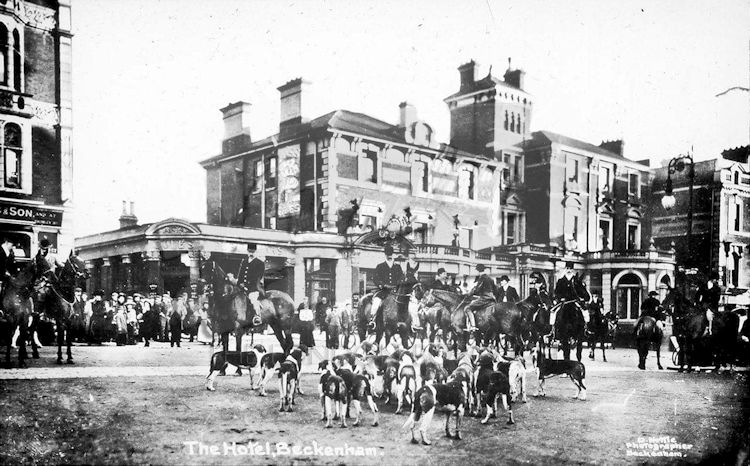
Above postcard, date unknown. |
|
|
The pub and surrounding buildings were destroyed by bombs between 1944
and 45 and is now the site of Beckenham Green.

Above showing the war damage after 1945. |

Above photo, 2016 by Colin Price. |
Now part of Greater London, this area was indeed Kent before 1965. Hence,
I will be adding information regarding this pub as and when I find or it is
sent to me, but at present I'll be concentrating on the areas that are
within the Kent boundary today.
Your help is appreciated, and every email is answered.
|
From the Bromley Record, October, 1861.
BROMLEY PETTY SESSIONS. 1st September, 1862.
Present:— Viscount Sydney, Coles Child, Esq , C. L. Wilson, Esq., R. Boyd, Esq.
This being the General Annual Licensing Meeting, the whole of the Inn Keepers of
the several parishes in the division were licensed accordingly, except in the
case of the "Railway Tavern," Beckenham, and the "King's Head," Bexley Heath,
which were adjourned to the next meeting, on the 15th inst.
Three applications for new Licenses in Bromley were also made: one by Mr.
Budding, of the "Anglesea Arms," New Bromley; one by Mr. Newell, of the "Laurell"
in the London Road, and one by Mr. Copelin, who has lately erected a new house
near the Shortland Railway Station. In the case of Mr. Budding, the license was
granted; Mr. Newell's refused; and in the case of Mr. Copelin, the application
was adjourned.
BROMLEY PETTY SESSIONS. Farnborough, 15th September.
Present:— G. W. Norman. Esq., W. Waring, Esq., Jas. Chapman, Esq., R. B. Berens
Esq.
At the adjourned Special Sessions for Licensing, Mr. Baxter, of Greenwich, was
licensed to the "King's Head," Bexley, in the room of Mr. Thomas, and Mr. Bird
to the "Railway Tavern," Beckenham, in the room of Mr. Taplin.
|
|
Dover Express, Saturday 13 January 1866.
Beckenham. Testimonial to a Station-Master.
A large party assembled on Monday at the "Railway Hotel," Beckenham,
to present a testimonial to Mr. M Moore, stationmaster.
It consisted of a purse containing 75 sovereigns, and a very
handsome inscriptions in a gilt frame, setting forth the high
qualities of Mr. Moore in his position of stationmaster, his strict
attention not only to his duties but to the comfort and convenience
of the travellers on the London, Chatham, and Dover, and
Southeastern lines.
It is due to Mr. Moore to say that he justly deserves his this mark
of respect, and he has a vast amount of extra duties to perform in
consequence of the great traffic that this junction having been for
a long time under his guidance for two companies. Not a single
accident to a passenger train has occurred. Some little
disappointment has been expressed that the subscription list was not
published, that more person's might have availed themselves of the
opportunity.
|
|
From the Southeastern Gazette, 23 January 1866.
THE LATE FATAL ACCIDENT ON THE LONDON, CHATHAM, AND DOVER RAILWAY.
In our last we reported a very serious accident which happened on the
London, Chatham, and Dover Railway near Beckenham, on Sunday, the 8th
inst., and by which John Hasted, aged 19, a native of Seasalter near
Whitstable, was killed,
It appeared that shortly after midnight on Saturday a goods train left
London, and after calling at Herne-hill it passed the Penge station
shortly before four o'clock. Between that station and Beckenham the line
of railway crosses a bridge thrown over a small stream, a tributary of
the Ravensbourne, which generally flows gently on the depth being from
six to twelve inches, but owing to the heavy rains, and the snow of the
previous Thursday, the stream was greatly swollen, and the waters rose
to a considerable height. This portion of the line is not the London,
Chatham, and Dover proper, but it was constructed by the West London and
Crystal Palace Company, the bridge in question, which is about four
hundred yards from Beckenham station, having been designed by Mr.
Fowler, the eminent civil engineer, and it passed into the possession of
this company by purchase. The bridge is only about 15ft. above the level
of the ground, and it is composed of two abutments and a centre pier,
the iron girders crossing resting on the abutments and pier. Through one
of the openings the stream flows, and the other is an accommodation road
used by Mr. Covell, of Kent House farm, the occupier of the land on both
sides of, this part of the line. We may, remark here that the greatest
supervision is exercised by the company’s officials with regard to the
bridges, the foreman examining them weekly, the inspectors monthly, and
the resident engineer occasionally; and on the previous Saturday
morning, when this bridge was inspected, it appeared perfectly sound,
and the water in the stream was no higher than customary, so that there
was the space of about 3ft. on either side of the stream to the
brickwork. About midnight a down passenger train passed over the bridge
without signs of instability being perceptible, and at about three
o’clock in the morning an up goods train also passed over safely. At
four minutes to four, however, the time being exactly known by the watch
found on the deceased having stopped at that moment, the goods train,
composed of about thirty trucks, besides two break vans, and the engine
and tender, arrived at the bridge, when the abutment at that side gave
way, the engine was carried forward and struck the pier, knocking a
portion of it down, and it then fell into the approach road beneath. The
tender followed and fell by it, and the break van fell upon the tender,
whilst the trucks, which were nearly all filled with merchandise, fell
after each other into the stream, until the archway was completely
blocked up, and the hinder part of the train was brought to a
standstill. The engine driver was thrown from the engine into a hedge,
and escaped without very serious injury, but the unfortunate fireman,
who had only just been promoted, this being his second journey in that
capacity, fell under as the tender turned over, and being caught between
that and the pier, he must have been killed instantaneously. The body
was not discovered until daylight, when the head alone was visible, but
it was so buried in the debris that it was not recovered until Thursday.
The head guard in the front break was very little injured, and managed
to creep through the window on to the bank, and the second guard, the
fourth person in the train, was only stunned for a short time by the
sudden shock.
The disappearance of the engine was seen by the signal-man at the
Beckenham junction, who was watching the progress of the train, and the
noise made by the crashing of the falling trucks was heard at a
considerable distance. The telegraph wires having been broken by the
snow, it was impossible to forward information of the calamity very
speedily, but Mr. Moore, the Station-master at Beckenham, and Mr.
Burgess, at Penge, hastened to the scene of the accident with all the
assistance they could gather at so short a notice, and means were taken
to prevent the approach of trains.
Early in the morning Mr. Bishop, the superintendent, Mr. Mills the
resident engineer, Mr. Martley, of the locomotive department, and other
officials and workmen, were at the place, and arrangements were made for
the continuance of the traffic and the recovery of the property. Up to
Monday at noon the passengers had to alight and cross the bridge on
foot, and trains were in readiness to continue the journey, but after
that time the up-line side of the bridge, which had received little or
no injury, was in a fit condition for the trains to pass over. During
Sunday and the following days hundreds of persons visited the spot, and
a number of the Metropolitan police, under Inspector Linvell, of
Bromley, were present and rendered good service by checking trespassing
on and over the line, which many of the visitors were disposed to
commit. Little difficulty was felt by those who visited the place early
on Sunday morning in forming a correct opinion as to the cause of the
accident, for during the night the stream had risen several feet, and
portions of the embankment below the bridge had been washed away, and
the rapid flow of the water through the arch had washed away the
foundation at that part of the abutment which gave way, as a hole to the
depth of about 5ft. was afterwards found to have been made there.
The body of the unfortunate young man having been recovered on Thursday,
the inquest was held at the “Railway Tavern,” Beckenham, on Friday
morning, before C. J. Carttar, Esq., and a highly respectable jury. Mr.
Church, was present to watch the case on behalf of the company, and the
chief officials were also present.
The father of the deceased, a respectable man holding a small quantity
of land at Seasalter, having identified the body as that of his son,
Thomas Smith, the head guard of the goods train in question; Christopher
Barrett, the under guard, Amos Groombridge, signalman at Penge station;
William Baxter, signalman at the Beckenham junction; Mr. Moore, the
Beckenham station-master; and Mr. Mills, the resident engineer of the
London, Chatham, and Dover Company, were severally examined. Their
evidence went to substantiate the facts narrated above.
The jury having deliberated a short time in private, the foreman said
they had agreed to a simple verdict of “Accidental death,” but left to
Mr. Mill, the engineer of the London, Chatham, and Dover Company, the
consideration of the evidence taken as to the state of the streams and
bridges.
A verdict of “Accidental death” was then recorded.
|
|
Bromley & District Times, Friday 28 March 1890.
The wrong place to seek advice.
Charles Shaw, 34, of Rogester Road, Balham, a clerk, was charged
with being drunk and disorderly at High Street, Beckenham, on
Saturday night last.
The prisoner, of gentlemanly appearance, denied the charge.
From the evidence of the police it appeared that the accused went to
the police station at Beckenham, to ask why a friend of his
was ejected from the "Railway Hotel" for disorderly conduct and was
locked up. It was alleged that he was drunk and disorderly
when he came to the station, and the inspector on duty ordered him,
too, into custody.
Accused stontly denied that he was drunk when he went to the police
station. He was perfectly sober, but instead of receiving any
courteous reply at the hands of the inspector in charge, he was
locked up for some two hours until bailed out.
Edward Jacguitin and Vernon Chalk (who bailed for the accused) went
into the witness box, and swore to the sobriety of the
accused.
The Chairman remarks that it was an important circumstance that the
accused went to the police station. A police station was not
the place to give legal advice to persons. Publicans had a right to
conduct their houses in a manner as would conduce to quietness,
and they had a perfect right to reject any person who made a
disturbance in the bar. The Bench were bound to protect the police
and the publican. It was evident the accused was what was called
"quarrelsome drunk," although not helplessly so, and he would
be fined 10s. and 7s. 6d. costs.
|
|
From unknown paper, 14 March 1906.
FOUND FLOATING IN THE SEA.
Barmaid and Her Ivyleaf.
No explanation of the death of Madelino Sarah Wells, a barmaid at
the "Railway Hotel," Beckenham, was forthcoming at the inquest at
Dover yesterday, and the inquiry was adjourned.
The body was found in the sea off Dover on Saturday. The previous
day she went for a walk from the hotel, and was lost sight of until
discovered in the water. There was then a return half ticket from
Beckenham to Charing Cross on the body.
It is suggested the deceased did not travel alone, and that a watch
which she generally wore is missing.
There was an ivyleaf on the girl's breast above her heart, and it
was stated that, in the language of flowers, this signified, "I
cling to thee."
The body was floating face downward, which, it was stated, was a
very peculiar circumstance. |
LICENSEE LIST
BIRD Sarah 1874-81+ (also posting house widow age 55 in 1881 ) )
CAKEBREAD John S 1891+ (age 42 in 1891)
THORN Stanley F H 1901+ (age 37 in 1901)
MILLS Charles 1903+

COLES Tom Fooks 1913-22+
COPE Alfred John 1930-38+
https://pubwiki.co.uk/RailwayHotel.shtml
http://www.closedpubs.co.uk/railway.html
Census
From the Kelly's Directory 1903
|

