|
From the Kent Herald, 9 December 1824.
A Singular Case Of Lunacy.
In Re Millson, a supposed Lunatic.
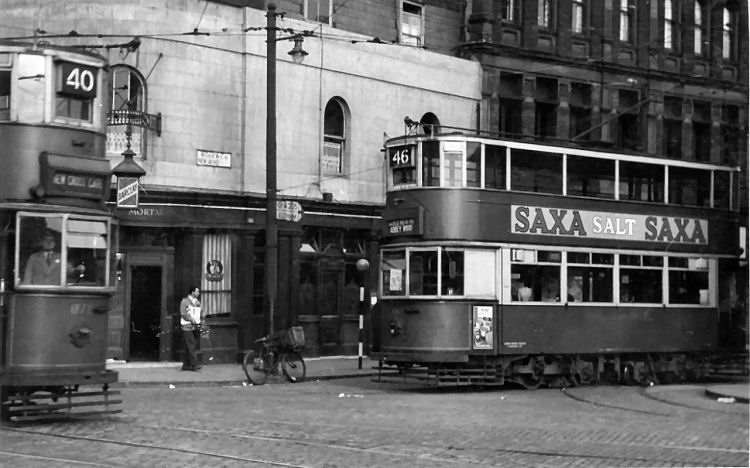
During the last week a commission of lunacy was held at the "Royal Mortar"
public house, in Woolwich, the proceedings excited the utmost curiosity. The
subject of the inquiry was one of the oldest farmers in Kent, who is possessed
of property to the value of between £30,000 and £40,000.
The evidence given upon these facts closed the case for the petition, which the
alleged lunatic himself was brought forward for examination. When he was ushered
into the presence of the jury, he looked round him with a vacant stare, but
behaved himself with perfect proprietary. He is a remarkably stout
healthy-looking old man. His hands were evidently affected with paralysis. He
sat down and the following examination took place by Dr. Phillimore:-
How are you, sir?
Pretty well; pretty well.
How goes on Farming?
Pretty well, pretty well.
They are now, then, good times for you?
Oh yes.
Then you find them good?
Oh no, they are bad.
How old are you?
36.
What is your name?
So and so.
Dr. Phillimore repeated the question, and the same answer was returned.
Why, I thought your name was Millson?
Oh, (recollecting,) so it is; yes, it is.
The examination was continued, but the above is a fair specimen of the whole.
Dr. Phillimore summed up the evidence, and the Jury returned a verdict, finding
that Thomas Millson, senior, had not been of sound mind since the 25th of
September, 1820.
The management of the lunatic will, in his usual course, now devolve upon the
son.
|
|
Kent Herald, 25 September 1845.
Explosion at Woolwich Laboratory, Seven Lives Lost.
One of the most frightful accidents that ever occurred happened on Wednesday
morning, in the Royal Arsenal at Woolwich. A few minutes before 10 o'clock a
loud explosion was heard in the Laboratory Department, at a building known as No
1. Breaking-up shed. Assistance was immediately at hand, the men rushing from
various parts of the department to the spot. As soon as ingress could be
obtained, a fearful spectacle presented itself. Immediately behind the door,
crowded together in a confused heap, lay the scorched bodies of five men and two
boys. They were immediately removed to an adjacent shed on stretchers. The
building being on fire, the alarm bell was instantly rung, and the engines from
the different departments, with the Royal Sappers and Miners, and the Royal
Artillery, were speedily on the spot. The flames, by the exertion of the men,
was soon subdued, their ravages being confined to the building, the roof of
which had been already blown off, and some slight damage done to the roof of an
adjacent building.
It would appear, from what had been gleaned in other parts of the same
department (for not one of the unfortunate beings in the devoted building had
escaped to furnish any information), that the men and boys were at the time
employed in breaking up rockets, and through some friction the whole mass
accidentally ignited; thus at once consigning seven unfortunate individuals to
instant destruction.
The names of the persons who thus lost their lives are John Crake (master,) and
aged man, and one of the oldest servants in the department; H. Butters, and aged
man, with a large family, and his son, Henry Butters, a young married man;
Robert Burbage, and Michael Purtill. Four of these were what is called
laboratory men. In addition to these, two boys, named Leonard and Henley, lost
their lives. Purtill was a labourer belonging to the store-keeper's department,
and was engaged at the time in loading rockets. A man named William Reid, who
was engaged with him at the same time, had a very narrower escape.
It would appear that when the fatal occurrence took place the unfortunate
persons made a simultaneous rush towards the door. Unfortunately the doors
opened inwards, and so this circumstance some of the chief officers of the
establishment attributed their destruction. By the side of the door out of which
they had vainly endeavoured to escape, their blackened corpses were found.
The writer visited them shortly afterwards, and then presented a fearful proof
of the dreadful agent to which they had been exposed. Their clothes, and even
their boots, where either wholly or partially consumed, their bodies literally
roasted, and the flesh in many cases deeply incised; every vestige of hair was
consumed off their heads, and their features so disfigured as to render their
identification almost impossible.
As soon as the fire was subdued a party of the Royal Sappers and Miners, under
the command of Colonel Barney, R.E. one of the head department, and Lieutenant
and Adjutant Webb, R.E. proceeded to pull down the remaining parts of the shed,
many of which were in a dangerous state.
The remains of a dog were discovered in one corner of the building. It was the
opinion of a medical gentleman, who viewed the bodies with the writer, that
death took place from suffocation by carbonic acid gas.
The Inquest.
On Thursday, a highly respectable jury was empanelled at the "Royal Mortar
Tavern," Woolwich, before Mr. C. J. Carttar, to inquire into the death of the
seven unfortunate persons. From all the information we could gather on the
subject, it appears that the deceased were the only persons in the building when
the accident occurred, so that the cause of the melancholy catastrophe is at
present involved in mystery. It appears that the building in which the sufferers
were at work was, inconsequence of the explosion, considered unsafe, that a
portion of it was immediately pulled down, all the glass having been destroyed,
and the rafters on fire.
The remains of the unfortunate men were removed to another building in the
Arsenal for identification, awaiting the coroner's inquisition. The jury, having
been sworn, proceeded to view the bodies. They presented a most horrible
spectacle, not a feature, of any being recognizable, the whole of the clothing,
with the exception of their shoes, being entirely calcined, and the bodies
scorched in the most dreadful manner, the skin coming off at the touch.
On the return of the jury, witnesses were examined, and the room having been
cleared of strangers, the jury remained nearly an hour in deliberation, and they
returned the following verdict:- "That the deceased died from the effects of the
explosion of combustible material; but that there was no evidence of the cause
of that explosion."
The Coroner having informally announced the verdict, address Colonel Cockburn,
and said that the jury, without attributing want of caution to the authorities
in their mode of carrying on the works, submitting for their consideration, the
propriety of abolishing the steel chisel, and substituting it for the copper.
They also urge the proprietor of not allowing the work men to wear nails in
their shoes, and that the door should be made to open outwards. Colonel
Cockburn, assured the coroner of the deep regret which the lamentable occurrence
caused to everyone connected with the Arsenal, and pledged himself that the
recommendations of the jury would be scrupulously obeyed.
He was resolved, that the fuses instead of being split, should be in future
boiled. The death of the foreman, said the gallant colonel, was deeply felt, as
he was a most steady, trustworthy man, who's experienced was a guarantee for his
precautions against accidents, or risks. A more worthy man never lived. He again
repeating, that for their own safety and that of the man, the utmost precautions
will be instantly adopted. He agreed with the jury, that it was so to be
lamented that the doors did not open outwards as they did in every other part of
the building.
Removal of the Bodies.
In the morning the mangled bodies of deceased were placed in a neat coffins
prepared at the expense of the Government, and removed to their late residences.
In 1814, during a visit of the Allied Powers to the metropolis, a similar
casualty occurred at the Arsenal. Several men were engaged preparing fireworks
to be displayed in honor of the Royal Visitors, when an explosion took place,
and four men were killed on the spot, whose bodies were buried, and whose widows
were fully pensioned by Government.
|




 )
)