|
20 West Street
Blue Town
Sheerness
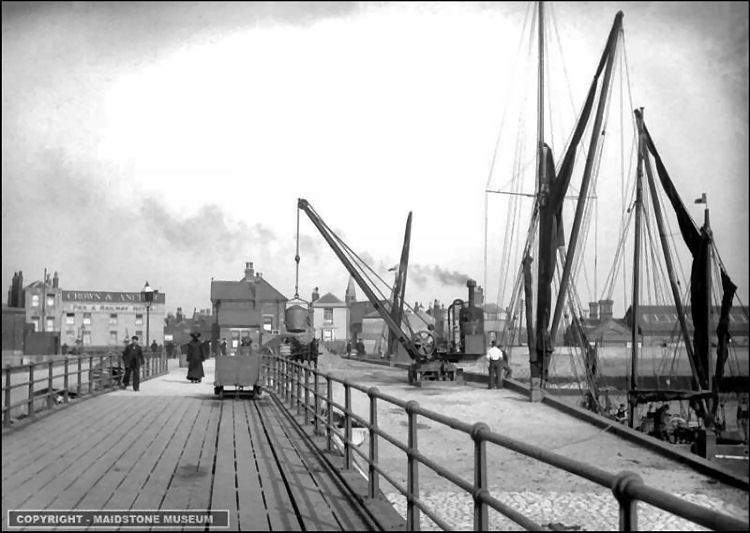
Above photo, date unknown. By kind permission of Trevor Edwards. |
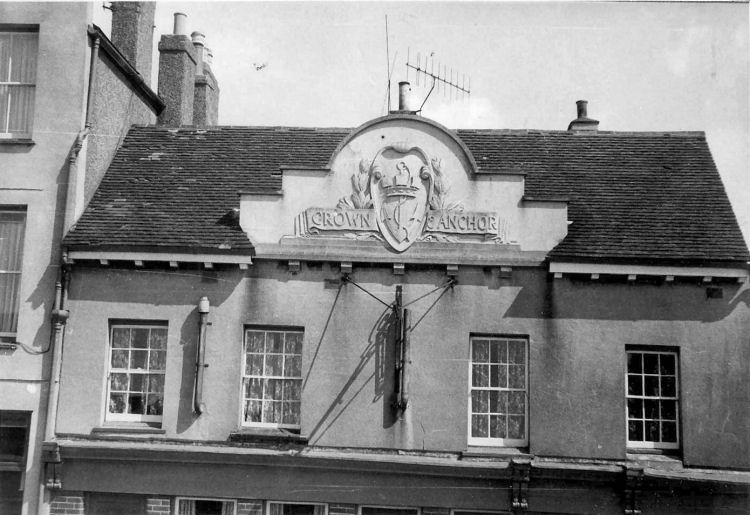
Above photo of a pub showing the "Crown and Anchor," unknown date, kindly sent by Peter Moynahan. |
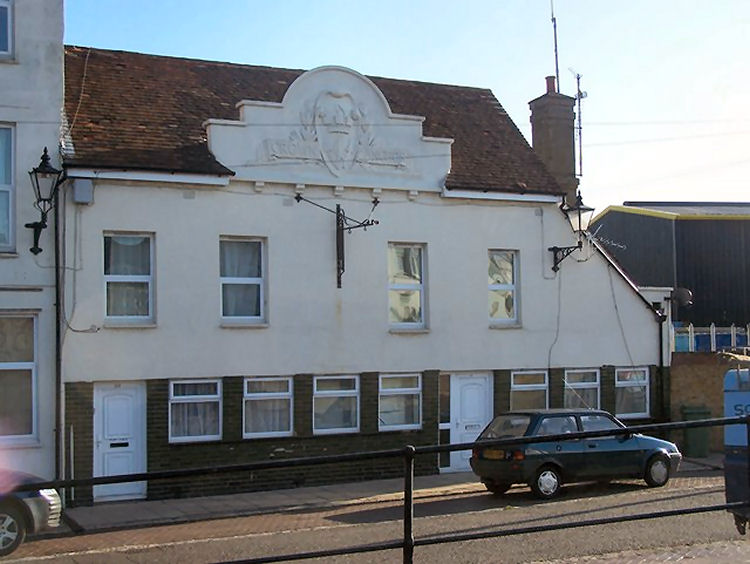
"Crown and Anchor" in Sheerness, above date 2008. |
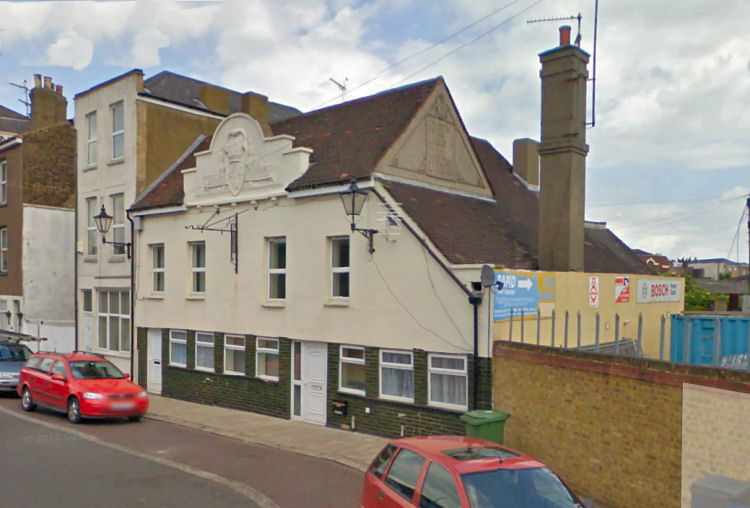
Above image taken from Google maps 2011. |
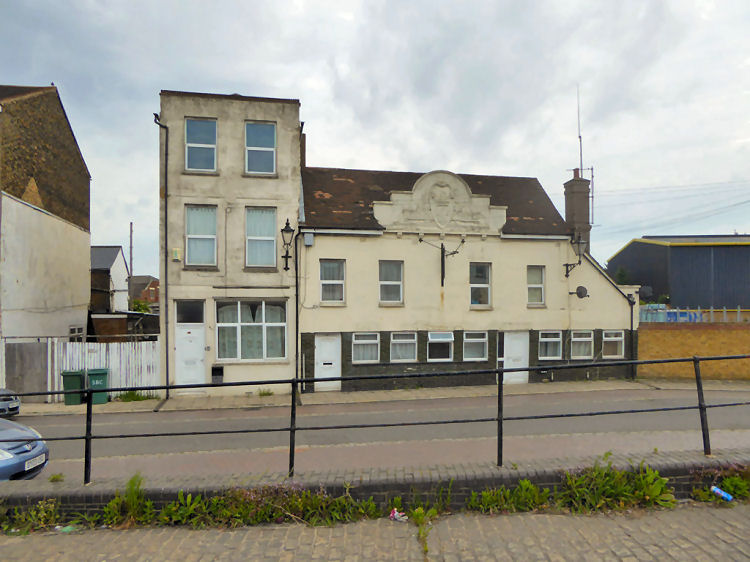
Above photo 2018 by Robin Webster
Creative Commons Licence. |
Also known as the "Pier and Railway Hotel."
Ind Coope & Co Ltd purchased the pub from Budden & Biggs Brewery Ltd by
conveyance and assignment dated 23 March 1931. The pub held a full license.
I am informed that the pub is closed and has been converted into flats,
as yet, date of closure unknown.
|
From the Kent Herald, 1 August 1833
Death
July 2, of dropsy, Mr. John Grinsted, landlord of the "Crown and Anchor
Tavern," Sheerness.
|
|
Morning Advertiser, Friday 10 November 1837.
Valuable Freehold Tavern, Sheerness.
H. Haines, Jun., will submit to Public Auction, at the Auction Mart,
opposite the Bank of England, on Monday, November 13th, at 12, without
reserve, by order of the Mortgagee, under a power of sale, the valuable
Freehold Property, known as a "Crown and Anchor," desirably situated
opposite the Pier at Sheerness, Kent. The above property is situate to
command a very extensive trade, being opposite the Pier, and also
surrounded by a large neighbourhood, and suitable for investment or
occupation - is at present let to a respectable tenant at will, at the
trifling rent of 60 shillings per annum. Particulars may be had on the
premises; of Messrs.. Oliveson, Denby, and Lavie, Solicitors, No. 8,
Frederick's Place, Old Jewry; at the Mart; and of the Auctioneer, No.
61, Fore Street, City, London.
|
|
From the Kentish Gazette, 28 May 1844.
AN ATTEMPT AT MURDER AND ROBBERY.
At the petty sessions held in the Guildhall, Rochester, on Friday
afternoon, before the mayor. Larkin Allen, esq., and Edmund Buck, esq.
and Edward Manclurk, esq., two of the borough justices, three watermen
from Sheerness were brought tip in custody of Edward Buckhurst, a
constable of Minster, in the isle of Sheppey, charged with robbing a
sailor, and attempting to murder him, by throwing him into the river
Medway. The men, on being placed in the dock, gave their names and ages
as follows:—
Edward Monck, 29, Chas. Henry Jest 26, and George Chapman,
35. None of the prisoners could read or write. The hall was crowded with
spectators. Several gentlemen were accommodated with seats on the bench.
Abraham Davis, the sailor who was ill-treated, was brought into court by
the boatswain and the quarter-master of her Majesty's ship Ocean, lying
off Sheerness. His throat was plastered up, and he had a bruise on the
right side of his temple. On being sworn, he said that on Wednesday, the
22nd inst., he was paid off from the Vernon frigate, at Sheeness, and
received five sovereigns. He went on shore about two o'clock p.m., and
entered a public house facing the entrance on to Sheerness pier. The
prisoners Monck and Jest were there, and he asked them what time the
steamer started for Loudon. Monck immediately took away his bag of
clothes, followed by the prisoner Jest; he followed them. They went
under the pier, and entered a boat, which he also got in, the prisoners
saying that they would lay off and wait the arrival of the steamer. When
they got him into the river, instead of waiting, they pulled the boat
into the middle of the Medway, when the prisoner Jest demanded from him
a sovereign as his fare, and as he did not know what to do, he gave him
one. Monck, the other prisoner, then demanded a sovereign, and he told
the prisoner he should not get one out of him, but to satisfy the
prisoner he gave him 3s. The prisoners could see that he had another
Sovereign. Monck said that was not enough, and pulled the boat to the
opposite shore—the Isle of Grain. When about three lengths of the boat
from the shore, one of the prisoners dropped the anchor. During the time
the prisoners were rowing to the Grain shore, Monck swore that if he did
not give him more money, he would throw him overboard. When the
prisoners cast their anchor he begged of them to put him ashore. Both
prisoners immediately seized hold of him and threw him overboard, also
his bag of clothes. He arose and caught hold of the gunwale of the boat.
The prisoner Monck desired Jest to knock his brains out. He then
received some blows on the head, and also a cut in the neck from some
instrument. His neck bled very much. He thought the prisoners wanted to
strangle him. Being much frightened he had not time to look which of the
prisoners had the instrument, as he hung on the gunwale of the
prisoners’ boat. A boat’s crew came up and took him out of the river. He
had been drinking, but was sober.
Stephen Young, seaman on board the Ocean, lying at Sheerness deposed
that he entered the “Crown and Anchor” public-house about two o’clock in
the afternoon of Wednesday, when he saw the complainant, who asked him
the hour the steamer left for London. He saw the prisoner Jest seize the
sailor’s bag, and run off with it round the corner of the “Fountain
Inn;” he told the sailor to be after it, or he would lose it. After that
he saw the two prisoners with the sailor; one of the prisoners had the
bag; and he saw the three go under the pier and enter a boat. Feeling
satisfied that all was not right, when he got on board the Ocean he
mentioned his suspicions to the officer on watch. The Loudon steamer
came alongside the pier head about a quarter of an hour after the
prisoners had taken away the man.
Thomas Adams, boatswain and supernumerary on board the Ocean and John
Church, quartermaster of the same ship, deposed that they saw the boat
pass under the bows of the Ocean. The prisoner Monck was pulling, and
Jest was silting by the side of the sailor. The boat had a small sail
up, and they proceeded towards the west shore. With a glass they saw the
boat let go its anchor, and the men on hoard seemed hustling one
another; when an order came from Capt Fleming to immediately man the
galley, and proceed to the spot. They took six men with them. We saw the
violent assault made upon the sailor. We succeeded in getting the man
into our galley, and captured the two prisoners with their boat. The
sailor’s neck was running with blood. We towed the prisoners to the
Ocean, and they were had up before the commander. The wounded sailor was
attended by the doctor of our ship, who dressed the wound. The sailor
was neither drunk or sober: he gave witness Adams a post-office order
out of his pocket, as it was wet, also a sovereign, and one shilling in
silver.
To a question from the Court, the wound in the neck could not have been
inflicted by a boat hook; it must have been done by a sharp instrument.
Monck and Jest denied that they intended to murder the man. If they had
had such an intention, they could have taken him further out, from the
eyes of every body. The man was so drunk that they could not keep him in
the boat, and ho fell out of his own accord.
Monck and Jest were fully committed for trial. Chapman was discharged
for this offence, but was detained on a charge of assisting the two
prisoners in their escape, after they had been given into the custody of
a peace officer by the Commander of the Ocean. It appeared from the
evidence of the constable, Buckhurst. that when the two prisoners were
given to him, he handcuffed them and they then went into the “Jolly
Sailors,” opposite the pier, when the prisoner Chapman held a
conversation with Monck and Jest, and both prisoners darted out of the
house and entered a boat, in which the prisoner Chapman entered, and
rowed off with them towards the western shore of the Medway. The
prisoners were pursued by the galley, manned from the Ocean, and
captured and brought back to the Ocean, where they were confined, The
officer stated that he called upon several persons to assist him when
they escaped, but everybody refused; and his life was threatened if he
took them. One man, a relative of the prisoners, drew a knife, and
threatened to murder him if he took them.
The Court said such a resistance to the civil authorities they never
heard of, especially under such circumstances, and fully committed the
prisoner Chapman for trial.
|
|
South Eastern Gazette, Tuesday 15th September 1857.
Sittingbourne. Petty sessions, September 7th.
(Before the Rev. J. Poore, T. Twopenny and W. Bland, Esq.)
John Stroud, of the "Crown and Anchor," Sheerness, was charged with
having his house open for the sale of beer during devine services, on
Sunday, 30th ult.
Mr. Hills appeared for the defendant, who stated that the parties to
whom the beer was sold waiting for the Chatham boat, and had a child
with them which was taken ill.
Under these circumstances the Bench only inflicted the nominal fine of
1s.
|
|
Sheerness Guardian 10 September 1859.
PETTY SESSIONS.
Before the Revs. J Poore, D.D., and G. B. Moore, E. Twopenny, Esq.,
W. Bland, Esq, and J. D. Dyke, Esq.
Mr. Sidney South applied to the bench for an adjournment of the
hearing of the charge against Mr. John Stroud, of the "Crown and
Anchor," Blue Town, Mr. Stroud having been summoned by the police
for having his house open at 4 o’clock on Sunday afternoon the 7th
August. Mr. South stated, that Mr. Stroud was ill and could not
attend, and produced a certificate to that effect from Mr. Swale,
surgeon, of Sheerness.
Adjourned till the 19th September.
|
|
Sheerness Guardian 1 October 1859.
PETTY SESSIONS.
Monday, September 18th, 1859. Present, the Rev. J. Poore, D.D.; W.
Bland, Esq,; and J. D. Dyke, Esq.
Mr. John Stroud, of the "Crown and Anchor," Sheerness, was summoned
for keeping his house open for the sale of beer, &c, at 4 o’clock,
p.m., on Sunday, the 7th August, Mr. M. Stephenson, appeared for the
defendant.
Sergeant Ovenden, deposed that at about 4 o’clock p.m., on the day
in question, he visited the defendants house, and found a quantity
of Steam-boat passengers partaking of refreshments; also several
seamen belonging to ships in the harbour. The seamen were in front
of the bar drinking beer and handed several pots of beer through the
windows to a crowd of seamen and marines who had assembled round the
house. The beer handed through the windows was consumed in the
street. Money was handed in at the window, apparently in payment for
the beer drunk outside. This was also witnessed by P.C. 144.
Cross-examined:— Neither Mr. Stroud, nor parish constable Barnard,
had been to the station that day to complain of the conduct of
seamen, but Mr. Stroud had complained of their conduct since. He
could not say that anything particular would have happened if Mr.
Stroud had refused to serve the seamen. Marine piquet's had been
sent on shore of late by the naval authorities, in consequence of
the general misconduct of some seamen belonging to the ships sitting
in the harbour, having been brought to the knowledge of the
commander-in-chief.
Mr. Stephenson stated in defence, that on the afternoon stated in
question, Mr. Stroud admitted several steamboat passengers as
travellers, and supplied them with refreshment and that whilst this
was going on, a crowd of seamen and marines assembled round his
house, many of whom had just received bounty money; — that several
of them made a forcible entry into his bar and demanded drink, and
on being refused, they became enraged and swore unless they were
served as well as the travellers, they would tear his bar down, and
that Mr. Stroud in consequence of these threats let them have a few
pots of beer to quit them, fearing that if he persisted in refusing
them, his windows would meet with the same treatment as the windows
of the "Fountain Hotel" met with at the hands of the North Cork
Rifles.
The magistrates considering all the circumstances dismissed the
ease, Mr. Stroud agreeing to pay the costs.
|
|
South Eastern Gazette, 7 February, 1860.
SHEERNESS.
TO BREWERS, PUBLICANS, AND OTHERS. THE "CROWN AND ANCHOR TAVERN,"
BLUE TOWN, SHEERNESS.
TO BE LET BY TENDER, Notice is hereby given, That the owner of the
above well-known and old-established FREE PUBLIC-HOUSE and TAVERN is
ready to receive Tenders from persons desirous of taking the same as
tenants from year to year.
The house is most eligibly situated, being opposite to the Pier Gate
and within a few yards of the new Railway Station.
The owner of the house has advantageously carried on business
therein for upwards of twenty years, and is now leaving it in
consequence of ill-health.
The incoming tenant will be required to take the furniture,
fixtures, and stock in trade at a valuation in the usual manner.
The tenancy to commence on the first day of March 1860, when payment
of such valuation is to be made, and possession given.
The owner does not bind himself to accept the highest or any other
tender unless satisfactory.
Persons desirous of becoming tenants are requested send, on or
before the Sixteenth day of February, 1860, to George Essell, Esq.,
Solicitor, Rochester, written Tenders, stating in words at length
the rent they are willing to give.
|
|
South Eastern Gazette, 12 March, 1860.
DEATH.
On the 8th Inst., at Lynsted, Mr. John Stroud, late of the "Crown
and Anchor," Sheerness.
|
|
Sheerness Guardian, 26 May, 1860.
Transfer of Licenses.
On Monday last, the license of the "Crown and Anchor Inn," at
Sheerness, was transferred to Mr. Bartlett, and that of the "Lord
Nelson" to Mr. Goatham.
|
|
Sheerness Guardian, 26 May, 1860.
A CORONERS INQUEST.
Was held on Saturday last, at the "Crown and Anchor Inn," Blue Town,
before T. D. Hills Esq., and the following gentlemen of the jury:—
Messrs, J. Bulling, S. Hare, J. Tomlyn, W. Pratten, E. French, J. H.
Burley, A. W. Howe, ---- Wallace, J. Hammond, R. Pott, A. Filmer,
and T. M. Rigg, (foreman), to inquire into the circumstances of the
death of Mary Ann Ward, who drowned herself in the moat, on the 18th
instant. The substance of the evidence is as follows:—
Honorah Ward, (the mother of the deceased), was the first witness
called. She said:— "the deceased was my daughter. She had been out
in service for a few short periods, but did not stay long in any
place. She left her last situation at my request, because I had the
ague. On Thursday I desired her to scrub the stairs. She did not
want to scrub them but afterwards she did scrub them. She was very
stubborn about them. I sent up another of my little girl's to ask
her what she had done with a marble I kept in the tea kettle. She
said "if I wanted to know, I must go and look for it." I then went
up stairs and asked her why she sent me such an answer. She replied
that she did not intend the answer for me, but for the child. I
struck her twice on the head with my hand and she cried. Shortly
afterwards I missed her, but I did not see her leave the house. I
thought perhaps she was going to drown herself and went to look for
her. I saw her on a slip of land in the moat. I beckoned to her to
come. When she saw me, she came a few steps forward; she then
screeched out and threw herself into the water. I did not get any
assistance. There were three or four men standing about, but they
would not go into the water."
In reply to an enquiry of the coroner, Mr. Tomlyn said the water was
about 5 feet deep.
The Foreman said it was not so deep, but that any man might have
gone in so far as to have rescued the girl.
Witness then
proceeded.:- It was about half-an-hour before she was got out. She
was always very stubborn and head-strong. She twice ran away from
home. Once she was found in the island and once she was found at
Bristol. I believe she was stubborn in service, as parties she lived
with complained of her on that account.
The Foreman:— What made you come to the very place she drowned
herself, and what made you think she would drown herself?
Witness:— Because she has often told people that she should like to
try what drowning was, if she could get out of the water alive
again.
By the Foreman:— Sometimes we did not agree very well, that is when
she would not do her work. I had a quarrel with her when she left
home and went to Bristol. When she went away into the island she was
brought back by a tradesman in the town and she ran away again the
next day. I have sometimes kept her without her tea and used a cane
sometimes.
The father of the deceased (who was present) interposed and thought
it necessary to state, that the deceased had a grandmother in
Ireland, who was much attached to her; that she always mentioned her
affectionately in her letters; that she had for some time lived with
her and that when she went to Bristol, she was trying to get to her.
Mrs. Ward:— That was some cause of making her dissatisfied with home.
Mr. G. Lockyer (of the "Grapes") was then examined and deposed that
the deceased had lived with him as a servant for 8 weeks; that she
behaved very well indeed for three weeks and that she was a very
good servant for that time, but that afterwards she became most
obstinate and would only do what she liked. Deceased had said she
had lived with a grandmother who was very fond of her, but witness
never heard her express a wish to return to her.
M. K. Robinson, Esq., deposed:— I saw the deceased, after she was
brought to the "Crown and Anchor." I examined her body, but there
were neither marks nor bruises, nor any discolouration upon it. I
have attended the family for 4 or 5 years and have noticed that the
girl had a peculiar temperament. She had a vacant and stupid
appearance as if from sullenness. I never saw any ill-treatment
shown her.
The Coroner (to the jury):— I don’t know whether you would like to
pursue this case any further? As to the examination of the mother,
it is not only what a parent in may do, but is in duty bound to do,
if it is done in a proper way. Mr. Robinson says there was not the
slightest discolouration on the body, so that the box on the ear was
not sufficient to drive the girl to commit suicide. It appears that
there has been a desire on the part of the child to get back to her
grandmother, and the fact of her saying she should like to try what
drowning was, was possibly to induce her parents to let her go. It
is either a case of self-murder, or of partial, temporary or
hereditary insanity. It is this you have to decide. There is a time
in life when females become subject to a certain depression of
spirits, which you will understand, without my further inferring to,
and it is for you to consider whether this child committed the deed
in her proper senses or not. If she had been under 14 years of age,
the law would not have held her responsible for the act, and as she
is but some 18 months older, it is but a small stretch of time. The
question also arises whether you should give the child the benefit
of any doubt. If however you would wish for further evidence, I will
carry the case on.
Mr. Burley:— There is no prospect of any further evidence. The
parents are entirely exonerated from blame.
The Foreman:— It is just possible as the girl had stated she would
like to see what drowning was, that she no sooner saw her mother
than she tried it on, in the expectation of being rescued, and that
her expectations were not gratified.
The Coroner:— That is precisely the conclusion I come to. It is hard
to say she was insane, and still more so, to say she deprived
herself of life, knowing the consequences. An open verdict would
answer every purpose.
Mr. Burley:— The child could not have been in her right senses for
the moment.
Mr. Robinson:— Sudden excitement or surprise is enough to produce a
temporary fit of insanity.
The Coroner:— There is sufficient evidence to justify you in coming
to such a conclusion.
The Foreman:— I think the girl wanted to frighten the mother more
than anything else.
Several others of the jury thought the same.
The Coroner thought the most merciful verdict would be an open one.
After some further conversation, a verdict of "temporary insanity"
was agreed to.
The jury presented the young man that got the deceased out of the
moat, with a sovereign.
|
|
South Eastern Gazette, 14 August, 1860.
KENT. SHEERNESS
TO BREWERS, PUBLICANS, AND OTHERS. FREEHOLD AND LEASEHOLD TAVERN.
TO BE SOLD BY AUCTION, By Mr. R. KIDWELL, (By order of the Trustees
of the late Mr. John Stroud, deceased), at the Auction Mart,
opposite the Bank of England, London, on Wednesday, August 29th„
1860, at Twelve for One o’clock,
THE valuable FREEHOLD and LEASEHOLDS PROPERTY, known as the "Crown
and Anchor Tavern," or "Pier and Railway Hotel," desirably situated
for business, opposite the Pier, and nearly adjoining that railway
terminus, Blue Town, Sheerness, Kent.
The above property is situate to command a very extensive trade,
being opposite the pier, close to the railway station, and
surrounded by a large and populous neighbourhood.
At present let to a highly respectable tenant from year to year,
agreeing to pay all taxes and repairs, at a rental of £160 per
annum.
Printed particulars and conditions of sale, with lithographic plans
of the estate, are preparing, and may be had of Messrs. Essell,
Knight, and Arnoll, Solicitors, Precinct, Rochester; Mr. M. Arnold,
Esq., Dr. Johnson's-buildings, Temple, London; New Inn, Maidstone on
the premises; at the Auction Mart; and of the Auctioneer, at his
offices, 31, High-street, Rochester.
|
|
Sheerness Guardian, 24 November, 1860.
Riotous Conduct.
On Thursday night, a regular row took place at the "Crown and
Anchor," between some marines and "Tipperary Boys" who had been
having a drop of the "dear crater" together. The landlord in trying
to eject the disputants was knocked down and unstained a slight
injury in the back. On being ejected, two of the Artillery took up
several large headers which they threw at the landlord's window,
breaking four squares of glass. They were subsequently arrested by
the "picket" and taken before the military authorities who sentenced
them to 4 days' confinement each.
|
|
Sheerness Guardian, 1 December, 1860.
The Tipperary Artillery.
We are requested to state, and are glad to do so, in reference to
the quarrel reported in our last, as having taken place at the
"Crown and Anchor Inn," between wine Tipperary Artillerymen and
Marines, that when the case came to be investigated, there was not
the slightest evidence that the windows which were said to have
broken, were broken by the Tipperary Artillery.
|
|
Sheerness Guardian, 15 December, 1860.
Mr. JOHN STROUD, Deceased.
Pursuant to an Act of Parliament of the 22nd and 23rd Victoria.
Chapter 36, intituled "an Act to further amend the law of Property,
and to relieve Trustees."
ALL Persons claiming to be the Creditors of JOHN STROID, late of the
"Crown and Anchor Tavern." Sheerness in the lsle of
Sheppey, in the
County of Kent. Innkeeper, deceased, who died on the Eighth day of
March, 1860, and whose will was proved on the Twenty-eighth day of
March. 1860, in the Principal Registry of Her Majesty's Court of
Probate, by George Ketchley Essell, Gentleman, and George Henry
Knight, Gentleman, the executors therein named, are required to send
in the Particulars of their debts and claims to the said Executors
at the office of their Solicitors. Messres. Essell, Knight, and
Arnold. The Precinct, Rochester, on or before the Thirteenth day of
January, 1861; and in default thereof the said Executors will
proceed to distribute the asserts of the said deceased among the
parties entitled thereto, having regard to the claims of which the
said Executors shall have had notice; and such Executors will not be
liable for the asserts to distributor, or any part thereof, to any
person or persons of whose debt or claim they shall not then have
had notice.
Dated the Sixth day of December, 1860.
ESSELL, KNIGHT, and ARNOLD,
The Precinct, Rochester.
Solicitors to the Executors.
|
|
South Eastern Gazette, 18 December, 1860.
Mr. JOHN STROUD, Deceased.
Pursuant to the Act of Parliament of the 22nd and 23rd Victoria,
chapter 35, intituled "An Act to farther Amend the Law of Property
and to Believe Trustees.
ALL persons claiming to be the CREDITORS of JOHN STROUD, late of the
"Crown and Anchor Tavern," Sheerness, in the Isle of Sheppey, in the
county of Kent, Innkeeper, deceased, who died on the eighth day of
March, 1860, and whose will was proved on the twenty-seventh day of
March, 1860, in the Principal Registry of her Majesty's Court of
Probate, by George Ketchley Essell, Gentleman, and George Henry
Knight, Gentlemen, the Executors therein named, are required to send
in the particulars of their debts and claims to the said Executors,
at the office of their solicitors, Messrs. Essell, Knight, and
Arnold, the Precinct, Rochester, on or before the Thirteenth day of
January, 1861. And in default thereof the said executors will
proceed to distribute the assets of the said deceased among the
partied entitled thereto, having regard to the claims at which the
said executors shall then have had notice; and such executors will
not he liable for the assets so distributed, or any part thereof, to
any person or persons of whose debt or claim they shall not then
have had notice.
Dated this sixth day of December, 1860.
ESSELL, KKIGHT & ARNOLD,
The Precinct, Rochester.
|
LICENSEE LIST
GRINSTEAD John 1832-2/July/33 dec'd

STROUD John 1840-8/Mar/60 dec'd
BARTLETT John May/1860-61+ (age 42 in 1861 ) )
BURFORD S 1867+
RANDALL James Freeman 1868-73
 (age 25 in 1871)
KENNEDY John 1874+
GOUGH Ann E 1881+ (widow age 47 in 1881)
CLARK Frederick Edward 1882+
GRIFFITHS Charles 1891+
FENDER Arthur F 1901-02+ (age 26 in 1901)
FRANKLIN Frederick 1903-18+ (age 60 in 1911)

MILLETT Henry 1930+

https://pubwiki.co.uk/CrownAnchor.shtml
http://www.closedpubs.co.uk/crownanchor.html
From the Pigot's Directory 1832-33-34
Census
From the Kelly's Directory 1903
From
the Kelly's Directory 1930
|

