|
322 New Cross Road
New Cross
020 8692 3140
https://whatpub.com/marquis-of-granby

Above photo, date unknown. |
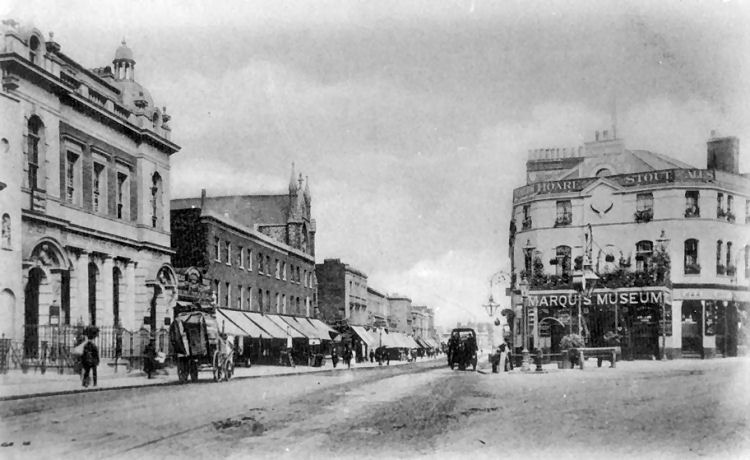
Above photo, 1905. |

Above postcard, circa 1910. |

Above photo, circa 1910. |
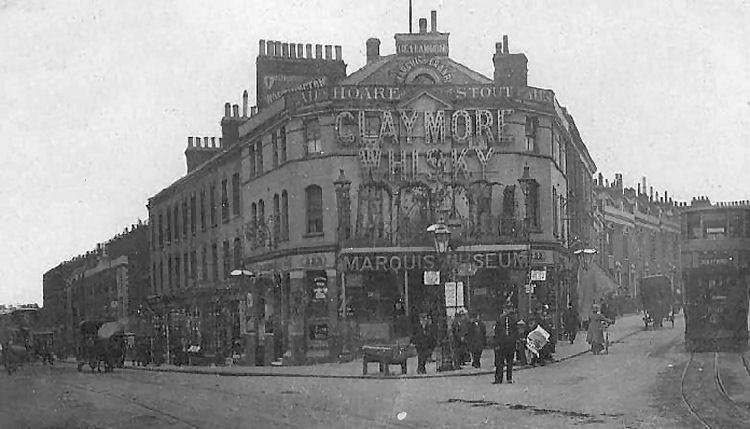
Above photo, circa 1910. |

Above photo, circa 1910. |
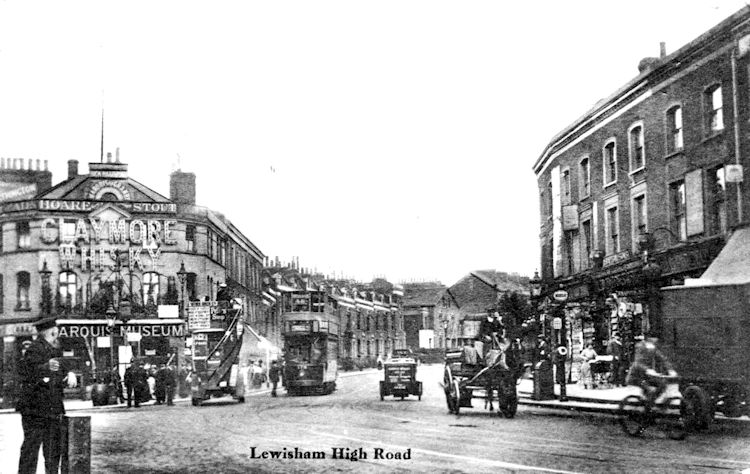
Above postcard, 1920. |
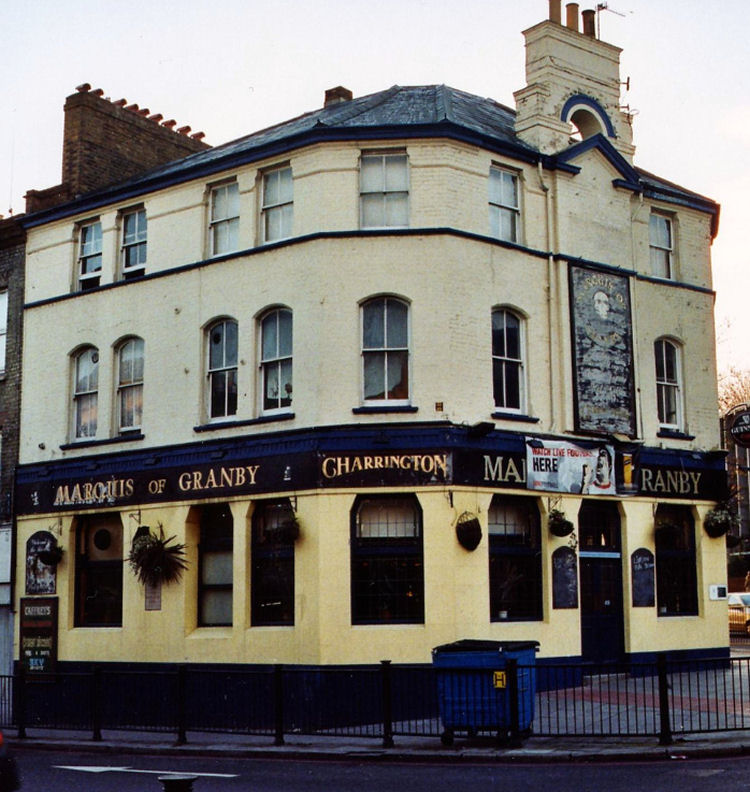
Above photo circa 2006. Taken by Matt Martin. |
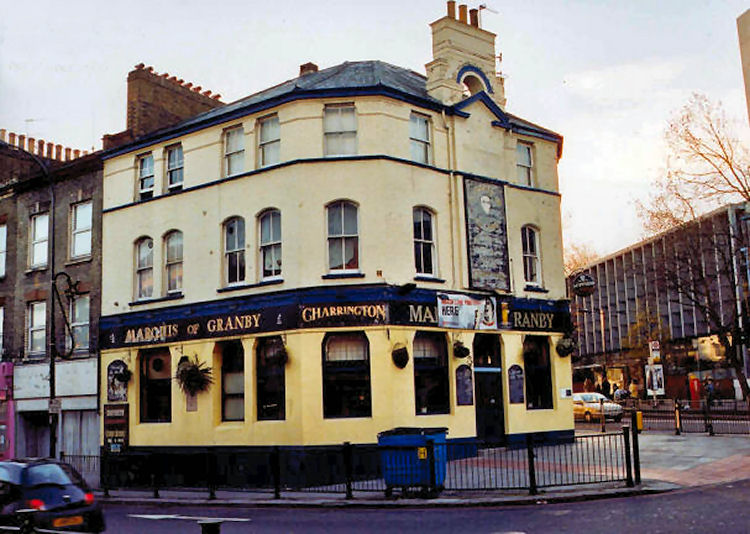
Above photo, December 2006. |
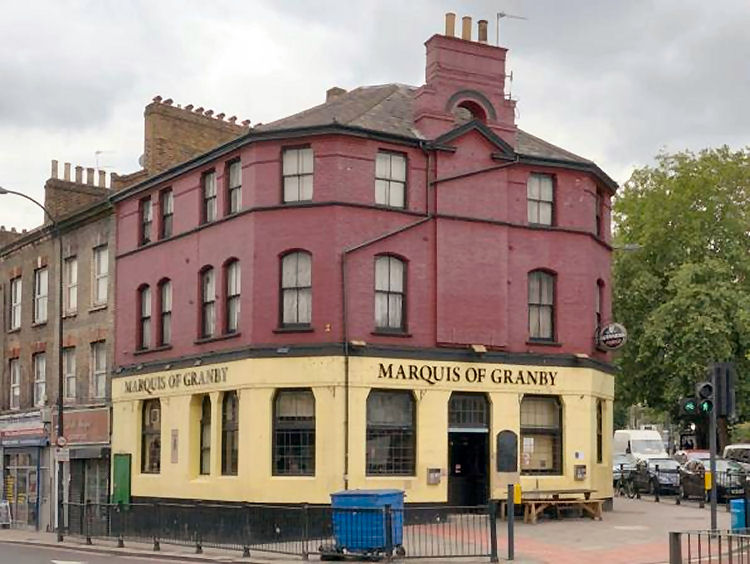
Above photo, date unknown. |
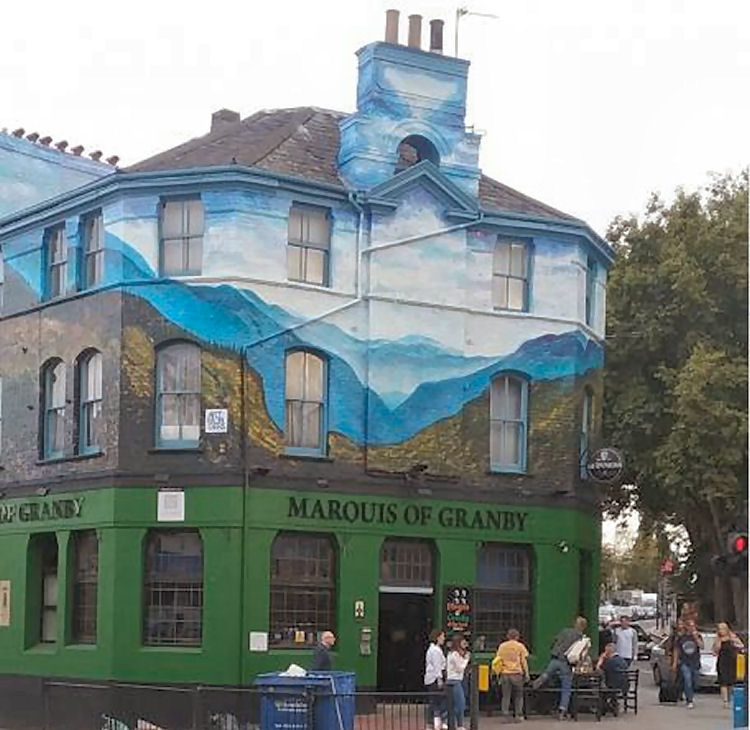
Above photo 2019. |

Above photo, date unknown. |

Above photo, date unknown. |

Above photo, date unknown. |

Above photo, date unknown. |
Although this pub is not a listed building, it is a One Star pub on the
Campaign for Real Ale’s (CAMRA) National Inventory with an interior of
special national historic Interest, and the description is as follows: "Mid
Victorian three–storey brick pub called ‘Marquis Museum’ (which advertised
“Curios of every description”) when owned by Hoare & Co. It was subject to a
significant refit by Charringtons in c.1936 and the glazed stone ground
floor was added including the two ‘House of Toby’ ceramic signs on the far
left and right of the ground floor – the Toby symbol was owned by Hoare &
Co. who were taken over by Charringtons in 1934. (Information from Brockley
Central and elsewhere).
This locals pub has an island style interior and the existence of 4
exterior doors are evidence of the former multi-room layout. In around the
mid 1990s a partition from the former door on New Cross Road side to the bar
counter and another partition was situated in the south west corner of the
pub where there was a gents’ toilet.
The counter has a fielded panelled front on the rear side and one of
vertical panelling that looks more like a 1950s style on the front side; the
bar top has a melamine inlaid top. The island gantry looks original with the
wording at the top on both sides of “Ales Charrington Stout’ with small
panels left and right with ‘Wines’ and ‘Spirits’ but most wording has been
painted over but the east side main wording can be seen by the clever
positioning of a mirror. Pot shelf is modern. There is a dumb waiter on the
bar top, one section of original fixed seating with a wood back, and an
inter-war wood surround fireplace on the front left but it has a modern
interior (fireplace at ear right is modern).
Near the remaining in use door on Lewisham Way are two baffles which
contained trade-mark Charringtons inter-war leaded glazed panels.
The exterior of this prominent pub on an angled road junction was in July
2017 subjected to a mural called (By the Way) commissioned by Artmongers.
Spanning over six weeks, 30 volunteers took it in turns to help Patricio
Forrester create the artwork.
The Marquis of Granby featured on the Fragments of the True (New) Cross:
Evening Crawl of New Cross and Deptford on 12 April 2017.
|
Kentish Gazette, 20 February 1844.
SUPPOSED TRANCE.
During the past week, intense interest has been felt in the upper
part of Deptford and Greenwich, in consequence of the belief that a
young man named William Francis, on whom a coroner’s jury had sat, and
returned a verdict that he died from natural causes, was still alive,
but in a trance.
The following are the facts of this remarkable case:— The young man
was (or is) the son of Mr. Francis, the landlord of the "Oxford
Arms," in Church-street, Deptford; and on Friday week he was at the
"Marquis of Granby" public-house, Lower Watergate, Deptford, which it
appears is kept by his brother. He went into the tap-room about seven
o'clock in the evening, when he complained of a violent palpitation of
the heart, and almost instantly fell down. He was picked up by some of
the customers quite stiff and cold. Mr. Hatfield, a surgeon, was sent
for, who pronounced him to be quite dead, and left. Mr. Taylor, of
High-street, afterwards attended, and although an hour had elapsed,
succeeded in bleeding him, but tried several remedies ineffectually to
restore animation.
The inquest was called the next day, and some of the jury expressed
their surprise that Mr. Hatfied had not attempted to bleed the patient
when he went, and thought he ought to be sent for, and that a post
mortem examination should be made. The coroner, however, expressed so
strong an opinion that the young man had died instantly from a disease
of the heart, and that it was unnecessary to call the surgeons, or have
a post mortem examination, that the jury returned the above verdict. The
body was afterwards removed to the "Oxford
Arms," when the countenance gradually resumed its natural colour,
and the chilliness of death gave way to a slight warmth. Two surgeons
have been called in, and on opening the eyes, expressed their surprise,
as they did not appear set in death, but would not at that time give a
positive opinion on the point. The relatives, as may be supposed, are in
a state of deep anxiety, and indulge in hope of his recovery. He has
been taken out of his coffin, and placed in bed until the issue is
known.
|
|
Kentish Gazette, 27 February 1844.
The Case of "Supposed Trance." at Deptford.
Upon inquiry being made on Monday afternoon into the facts of the
case as connected with the supposed trance of the young man William
Francis, who lies at the "Oxford
Arms" Church Street, Deptford. Dr. Arthur, of High Street, states
that no positive ground ever existed for supposing such to be the case,
life undoubtedly having been extinct ever since the evening of the 2nd
ult., when he suddenly fell off a table in the tap-room of the "Marquis
of Granby" public house, kept by his brother, in Watergate, Deptford.
Some symptoms appeared which were considered of a singular character.
The cornea of the eye lid did not film as is usual after death, and
the limbs continued elastic; but Dr. Arthur and other medical gentlemen
who have seen the case say that these results are not at all infrequent
when parties die either of aneurism or ossification of the heart. The
father of the poor lad still persists in his determination not to have
the body interred while these appearances remain; but as decomposition
is already manifesting itself on one side of the neck and on the
abdomen, it is most probably that before long he will see cause to
revoke his present decision.
|
|
Kentish Gazette, 5 March 1844.
CASE OF SUPPOSED TRANCE AT DEPTFORD.
Deep interest has been excited in Deptford respecting a supposed case
of trance, and it is deemed one of the most extraordinary which has ever
come before the faculty. It is necessary to observe, that two reports
which have appeared in some of the papers are wholly without foundation,
and have caused great pain to the relatives. The first was that
decomposition was apparent at the early part of last week, and
subsequently another report was made, that the body had actually been
buried. Even up to Monday not the slightest appearance of decomposition
had taken place. This assertion is made on the authority of the medical
gentlemen who have from time to time, up to Monday, watched the progress
of the case. The following are the facts which have not been generally
published:—
On Friday, the 2nd of February, Mr. Francis, jun., the son of Mr.
Francis, the landlord of the "Oxford
Arms," in Church street, Deptford, was sitting in the tap room of
his brother's house, the "Marquis of Granby," at the Lower Water gate,
Deptford, when he fell down apparently in a fit, and a medical gentleman
pronounced him to be dead, and took no means to restore what has since
been declared by competent authorities to have been only suspended
animation. Mr. Taylor, surgeon, of High-street, afterwards went to the
house, and made several skilful experiments; and although an hour after
the young man had been pronounced to be dead, succeeded in bleeding him,
but not to restore animation. On the jury being empanelled one of the
jurymen was also taken in a fit, whether from the sight of the body or
not can only be imagined, but for a few moments a fatal result was
expected. The jury generally were not satisfied with the general
evidence, and requested the attendance of the medical gentlemen who
attended at the time, or that a post mortem examination might be made,
but the dictum of the coroner, that the deceased died from an
enlargement of the heart, was submitted to by the jury, who appeared,
however, not quite satisfied, but returned a verdict that the deceased
died from natural causes. Almost immediately afterwards a brother of the
deceased was seized with a fit intermittingly for three hours. The
surgeon then called in, on hearing the probable cause of excitement, at
once pronounced the verdict to be premature, and that the coroner was
exceedingly wrong in directing the jury in such a case, and he himself
doubted whether death had been so instantaneous. The brother was bled,
and recovered, and subsequently Mr. Atkins, the surgeon spoken of,
afterwards saw the body, which then exhibited all the freshness and
bloom of health. Several medical and surgical men in the vicinity of the
place, and from the London hospitals, also visited the place; from their
vague expressions there appeared no doubt that life was not extinct, at
least for nine or ten days after the holding of the inquest. On Friday
Messrs. Downing (the surgeons to the police force) and Mr. Taylor, the
surgeon before alluded to, again visited the house, and gave a most
unqualified contradiction to decomposition having taken place. Mr. Halse,
a professor of galvanism, recommended galvanism, but it was not deemed
expedient to try it. On Monday, Mr. Hope, of Deptford, came, prepared
with a galvanic battery, but, on viewing the body, considered it
advisable not to make the experiment; he, however, recommended that the
head should be raised more, so that if any life did remain, the blood
should not flow to the head. He also strongly recommended, that as no
decomposition had taken place, no interment should be made until
decomposition was unequivocal, and then, for the satisfaction of the
relatives and justice to the medical profession, a post mortem
examination should be made. He observed that the limbs were not stiff
and the sides were almost warm, and not like death.
The relatives still entertain hopes, and the body is frequently
washed. It is, however, in the coffin. The limbs are up to the present
time perfectly supple. Twenty-four days have elapsed since the inquest.
|
|
Kentish Gazette, 12 March 1844.
THE CASE OF SUPPOSED TRANCE AT DEPTFORD.
In the last notice of this extraordinary case it was stated, on the
authority of several surgeons of experience, that decomposition of the
body was going on, although not apparent to a non-professional person.
On Friday, however, there were such unequivocal signs of decomposition
having taken place, that the parents of the deceased determined on
having a post mortem examination, and Messrs. Downing, surgeons to the R
division of police, and Mr. Caleb Taylor, surgeon of High-street,
Deptford, were requested to perform the operation, which they did in a
most minute and careful manner, and in which they were occupied several
hours. The following is an authorised copy of their report:—
"Friday, March 8.
"POST MORTEM EXAMINATION OF THE BODY OF HENRY FRANCIS.
"The body was well-proportioned, robust, and above the middle
stature. The calvariuin being removed, the dura mater and arachnoid were
found translucent and healthy, and no unusual quantity of serum in its
cavity, but the vessels of the pia mater were remarkably congested with
venous blood, the larger ones being quite prominent from distension and
their minutest ramifications filled. The brain was also found very much
congested, and sections of it being made, bloody points in very unusual
number were shown, from extreme congestion of its small vessels. The
ventricles contained no unusual quantity of serum, butt the plexus
choroides was much congested. No clot of estasusations was found.
"On opening the chest the pericardium was found to contain about four
ounces of redish serum, the left ventricle of heart dilated and
hypertrophied; the right ventricle, semilunar, mitral, and trienspid
valves and aorta quite healthy, but the right ventricle, venae cavae
ascendens and desceudens, brachio-cephalics, coronary, and other veins,
were much distended with blood; the left pleural cavity contained about
eight ounces reddish serum (this as well us the contents of the
pericardium being probably the result of cadaveric exosmosis), the
membranes themselves being healthy. The right pleural cavity was
completely obliterated by old adhesion, the lung being adherent
throughout from apex to base, so that it was impossible to remove it
without laceration; both lungs were also much congested, but otherwise
healthy. The stomach contained some undigested food, amongst which were
found many large masses of cheese, considerably larger than filberts
their nature being evident when cut into. The stomach was healthy,
except being, in common with all the organs of the body, much congested,
which was also the case with the kidneys, being large of a deep
chocolate colour. The liver spleen, intestines, and peritoneum healthy.
"From this examination, it is evident that disease of the heart was
not the immediate cause of death, it having been produced by congestive
apoplexy.
"C. TAYLOR. E. DOWNING."
The foregoing document will no doubt be read with great interest by
the profession as well as the public. One remarkable fact is, that
amongst the number of professional gentlemen who viewed the body during
the 35 days after death, only one gentlemen expressed an opinion as to
the cause of death which has been borne out by the post mortem
examination, and that was the gentleman who was mistaken for Mr.
Callaway by the family (on whose authority it was stated Mr. Callaway
and Mr. Bransby Cooper had seen the body). The gentleman referred to
pronounced that the deceased had died from paralysis of the brain, and
pointed out the proper course which should have been pursued. Mr. Taylor
certainly bled the deceased half an hour after the first surgeon had
pronounced him dead, and the blood flowed copiously from the arm.
Messrs. Downing and Taylor have not at present given any opinion as to
the cause of the extraordinary retention of natural appearances for so
great a length of time. Even on opening the body the effluvium was very
slight.
This case clearly shows the necessity of a more patient inquiry by
coroners’ juries, as in this case the coroner thought it unnecessary to
call the medical man, himself pronouncing that deceased died from an
enlargement of the heart, on which the jury returned a verdict.
|
|
Kentish Gazette, 7 September 1847.
DEATH.
Friend:— August 22, in his 81st year, Mr. Thomas Friend, of the
"Marquis of Granby lnn," New Cross, near Deptford.
|
LICENSEE LIST
FRIEND Thomas 1826-22 Aug 1847 dec'd
HEGDES Ann 1832+

THOMAS Charlotte Mrs 1848-Aug/61+ (widow age 56 in 1861 ) )
HOBSON Thomas 1869-71+ (age 52 in 1861)
SEAGER Emma 1881+ (widow age 45 in 1881)
HOLDING Emma Lsa Ms 1882+
SCOTT John Scott & Co 1884+
SCOTT John Scott 1891-95+ (widower age 61 in 1891)
VENNER Frederick 1899+
SMITH Charles J 1901+ (age 40 in 1901)
HAMMOND Richard Charles 1904-21+ (age 49 in 1911)
STONEHILL Henry 1938-44+
https://pubwiki.co.uk/MarquisofGranby.shtml
From the Pigot's Directory 1832-33-34
Census
|

