|
Information taken from
https://thanetonline accessed 12/May/2025.
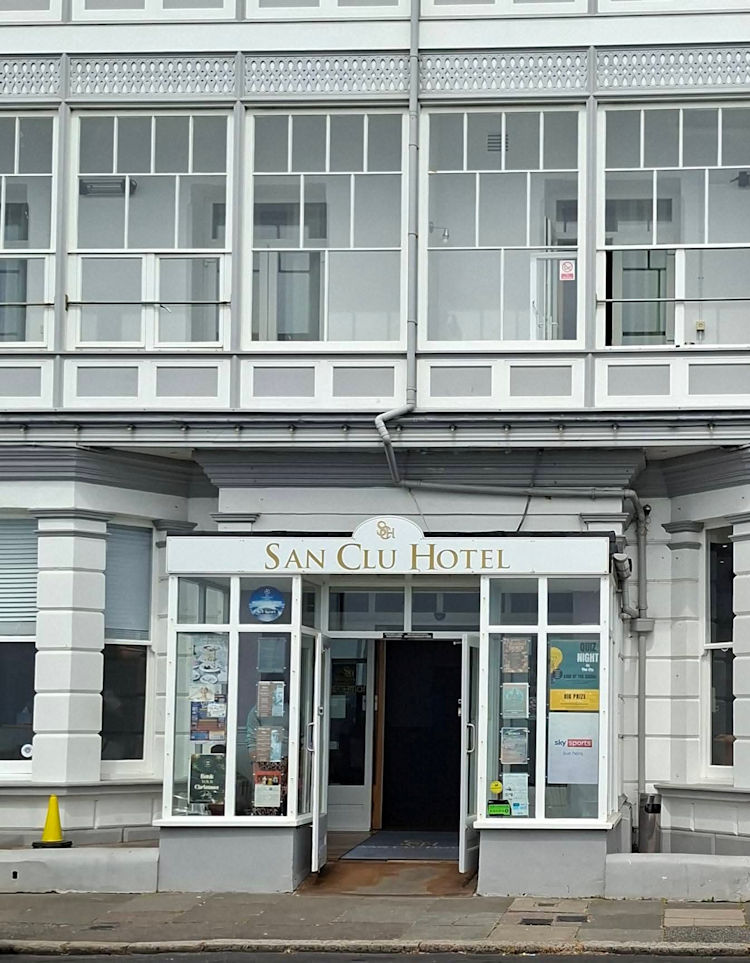
THE SAN CLU HOTEL, RAMSGATE.
On 29th January 1881, Herbert Sankey paid £2,500 to William Harrison,
a local builder, to build an eight-bedroom house in Granville Terrace, a
road which we now know as Victoria Parade. The house in question was on
the corner of Albert Road, now part of the garden of the hotel. A
further seven houses were quickly erected, being numbered two to eight,
Granville Terrace, thus completing the terrace.
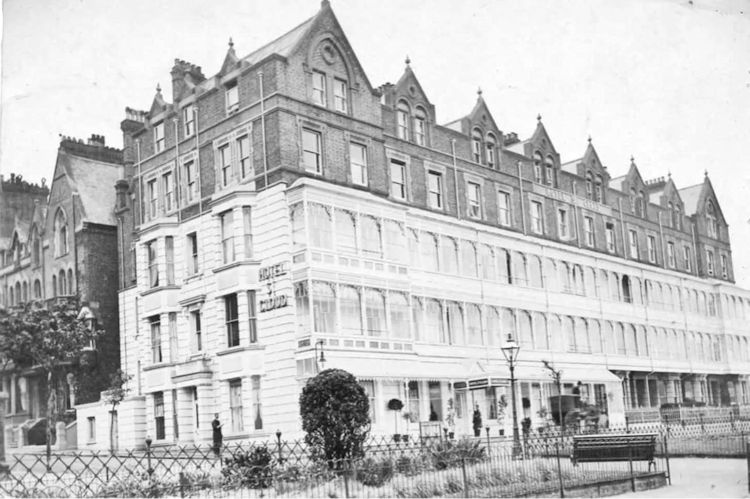
In 1897 Mr R. Stacey acquired the first five houses which he converted
into an hotel, naming it the Hotel St Cloud. Little did he know at the
time that he had founded not only an hotel, but a place which, as the
years passed, would become very much part of the social and civic life
of Ramsgate. A 1904 brochure of the Hotel St Cloud, St Lawrence-on-Sea,
Ramsgate, gives a most interesting insight into a middle class hotel of
that period.
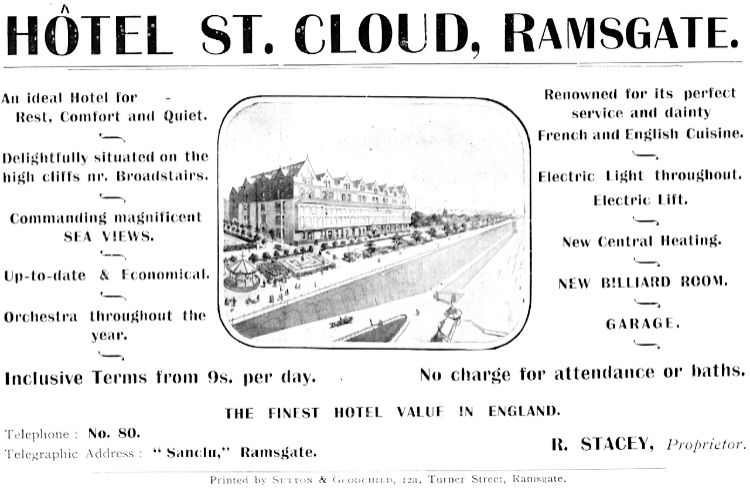
En Pension Charges.
From 2 ½ to 4 guineas per week to include.
Table d'Hõte Breakfast, Luncheon, Afternoon Tea, Dinner and Bedroom.
Fires in Bed or Sitting Room per day 1/6d
Baths: Hot 1/-; Cold 6d; Sea Water hot or cold per pail 6d.
Dogs charged 1/- per day and not allowed in any of the public rooms. No
large dogs admitted, but they can be cared for at the stables.
Good stabling and loose boxes, Flys and Private Carriages at a moment's
notice.
Accommodation near the hotel can be provided for motor cars; petrol
obtainable.
The Hotel is furnished and decorated in a very superior manner, and with
that artistic elegance which appeals to the refined taste. It has
upwards of 50 Bed and Sitting Rooms, with spacious Public Rooms viz:
Coffee and Table d'Hote Room, Ladies Drawing Room, Reading and Writing
Rooms, Smoking Room.
The Cuisine, which is made a great speciality, is under the care of
famous French and English cooks.
Such was the fame of the hotel that in July 1904, after only seven
years, the Hotel Chef, Mr Scrivener, was asked to prepare an eight
course meal at the Town Hall for the visit of Princess Louise, Duchess
of Argyll, who had come to open the Royal Victoria Pavilion erected in
memory of her mother, Queen Victoria.
Mr Stacey, with his, by now, well-established hotel, entered into the
life of the town, and on 15th July 1904 he became one of the first
Directors of the 'East Kent Times', which for well over a hundred years
was Ramsgate's much loved local newspaper. The changing type of visitor
to the south coast was by then looking for more than the ozone and the
famous sands.
Entertainment was needed. In this field Mr Stacey was a master and he
ensured that first class London companies appeared at the Palace
Theatre, with Variety at the Pavilion. However, his striking successes
with fetes in Ellington Park had crowds from all over East Kent and
London making for Ramsgate. One such event during Easter 1912 had no
less than twelve military bands taking part, with a great Tattoo in the
evening. After the 1914/18 war these and other events, once the sole
work of Mr Stacey, were taken over by the Borough Council, but Mr Stacey
could well be regarded in Ramsgate as the father of the modern holiday
trade.
The hotel carried on through the First World War, during which Ramsgate
was, according to a book published in 1919 by Chas. A. F. Austin with a
Foreword by Horatio Bottomley, MP, the founder of 'John Bull' magazine,
'England's most bombed town'. It stated that the first raid was
something of a novelty, but within a few months, the population was
halved and visitors thought it safer to stay at home. It
must therefore have come as no surprise to everyone that Mr Stacey
decided to sell the hotel in 1919 and he soon found a buyer in a Mr
Sugden who paid him £10,000.
Everything carried on as normal until in 1922 Mr Sugden decided to
change the name from St Cloud to San Clu. This was because the local
populace insisted on pronouncing it Saint Cloud instead of giving it the
French pronunciation 'San Clu'.
However, apart from the change of name the hotel saw very little change
in the 1920s. Prices were still only £5.5s.0d per week; servants daily
12/6d; a bath was still 1/-; but dogs were now 2/6d a day. The Dining
Room was still one of the finest on the coast, but it was the Billiard
Room which was the pride of the place, with its fine oak panelled walls
and decorations of swords and armour. Its inviting new billiard table
was considered one of the showpieces of Thanet.
On the night of 26th October 1928 everything was to change when the
hotel was gutted by a disastrous fire. For six hours the combined
energies of the Ramsgate, Broadstairs and Margate Fire Brigades ensured
that part of the hotel and the adjoining three houses, now flats, were
saved. Fortunately there was no one in the hotel at the time, as it was
closed for redecoration, although due to be opened again at Christmas.
The fire was discovered at 2.10 a.m. by P.C. Ford of the Ramsgate
Borough Police Force, who went to the nearest street alarm post and gave
the alarm. Under the direction of the Chief Constable (Mr S. F. Butler)
the residents of the adjoining houses were helped to safety. Furniture
was taken into the road and also stored in the Coastguard Station.
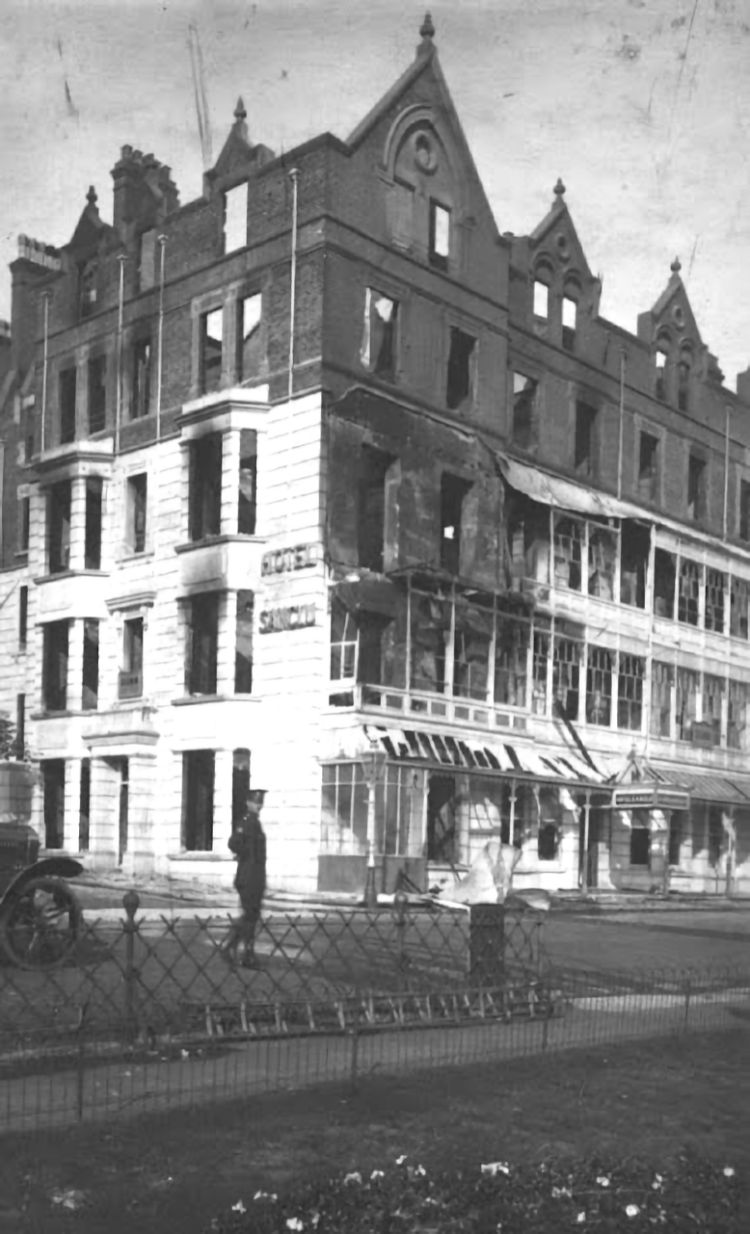
The Day After the fire, 27th October 1928.
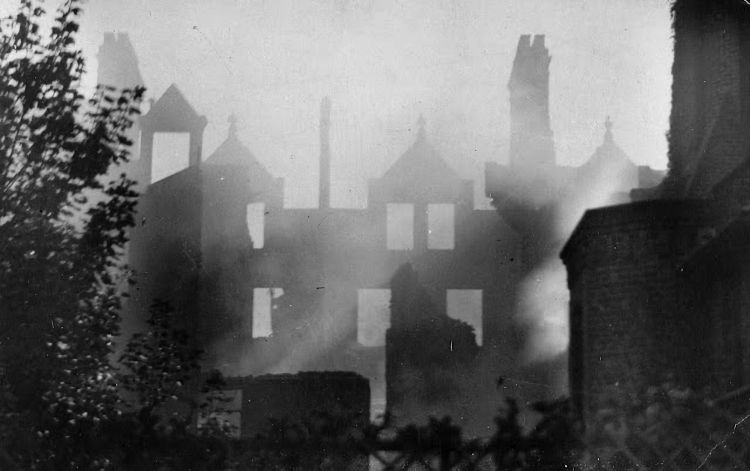
The Back of the San Clu After the Fire.
Throughout the night many people were awakened by the glare
which could be seen from Margate and Deal as well as for miles out to
sea, and they came in large numbers to watch the brigades in their
efforts to put out the blaze. By morning more and more people had
gathered and barricades were put across Victoria Parade, Albert Road and
Thanet Road. The hotel owner, Major Watkins, who had taken it over from
Mr Champneys-Taylor, the third owner, some two years before, was able to
rescue some swords from the billiard room.
Following the fire, four of the five houses which had formed the hotel
were demolished and they have never been rebuilt. Many would have given
up at this point, but Major Watkins set to work restoring the one
section which was left and within a year it was back in business.
In 1935 Mrs Elsie Robson purchased this small fourteen-bedroom hotel.
She had been widowed at the early age of thirty-five and had two young
sons, John and Peter. She ran the business almost single-handed and even
at this early stage of her time in Ramsgate she began to take a keen
interest in the affairs of the town. Then came war, and soon after the
Dunkirk evacuation she closed the hotel and left Ramsgate for Stafford
where she opened a restaurant which, of course, she called the San Clu.
The majority of Ramsgate's school children had been evacuated to that
town, and for many it became home-from-home. Much could be written of
this period of history. Mrs Robson's sons spent the war in the Royal Air
Force as fighter pilots. Her younger son, Peter, was killed in 1945,
three weeks before the war ended, but John survived and was awarded the
DFC.
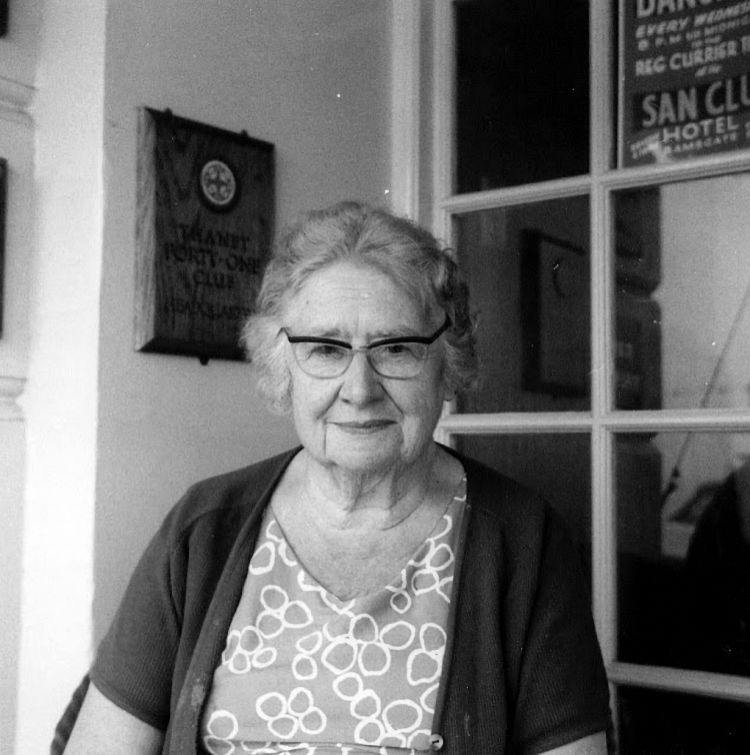
Ma Robson as everyone remembers her.
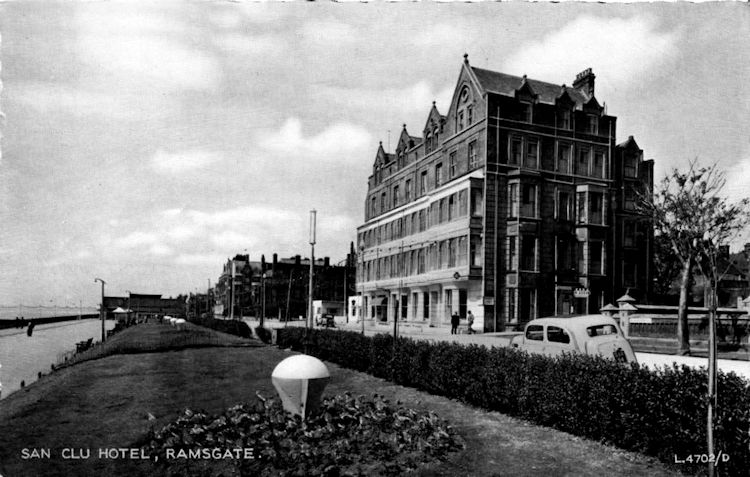
The San Clue mid 1900s.
Mrs Robson, who by now was affectionately known as 'Ma'/ spent four
years at her restaurant in Stafford - but early in 1944 she decided to
return to Ramsgate where later that year she purchased the next two
houses and was able to re-open the hotel which soon had forty bedrooms,
all with hot and cold running water. A few years later, after a long
struggle, the last house was purchased from Vera Wilkie and the hotel
was back almost to its original size. So much was to happen there during
the boom years of the 1950s.
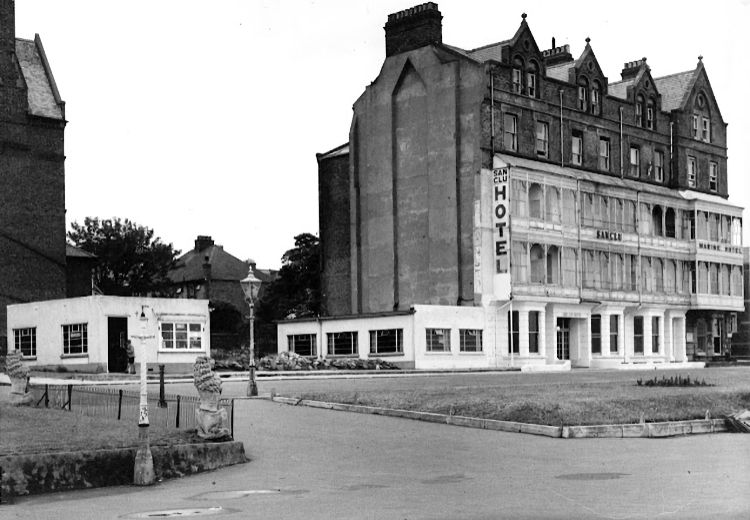
The San Clu Hotel 1950s.
Apart from running the hotel, the Robson family entered into the life of
the town. Ma became a Councillor, and in 1953 was offered the position
of Deputy Mayor, but declined due to pressure of business. John married
in 1950, Betty Geltem, the head receptionist of the hotel, and in 1951
had a son, John Simon, who years later was to take over. John was the
organiser of the Ramsgate Carnival for many years and it was at the San
Clu that the Rotary Club, Round Table, and many other organisations
made their headquarters. Memorable events were those such as the
presence of Archbishop Geoffrey Fisher at a meeting and lunch at the
hotel in 1954 which sealed a partnership of Town and Church. This
concerned a large housing estate which was being built at Newington,
north of the town, and the result of the meeting and lunch at the San
Clu was the founding of St Christopher's Church on that estate. The
following year the church had been built and was consecrated by
Archbishop Fisher.
The famous came, and came again - many becoming good friends with
locals. From show business came Dicky Henderson, Bob and Alf Pearson,
Norman Wisdom, Jimmy Hanley, John Ie Mesurier and many others. But they
came from every field: Hugh Scanlon, John Betjeman, Sir Edward Heath, as
he later became, and also royalty from Belgium, Denmark and Thailand.
One could go on.However, time goes by and history almost repeated itself in 1973 when in
January another fire broke out - this time in the afternoon - and though
the damage was great and the hotel was closed to residents for some
months, no one was hurt. The residents, one of whom was the MP Jonathan
Aitken, were all out at the time. However, Ma was in her room on the top
floor, and her dramatic rescue was seen nationwide on BBC Television
News as she was taken down the eighty-foot turntable ladder by
Sub-Officer Frank Webb. She was then 79 years old. Despite all of this,
the bar, though damaged, remained open - the one lifeline giving hope to
staff and locals that once again, like the Phoenix, the hotel would rise
renewed from the ashes. It re-opened at Easter that year.
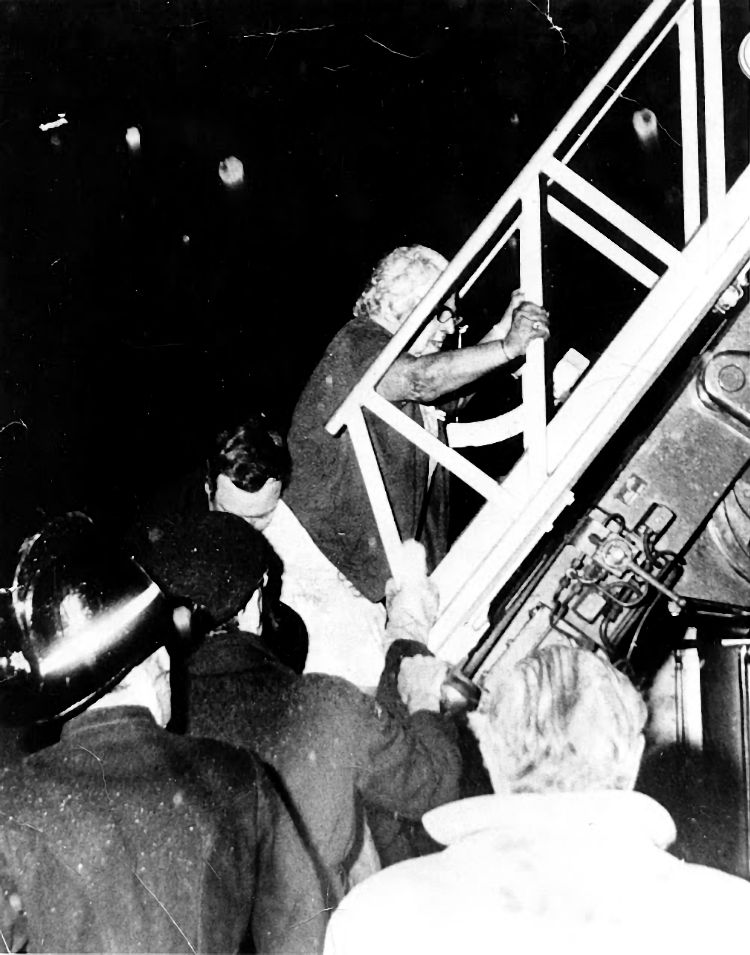
Mrs Robson Escaping from the Top Floor During the Fire.
In 1978, after forty-three years, Ma retired and handed the hotel over
to her son, John, and grandson, Simon. However, as John said many times
- Ma was still the boss. Sadly, Mrs Betty Robson died in 1980, and her
husband John in 1982; then 'Ma' herself followed them in 1984 aged 90.
As a result, Simon took the hotel over and appointed Mr John Stewart as
General Manager. In 1989 he sold the hotel to Universal Projects and its
days as a family owned and run hotel were over.
Changing times brought another change of name to Amecco Hotels. Under
this new management the number of rooms has been reduced to thirty-two
by major refurbishment. With the decline of the holiday trade the hotel
looks in a different direction - to conferences of up to 150 people as
well as all the social functions which have always been part of its
business.
|
|
From the
https://www.kentonline.co.uk By Oliver Leonard, 29 April 2025.
Plans for ‘brutal’ five-storey extension at Ramsgate’s San Clu refused.
Plans for a “brutal” five-storey extension at a historic hotel have been
thrown out following fierce opposition.
The proposal for the Hotel San Clu, on Victoria Parade, Ramsgate, was
refused last Wednesday (April 23) after planning officers and
councillors at Thanet District Council (TDC) raised significant concerns
about the impact on neighbours and the surrounding area.
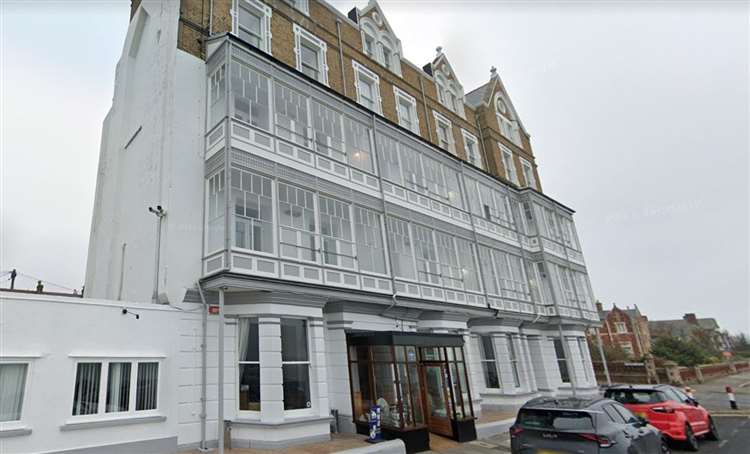
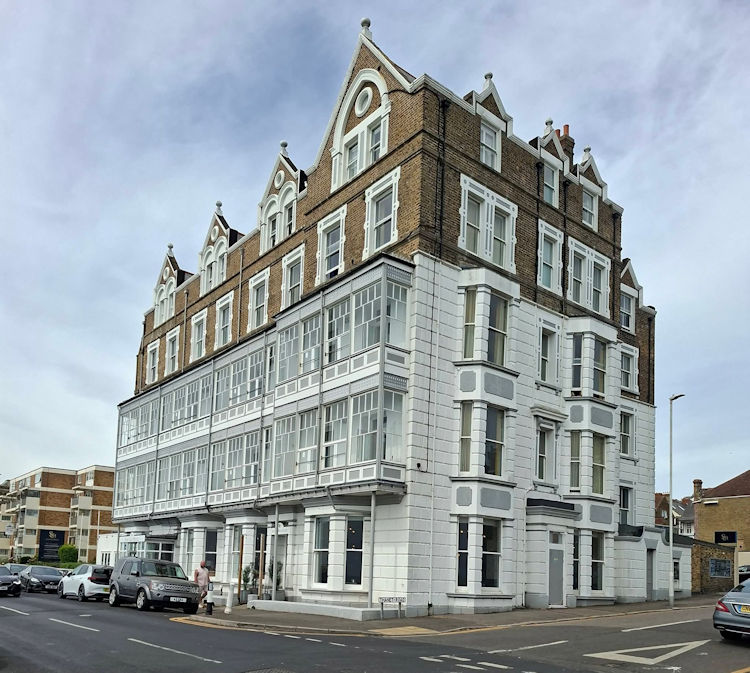
Plans to extend Hotel San Clu on Victoria Parade in Ramsgate have been
rejected. Picture: Google.
The extension would have included 19 self-contained flats—10 for sale
and nine as holiday lets—alongside new conference facilities, a coffee
shop, a reception area and a “wellbeing suite” with a gym and spa.
But planning officers recommended refusal, warning the proposals would
lead to “an unacceptable loss of light and outlook” for nearby homes.
They criticised the design as “neither a pastiche continuation of the
existing building, nor a sufficiently modern contrast,” lambasting it as
“prominent and incongruous.”
Cllr Debra Owen-Hughes, speaking at the planning committee meeting,
branded the proposal “brutal” and “insufferable”.
She added: “It takes away the light of so many residents.
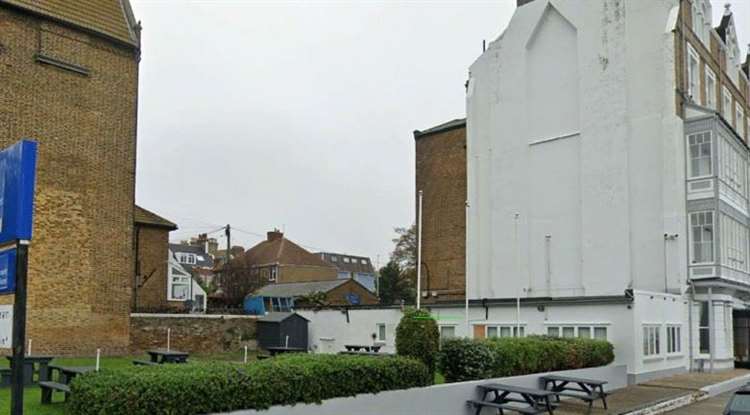
The side garden of the hotel where the extension would have been built.
Picture: Google.
“This is slaughtering the ordinary and reasonable expectation of
residents enjoying their home.
“The proposal is too harsh, too strident and too unreasonable to be
allowed to be granted.”
The Grade II-listed hotel, built in 1883, is owned by sisters Hema
Kanani and Rina Gandhi, who argue the project will boost the local
economy and meet demand for high-end accommodation in Thanet.
“We proudly co-own the San Clu hotel,” Ms Kanani said during the
meeting.
“We have consistently invested in the hotel and the community.
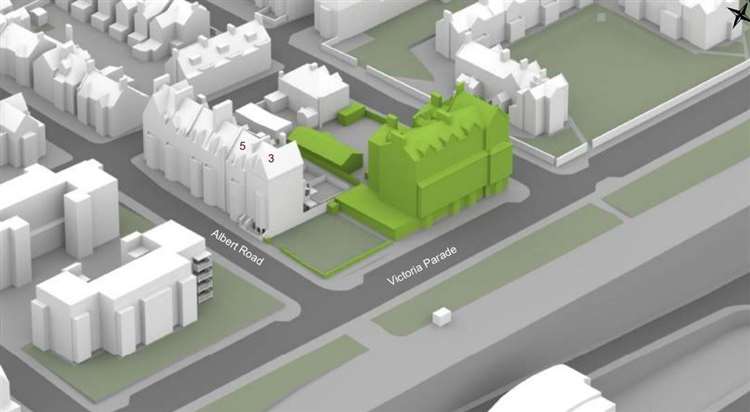
A 3D model of how much space the hotel currently takes up. Picture:
Herrington Consulting.
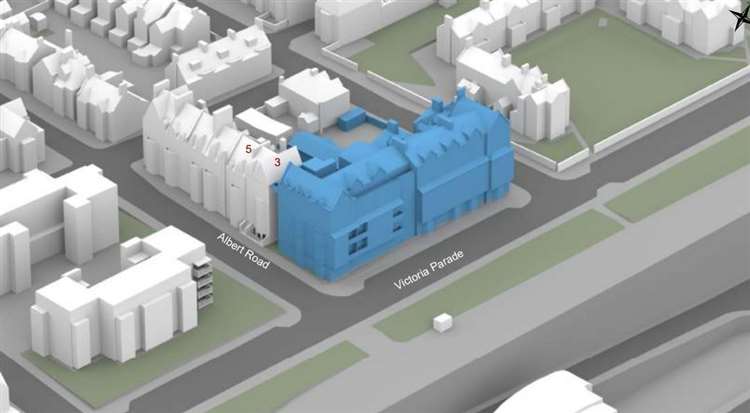
A model showing how much space the building would have occupied, if
plans had been given the green light. Picture: Herrington Consulting.
“The San Clu is more than just a hotel. Since reopening in 2022 we made
a pledge to invest in our community.
“This proposal would provide quality flats on a brownfield site and 20
more jobs.”
Despite such arguments, some 80 objections were lodged with TDC and a
petition against the plans was signed by 450 residents.
Speaking last Wednesday, Albert Road resident Mark Lister said the
extension would “kill valuable green space, and block out light and
privacy” for surrounding homes—comments which were met with applause in
the chamber.
Residents living nearby previously raised serious concerns over the loss
of sea views, noise, dust and parking disruption during construction.
“The extension will create parking chaos and will destroy our sea view,”
wrote one objector.
“It’s an eyesore, a monstrosity,” another added.
A handful of supporters argued the scheme could rejuvenate the area and
increase employment, but councillors voted to reject the scheme. |