|
71 The Street
Boughton Under Blean
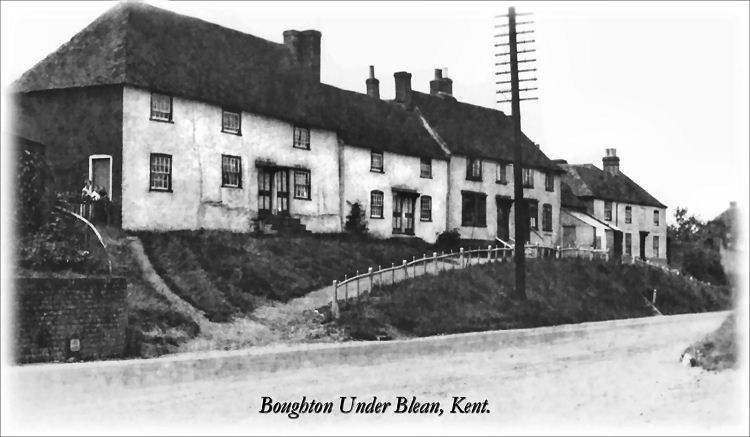
Above postcard, date unknown, kindly sent by Marie Rook. |
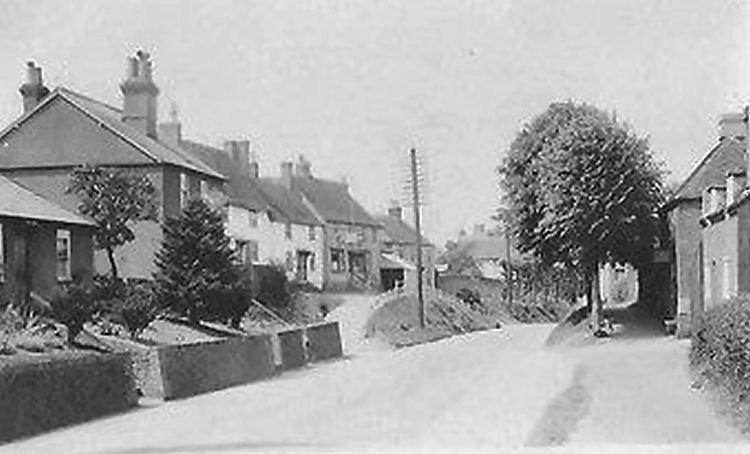
Above photo 1910. Kindly sent by Rory Kehoe. |
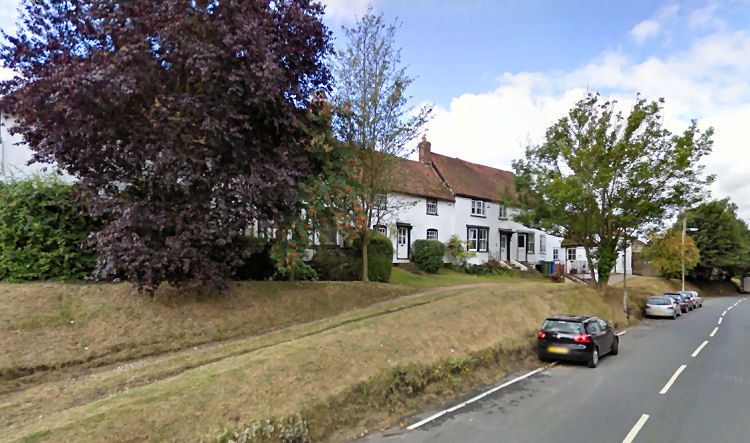
Above Google image, July 2009. |
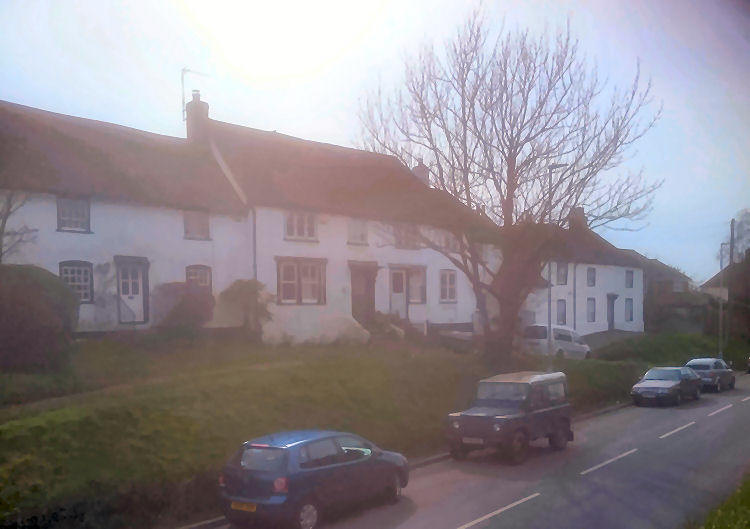
Above photo 2016, kindly sent by Rory Kehoe. |
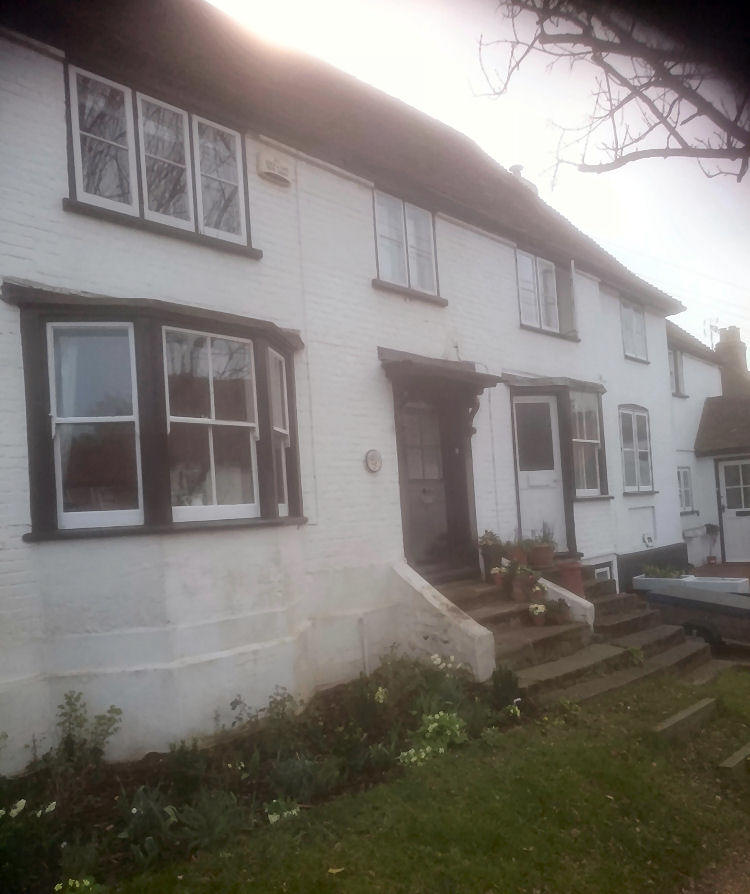
Above photo 2016, kindly sent by Rory Kehoe. |
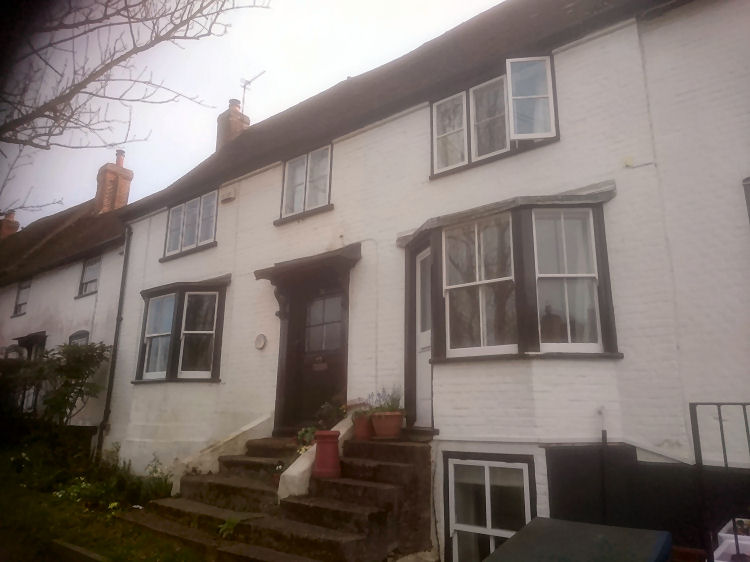
Above photo 2016, kindly sent by Rory Kehoe. |
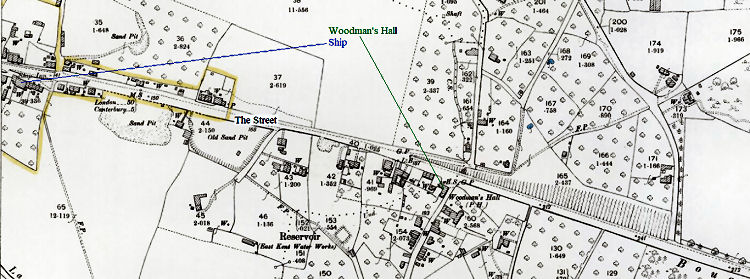
Above map 1896, annotated by Rory Kehoe. |
I am informed by David Swaffer who tells me he was born in the house in
1937 and lived there till 1960. The pub was sold into private ownership in
1921 and his grand parents were the first tenants when it was divided into
two halves, Thomas Rodgers who was the last landlord lived in the other half
also as a tenant. The pub was closed in 1921 but was not actually sold until
1926. The premises is know (2018) known as "Ship House."
|
Kent Herald, 27 October 1825.
Elias Culver, Thomas Culver, William Culver, and Richard Culver, for stealing on
the 18th day of June, 1824, at the Ville of Dunkirk, 23 bundles of bark, the
property of Robert Rooke.
Mr. Bolland opened the case, and related the facts, which were afterwards
proved, and detailed in evidence. The following witnesses were then called:-
Robert Rooke examined:- Purchased a cant of wood in Blean Wood, which was felled
in March, 1821, by a man named May, who was employed in flawing it, in the month
of June following; was certain it was safe on the 18th June in the evening; on
the 19th he missed it; the spot from whence it was stolen is about 20 rods from
Dargate Common.
William Rye comer a labouring man, then deposed, that he lived on Dargate Common
in the month of June, 1824, new the cant purchased by Rooke, and also that
purchase by Culver; his Cottage was about 60 rods from Mr. Rooke's cant and 40
from culver's. Remembered the 18th June; it was star-light; heard a noise about
half past ten o'clock, as he was going home; he immediately went to the wood,
and saw the prisoners; he concealed himself behind a large oak tree, and
distinctly saw four persons go to Mr. Rooke's cant and take two bundles of bark
each; the prisoners were the men; they went twice; the second time taking two
more bundles each, making in all 16; Culver's cant was not bound; Rook's was;
saw them take the bundles and lay them near their own; he then went home, and
related to his wife what he had seen; he did not immediately speak of the
robbery to any other person, less the Culver's, if they knew he gave the
information, should do him some bodily mischief; it was some weeks afterwards,
when he told the prosecutor, at the "Monument" public house in Saint Dunstan's.
This witness was severely cross-examined by Mr. Berens. The man gave his
evidence in a very clear and distinct manner; much better, indeed, then the
generality of labourers; and there was nothing elicited which shook his evidence
in the slightest degree.
William May, a labourer, examined:- Was employed in 1824, to flaw some bark for
Mr. Rooke; the prisoner, Elias Culver, had a cant adjoining; he bound 77 bundles
of bark with whiffs which he obtained in Blean Wood; they were horse beech;
finished binding on the 18th June; saw the whole of the bark safe on the evening
at 9 o'clock; Culver's lot was not bound; after he had done work, he went to the
"Ship," at Boughton, which was about half past nine; saw the prisoners Thomas
and William there; the next morning he missed 23 bundles; saw Thomas Culver,
William Culver, and William Pettman, in Elias's cant at work binding the bark;
went to them, and asked what time they got there; prisoners said about 2
o'clock; witness then told them he had missed 23 bundles of bark; one of the
prisoners said, "The hell you have;" he then asked whether they had seen a wagon
or a cart; prisoner said no; the weight of the bark stolen might be about 700
cwt.; found the whiffs in the Wood, which were the same as he had bound Rookes
bark with.
----- Ralf, junior, worked in Blean Wood, where he found the whiff's lying
together with some leaves over them, which he took to his father; found
altogether 23 whiffs.
Thomas Ralph examined- Deposed to having sent his son for some whiffs, who
returned with 23, which appeared to have been used.
John Coultard, landlord of the "Ship," at Boughton, proved that he's house was
empty on the night of the robbery before 11 o'clock.
The Chairman then, dwelling occasionally upon various trifling discrepancies of
evidence, which he pointed out to the Jury, left it for their consideration,
whether the prisoners were guilty of the charge alleged against them.
After a short deliberation, a verdict of Guilty was pronounced.
The prisoners with the exception of Richard Culver, were sentenced to be
transported seven years.
|
|
From the Kent Herald, 17 August 1826.
In a garden belonging to Mr. Coultard, "Ship Inn," Boughton, Blean, is a flower
called Hydrongia, with the astonishing number of 280 separate flowers upon one
stem.
|
|
Kentish Gazette 11 January 1876.
A FRACUS AT BOUGHTON.
William Foreman and Rilo Rook, labourers, were summoned for
assaulting William Branchett, labourer, on Christmas Eve.
This was a peculiar case, the complainant stating that he was coming
out of the "Ship Inn," Boughton, at eleven o'clock at night, when,
without any words, the defendants assaulted him, knocking him down
four times, and Foreman kicked him. Corroborating evidence was given
by three witnesses.
The defence was then taken. The defendants are son-in-law of the
landlord, and Foreman stated that a disturbance arose in the house
and they could not get the place clear. Branchett hit him and he
struck him in return.
Rook said that in clearing the house he pushed complainant down the
stairs.
James Butcher and James Rice were called for the defendants, but
their evidence, while it showed that there had been a general melee
in the darkness, failed to disprove or contradict complainant's
case.
The defendants were convicted.
Foreman was fined £3 5s. 3d. and Rook £1 15s. 3d., costs included in
each case.
|
|
From the Canterbury Journal and Farmers' Gazette, Saturday 6 October, 1906.
THE THREE SQUIRRELS AND THE SHIP, BOUGHTON.
Mr. Mercer applied for the renewal of these licences, and Mr. Hohler
appeared on behalf of the Licensing Justices.
Police-Sergeant Hendy stated that he was stationed at Boughton for two
years. The "Three Squirrels" and the "Ship" were situated in Boughton
Street. There were other licensed houses in close proximity and he did
not think there was any need for so many. The accommodation at the
"Squirrel's" was not good and there had been several transfers during
the past few years. There was very good accommodation at the "Ship," but
it was not so good as at the "Queen's
Head." Witness did not think 7
licensed houses were necessary in Boughton Street.
In answer to Mr. Mercer, witness said both houses belonged to Messrs.
Flint. The length of the village was nearly a mile. The "Three
Squirrels" was a well conducted house, and the tenants had been in the
house over 4 years. The tenant of the "Ship" had also been in for four
or five years.
Mr. Mercer pointed out that in Boughton Messrs. Flint were the only
brewers whose houses had been reported to the Committee. Although other
brewers had licensed houses in Boughton the Justices of taking no notice
of them. He (Mr. Mercer) remembered when he was a young man it was quite
a common thing for fights take place in Boughton, and during the hopping
season extra police had to be brought into the District but that was all
stopped now and the place had quite quietened down.
William Gower, tenant of the "Three Squirrels," stated he averaged 110
barrels of beer a year, 54 gallons of spirit, and 420 dozens of
minerals. His customers were the working class people of the district.
His rent was paid up.
John Chambers, grocer, of Boughton, stated that he had known the "Three
Squirrels" for the past 20 years. Since the present tenant had been in
the house it had been well conducted. Witness had never heard anyone say
he thought the house should be done away with. The sobriety of Boughton
had greatly improved during the past few years.
Walter Miles, miller of Boughton, stated that he had known the "Three
Squirrels" for many years. It was a well conducted house and he thought
it was required.
William Harvey, tenant of the "Ship," was next called, and stated that
he average 154 barrels of beer a year, 55 gallons of spirits, and 1,020
dozen of minerals.
In reply to Mr. Hohler, witness said he thought 7 licensed houses were
necessary for the wants of Boughton.
Mr. Plumber, farmer, of Boughton stated that he thought the "Ship" was
necessary. He also thought seven houses were required if they all got a
decent living. The opinion in Boughton was that a licence of the "Ship"
should be renewed.
Mr. Forman, who lives next door to the "Ship," also gave it a good
character. He said the house was very well conducted and he hoped it
would not be done away with for his own convenience.
The Committee granted the renewal of a licence of the "Ship," but not
that of the "Three Squirrels."
|
|
Dover Express, Friday 09 February 1906.
LYMINGE. LICENCES OBJECTED TO.
The Faversham County Bench of Magistrates gave notice at their meeting
on Thursday that they should object to the renewal of the following
licenses:- The "Dolphin", "Three Squirrels," the "Ship" ale houses at Boughton; the
"Swan" ale house at Lynsted; the "Crown" ale house and the "Mayor's
Arms" beer-houses at Ospringe; the "Rose" beer-house at Teynham; the
"Scots Greys" beer house at Throwley; and the beer off-license held by
Mr. Philpott at Davington.
|
William Harvey was the son of Edward who was licensee of the "Compasses
Inn" in Crundale, and sadly died at this pub in 1911.
LICENSEE LIST
BAKER Thankful to Sept/1696 dec'd
COULTARD John 1825-28+

JUDGES Isaac 1832+

CULVER Edward 1851-58+ (age 57 in 1851 ) )
FOREMAN Elijah 1862+
HADLOW William 1881-82+ (also dealer age 48 in 1881)
HARRISON Winder 1891+ (age 28 in 1891)
CARTER John Frederick 1902-03

HARVEY William 1903-13+


RODGERS Thomas to 1921
https://pubwiki.co.uk/Ship.shtml
From the Pigot's Directory 1828-29
From the Pigot's Directory 1832-33-34
Census
From the Kelly's Directory 1903
From the Kelly's Directory 1913
|

