|
The Common
Sevenoaks
01732 452022
http://www.brunningandprice.co.uk/whitehart/
https://whatpub.com/white-hart
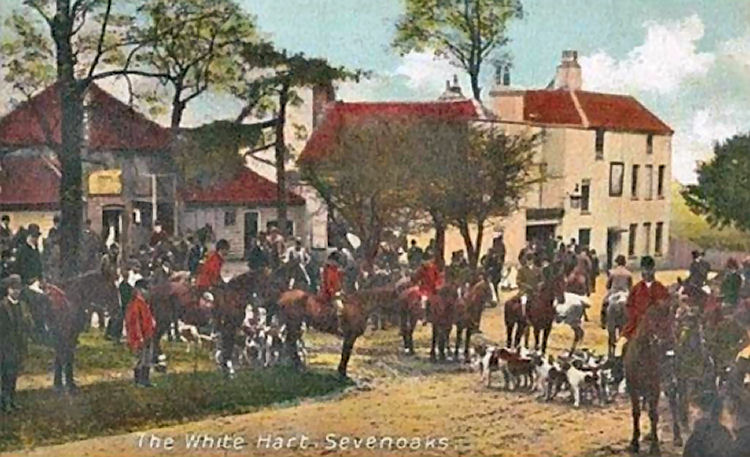
Above postcard, 1905. |
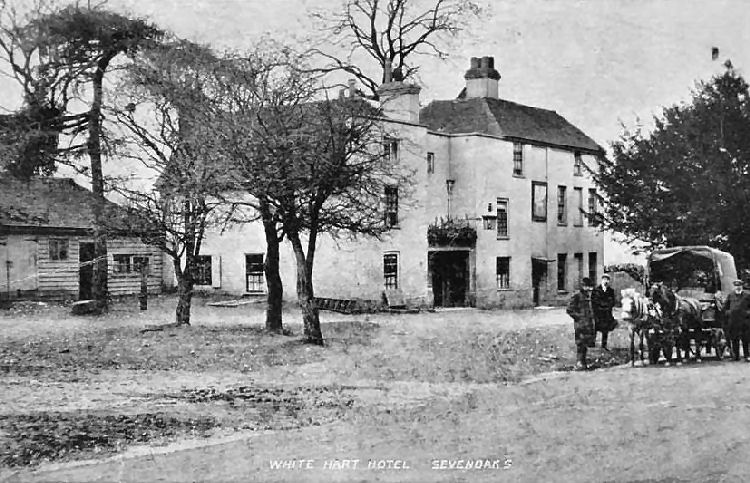
Above postcard, date 1906, kindly sent by Mark Jennings. |
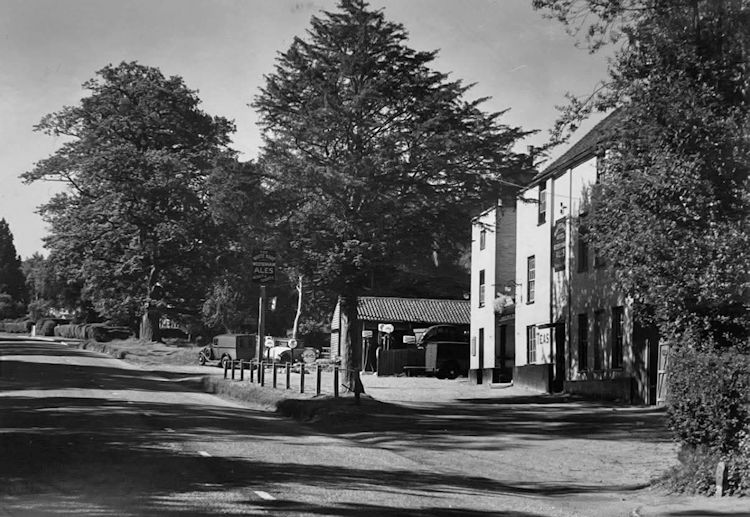
Above photo, date unknown. |
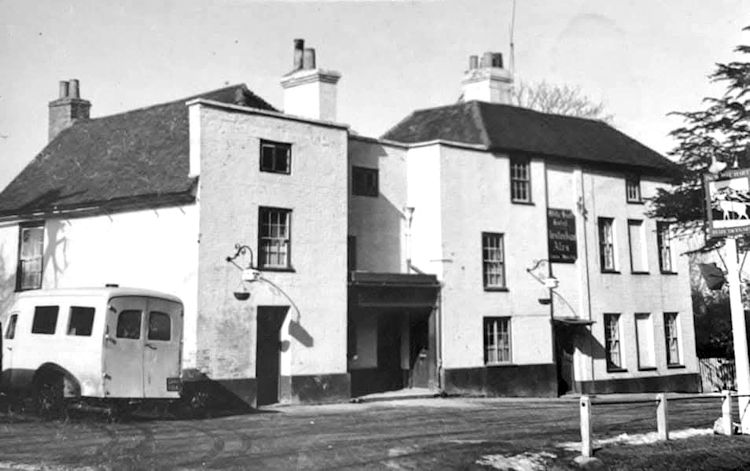
Above photo, circa 1960s. |
|
Taken from Kent a Chronicle of the Century book 3.
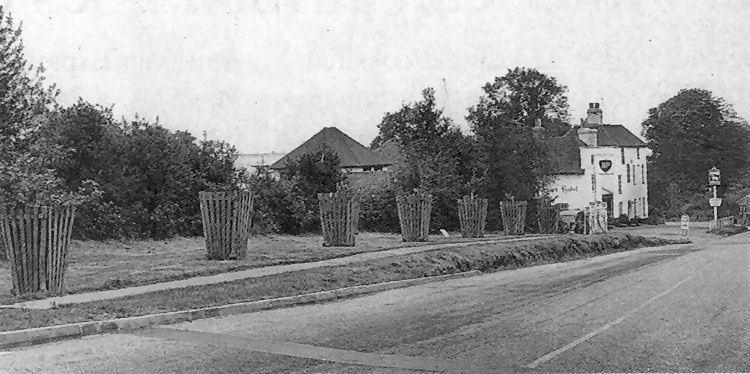
March 1955: The seven eponymous oak trees, ceremoniously planted in 1727
next to the "White Hart" public house at the southern entrance to
Sevenoaks, have been felled — unnecessarily.
Sevenoaks Urban Council held that they were diseased but when Peter
Smith of the Invicta Company took them down they proved to be as sound
as other oak trees in nearby Knole Park.
The embarrassed councillors will now plant seven saplings in their
place. According to legend seven oak trees have stood on Sevenoaks
Common since time immemorial and it was from one such group that the
town took its name. Distinction by seniority passes to the seven oaks
around the northern perimeter of the Vine Cricket Ground, planted in
1902. Photograph shows the new saplings. |
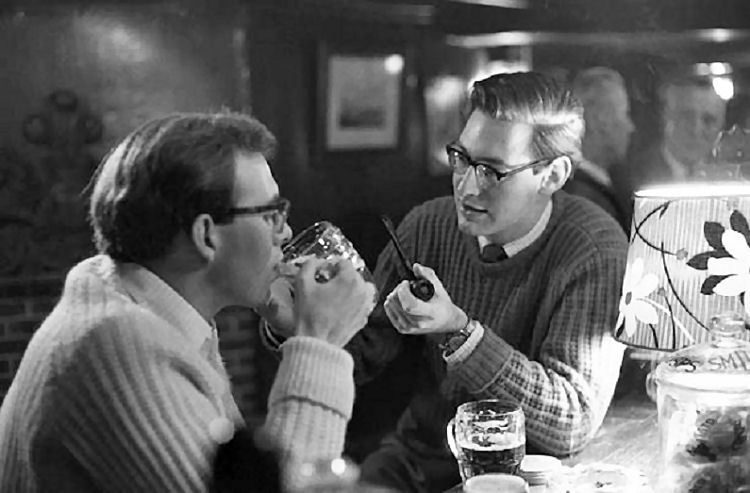
Above photo 1960, kindly sent by Rory Kehoe who says he hasn't a clue
who they are, but the photo was well referenced. |
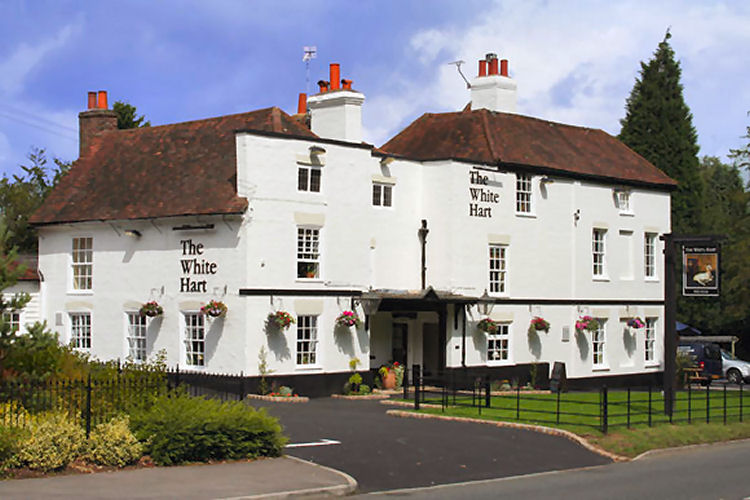
Photo taken 2013. |
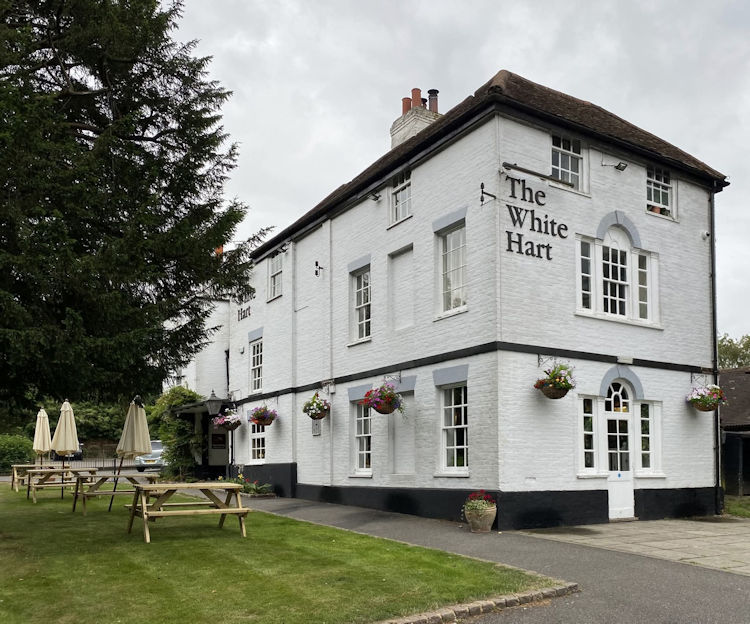
Above photo, date unknown. |
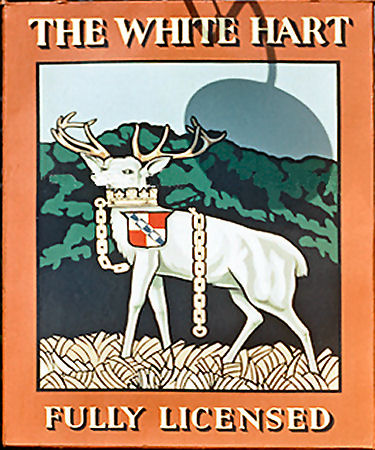 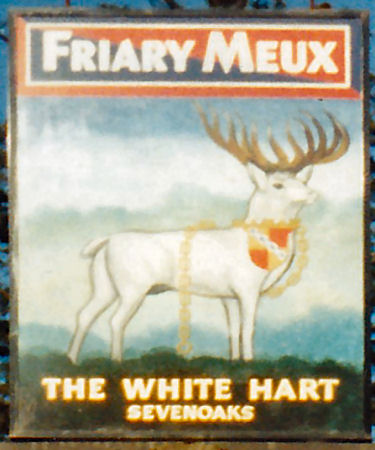
Above sign left, 1960s, sign right, November 1986.
With thanks from Brian Curtis
www.innsignsociety.com. |
The "White Hart" was formerly the "Dorset
Arms," named after the noble family who once owned Knole Park; and
not to be confused, the
present "Dorset Arms Inn" was
known in 1750 as the "Bull."
The "White Hart" is a fascinating building, its intriguing architecture
bearing witness to many and varied stylistic influences in vogue since it
was built in the early 17th century. It was originally positioned right next
to the Sevenoaks turnpike, and as you'd expect of a coaching inn that has
been nourishing and refreshing travellers for over 300 years, you'll find
character and charm at every turn.
The Site of The White Hart
The White Hart on Tonbridge Road in Sevenoaks was built high on the
Greensand Ridge in the late 16th / early 17th century near to the site of an
ancient inn called The Cock.
The legend
A ‘hart' is a male deer or stag, but the white hart took on a mythical
quality through its association with Herne the Hunter (pronounced ‘Ern the
‘unter ).
Herne worked for Richard II in Windsor forest, but was fatally injured
while defending the king against a cornered white stag. A local wizard
restored him to health but, in return, Herne was forced to give up his
hunting skills and eventually through frustration and disappointment hanged
himself from an oak tree near the castle. Richard II subsequently adopted
the White Hart as his crest.
King Richard's White Hart had golden antlers and a golden crown around
its neck with a gold chain hanging from the crown. Heraldically, the Hart
symbolises peace and harmony, the White denoting purity.
In 1389 Richard passed an Act making it compulsory for pubs and inns to
have a sign outside in order to identify them to the official Ale Taster,
"otherwise he shall forfeit his ale." Consequently, a great many pubs were
named “The White Hart”, after Richard II's own heraldic emblem.
Toll Charges
The first turnpike road in Kent from Sevenoaks to Woodsgate (1709) ran
past the White Hart. Passing coaches were required to pay a toll to the
turnpike trustees. This included those in charge of the four-horse stage
coach, which called at the White Hart three times a week on its long journey
from the Nag's Head in Southwark to Rye in Sussex.
|
Kentish Gazette, 27 January, 1779.
"White Hart Inn," Sevenoaks Common Kent, adjoining his grace the Duke of Dorset's Park.
To be let, and entered on immediately.
That well-known, long-established, and good accustomed inn, known by
the "White Hart," on the Sevenoaks
common, Kent; consisting of very genteel and convenient apartments
in the house, good stabling for 50 horses
and 16 acres of land, in excellent condition and adjoining.
The whole fitted up afresh, and put into very good order, within
those few years, at a very comfortable expense,
and enjoying a very flourishing trade, in the occupation of the late
Robert Palmer, deceased; together with
which maybe had, if approved of, a very desirable Farm, containing
onwards of 100 acres of very good land, in
very good condition, and at a very moderate rent.
This Inn is altogether commodious, pleasantly and advantageously
situated, being on the Turnpike Road from
London to Tunbridge Wells, 12 miles from Tunbridge Wells, 14 from
Bromley, 24 from London, and within 1 mile
of Sevenoaks Town.
|
|
From the Maidstone Journal, 24 May 1796.
"White Swan" (sic) - late "Dorset Arms," Sevenoaks.
John Blatcher, from Maidstone, begs leave to acquaint his friends and the public
in general, that has taken the above house, where he has laid in a large stock
of the choices wines and other liquors, good beds, and every other comfortable
accommodation; good stabling, &c. Those who pleased to favour him with their
commands will be punctually attended to; and every step taken to merit the
continuance of their favours, and which will be most gratefully acknowledged.
N.B. Having followed the profession of an Auctioneer and Sworn Appraiser 24
years, he begs leave to inform the public he means to continue the same, to
those who will honour him with their commands.
|
|
From the Kentish Gazette, 27 June 1848.
Walter.
In London, on the 17th inst., rather suddenly, Mr. James Walter, of
the "White Hart Inn," Sevenoaks Common highly and justly respected.
|
|
Kentish Gazette, 19 February 1850.
Fire.
On Monday evening se’nnight about 9 o'clock, a fire broke out in the
buildings of the "White Hart Inn," at the common near this place, in
a lodge occupied by Mr. Ring, of Sevenoaks, who holds the farm; the
flames soon communicated to the coach-house and granary of the Inn,
but there being a good supply of water, by great exertions, and the
assistance of the Sevenoaks fire brigade with their powerful engine,
the fire was got under after having totally destroyed the granary, a
lodge, and a portion of the coach houses; the property which belongs
to Earl Amherst, we understand was fully insured. The origin of the
fire is involved in mystery.
|
|
From the Southeastern Gazette, 6 March 1866.
Attempted Murder.
A most determined attempt to commit murder was made at the “White Hart”
public-house, Sevenoaks-common, on Saturday night. It appeared that a
number of railway men were in the tap-room of the “White Hart,” and in
company with them was a person named William Slangsbay, who gets a
living by acting as a barber to the navvies. Whilst this man had been
sleeping, some practical joking had taken place, and he, supposing that
William Tyson was the offender, suddenly caught hold of him and
attempted to cut his throat. Fortunately, however, his object was not
successful, but he cut from the ear downward for about four inches, and
the arteries were exposed. Had the razor entered the sixteenth part of
an inch deeper, death would have been the result. Dr. Charles was
speedily in attendance, and rendered the necessary medical aid, and the
would-be murderer, who was not permitted to leave the house, was handed
over to the care of the police.
|
|
From the Southeastern Gazette, 13 March 1866.
CUTTING AND WOUNDING.
The attempt to cut a man’s throat last week, appears to have been the
result of “practical joking,” as will be gathered from the following
statements, which were taken as evidence before following M. Lambarde,
Esq., on Thursday, when William Slingsby was charged with cutting
William Tyson with razor, with intent to do grievous bodily harm. The
prosecutor, who is a labourer on the new South Eastern Railway works,
was in the tap-room of the “White Hart” public-house, Sevenoaks-common,
with several of his mates, on the previous Saturday afternoon, and
prisoner, who gains a living by acting as a barber to the navies, was
also there. He appeared, however, to have been in a state which, for a
time, prevented him pursuing his vocation, and during that time he lay
asleep in the room, and practical jokes were played on him. It appeared
also that in the same room, on the previous Saturday, a party of navies
had stripped him naked and tool all his money from him, and doubtless,
as he was an Irishman and evidently very excitable, exasperated him.
After he woke from his sleep and was standing by the fire, the
prosecutor Tyson wert towards the fire for a light, and he was pushed
against the prisoner, who seized him by the thumb and bit it severly,
and, according to the prosecutor’s statement, while he was showing his
thumb to a labourer named Rawlins, the prisoner “chopped” him down the
face with something. Rawlins, however, who was called, said that he
noticed the cut down the cheek after the prisoner and prosecutor had
been tusseling together in the corner. Dr. Charles, assistant surgeon on
the railway works, who performed the necessary medical operation;
described the wound, which must have been inflicted by some sharp-edged
instrument, as a razor or a knife, as being four inches long, and
extending from a little below she left ear along the jaw towards the
angle of the mouth, but it was not dangerous in itself. The prosecutor
had been under his care ever since and was going favourably. The barber
was taken into custody by Ransley, 77, K.C.C., who found on him three
razors, on one of which here were marks of fresh blood. The prisoner
entered into a statement of the manner in which he had been treated by
the navvies, and that as he had the razor in his band preparing to shave
a man, when the prosecutor struggled with him, the wound was
accidentally given and he was not aware of it until afterwards. He was
committed for trial at the assizes.
|
|
From the Southeastern Gazette, 20 March 1866.
CROWN COURT. THURSDAY.
(Before Chief Baron Pollock).
Unlawful Wounding at Sevenoaks.
William Slingsby, 38, barber, was charged with cutting and wounding
William Tyson, with intent to do him grievous bodily harm, on the 3rd
March. Mr. Channell prosecuted.
The prosecutor, who appeared with his face bandaged, said that he was at
the “White Hart Inn,” Sevenoaks-common, on the day in question. When he
went in prisoner was asleep. Several men were “playing games” with
prisoner. Witness had nothing to do with it. Some three or four hours
after he got up to light his pipe. There were some men against the fire.
One of them fell against witness, and witness fell against prisoner, who
fell into the corner. The prisoner bit the thumb. Witness said, “See
where this barber has bit my thumb.” Prisoner then cut him down the face
with a razor.
Dr. Charles, surgeon to the labourers on the South Eastern Railway, said
he dressed the wound, which was an incised one, about 4 ½ inches in
length, and a quarter in depth. It was not serious.
The jury found the prisoner guilty of unlawfully wounding, but
recommended him to mercy, on the ground of his having received
provocation.
Three months’ Hard labour.
|
|
|
LICENSEE LIST
BLATCHER John 1796+
HARRIS Samuel 1832+

CHAPPELL Harriett 1874-81+ (also Farmer age 70 in 1881 ) )
WICKENDEN H N 1891+
KEMP George 1903+

KELSO to Nov/1904

WALKER Henry Nov/1904+
MAYNARD Thomas William 1913+
TARVIN Frederick 1918+
COMBEN Richard Edward 1922+
FARRELL John 1930+
MORRIS Joseph 1938+
https://pubwiki.co.uk/WhiteHart.shtml
From the Pigot's Directory 1832-33-34
From the Kelly's Directory 1903
Kent
and Sussex Courier
Census
|

