|
Belle and Lion Street
Mile Town
Sheerness
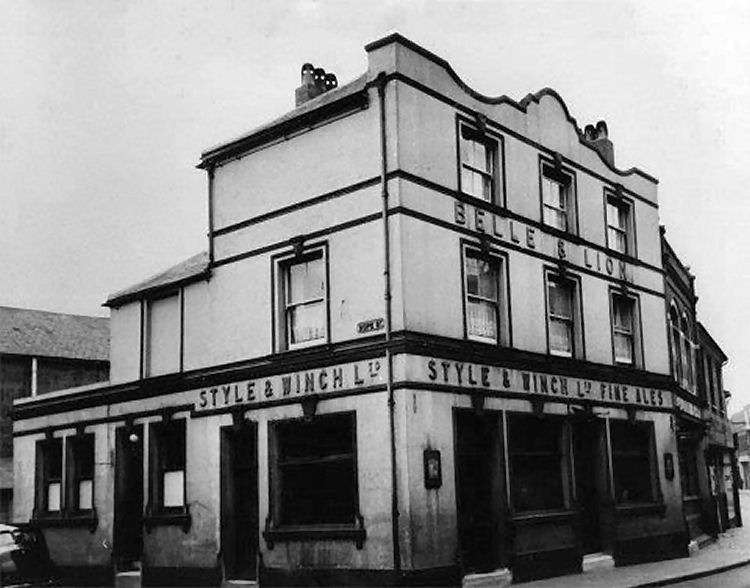
Above photo, date unknown, kindly sent by Peter Moynihan. |
I am informed by Debi Birkin that the original "Belle and Lion" was
situated on Belle and Lion Street, and is not the same building as the
current Wetherspoons "Belle and Lion," in the High Street.
She says that the Wetherspoon's pub is relatively new and just adopted
the name, she doesn't think the two are in the same area, but says she could
be wrong. However Wetherspoons says the following:- The "Belle and Lion" was
the first public house to be built in Mile Town. Other inns and ale houses
were built soon after. The "Belle and Lion" is listed in a local directory
of 1824 and a more recent one published in 1938. Boots store now stands on
the site of the inn, at 59 High Street.
So indeed, there have been two different pubs with this name.
|
Public Ledger and Daily Advertiser, Friday 11th January 1805.
At the "Belle and Lion Inn," Sheerness, on Monday, the 21st inst. at
three.
The Hull of the Brig Malvina, register measurements 194 20 94 tons,
carries fourteen and a half keels of coals, together with her lower
masts, bowsprit, and lower standing rigging, iron necked windlass and
capstan, as she now lies on the beach near to Sheerness garrison. For particulars apply to Messr's Betham and Son, at Sheerness, or to
Robert Maxwell, Ship Agent, No. 2, Great George Street, Minories. |
|
From the Kentish Gazette, 2 February 1810.
Tuesday, Jan. 30, Mr. Barren, landlord of the "Bell and Lion"
public-house, Mile Town, Sheerness.
|
|
From the Kentish Gazette, 6 February 1810.
January 30, Mr. — Barren, landlord of the "Bell and Lion"
public-house, Mile Town, Sheerness.
|
|
Kentish Gazette, Tuesday 18th September 1810.
Eligible leasehold building ground, to be sold by auction, by J. B.
Rose.
At the "Belle and Lion," Mile Town, between six and eight o'clock in the
evening of Tuesday, September 18th, 1810, in four lots each, 22 feet 6
inches in front of and adjoining the high road at Mile Town, leading to
Sheerness Dockyard, Garrison, &c. by 35 feet in depth - each lot subject
only to 10s. per year ground rent.
|
|
Kentish Gazette 26 March 1819.
On Friday last an inquest was held at the "Bell and Lion," Sheerness
on the body with child about 3 years old, whose clothes had caught
fire during the temporary absence, of about 7 minutes, of its mother
on the previous Monday.
It died on Tuesday.
Verdict. Accidental death.
|
|
Kentish Gazette, 16 February, 1821.
On Tuesday, the 6th instant, a fatal accident happened at Sheerness.
Mr. Newton sent a cart with two horses to be washed on the beach,
with them he sent three lads, viz. ---- Meadows, ---- Newton, aged
17 (Mr. N's brother,) and another; the latter unhooked the fore
horse from the cart, and stayed with it whilst the other two went
into the water with one horse and the cart; Newton was in the cart
and Meadows was sitting astride upon the horse, having hold of the
bridle and backing into the sea; they
when into the water too far, when Meadows improperly pulled the
bridle and brought the horse and cart with their broadside against
an ebbing tide; in endeavouring to get out horse stumbled and upon a
bank of mud, and they were carried into ten feet of water; the boy
on shore immediately mounted the horse in his care, and swam to
them, but he could assist Newton only, whom he saved by taking bold
of his hand and towing him ashore. An inquest wan held on the body
of Meadows at the "Bell and Lion" public-house, on Friday last,
before Robert Hinde, Esq. and a verdict of Accidental death
returned.
|
|
From the Kent Herald, 11 November 1824.
Death.
An inquest was held on Monday last at the "Bell and Lion" public house, Mile
Town, Sheerness, before Robert Hinde, Esq., Coroner, on the body of Daniel
Wollard, an elderly man, who came by his death in consequence of an injury he
received by a fall on the Saturday week previous, at the "Britannia" public
house. It appeared in evidence, that the deceased, with several others, had been
from one public house to another, the whole of the day, drinking and fighting,
and when they arrived at the "Britannia" they were quite drunk, and that the
deceased was very quarrelsome and irritated a man, by striking him on the head
and repeatedly challenging him; the man stooped and took hold of the deceased
legs, as though he would lift him up in his arms, but did not appear to have any
intention to fight; in the affair the deceased fell, and received an injury that
caused his death on the following Saturday.
The jury, after deliberating for some time, returned a verdict of Accidental
Death. The Coroner then called up the man whom the deceased have provoked,
(whose name we shall suppress, as his situation in life should have been a
barrier to his mixing with such company,) to whom he pointed out the narrow
escape he had had from being committed on a verdict of manslaughter and
cautioned him against following such a course of life in future; the worthy
Coroner applied the latter part of his address to the witnesses who were also
called up, with the exception of one, who is Osler at the "Britannia," and a
sober man.
|
|
From the Kent Herald, 30 November 1826.
DEATH.
Nov. 26, at an advanced age, Mrs. Knight, widow, many years landlady of the
"Bell and Lion" public house, Mile Town, Sheerness.
|
|
Kent Herald, 16 January 1845.
Sheerness. The case of the Late Miss Russell.
(From our own Correspondent.)
Coroners inquest.
On the afternoon of Wednesday last and inquest was held before J. Hinde. Esq.,
and a respectable jury, at the "Bell and Lion Tavern," Mile Town, on the body of
the late Miss Russell; the same jury was re-sworn, the foreman being changed, to
inquire into the death of a newly born male infant, of which the said deceased
Miss Russell had been delivered. After the coroner had briefly addressed the
jury, and the jury had returned from taking a view of the bodies, Mrs. Russell,
the mother of the deceased young person, was called in, and stated that her
daughter, the subject of the present inquiry, was 22 years of age, and that her
name was Esther, and that she was a single woman; was her second daughter;
eldest daughter was married; that on Tuesday morning, about 3 o'clock, her
daughter, who slept in an adjoining department, called her, and when she
(witness) went in, her daughter said "look there," pointing to a newly born
infant that lay by her side. She saw that the deceased was fainting and got her
a cup of tea, and removed the dirty linen; was wholly ignorant of her daughter
being in the family way; will swear to that; has had 13 children herself. Had
not observed her daughter making any preparation for an event of this kind; but
for the last two months had been working for her (witness,) who expected to be
confined against shortly. Was very much frightened when she saw what was the
matter with her daughter, and called her (witness's) husband and desired him to
go for a doctor. Her daughter died before the return of her husband with the
medical gentleman; sent for the medical gentleman in about 10 minutes after,
being first called by the deceased, but it was half an hour before the doctor
came. Did not know that the deceased had ever applied to a chemist for poisonous
drugs.
Samuel Russell, the father of the deceased, was next called:- is a broker
residing in Mile Town, Sheerness. The evidence of this witness was very similar
to that of his wife's, so far as it went, but he was a perfect "Non mi ricardo";
to almost every question put to him by the coroner, he replied, "I don't know. -
I can't tell." He knew he went to bed on Monday night, and was called before
morning, but did not know what time he went to bed, nor whether he or his wife
went first or whether they went both at the same time. Did not know his daughter
was in the family way. Did not know what time he was called on Tuesday morning,
nor what time he went for the medical gentleman; it might have been an hour and
a half or two hours after his wife called him. It was getting late in the
morning. Called the nearest surgeon. However, as we have already said the
evidence of Mr. Russell was very similar to that of his wifes, with the
exception of a great discrepancy as to time; he attributed his want of record
collection to the surprise and consternation at finding his daughter confined of
an infant, and witness concluded his evidence by stating that the deceased had
lately complained of her bedroom being overrun with mice, when witness proposed
to shut a cat in the room at night, to which deceased replied, that would be of
no use as a cat always got upon the bed and did not look after the mice. He knew
the deceased afterwards purchased some arsenic, but supposed it was for the
purpose of destroying the mice. When he was first called into his daughter on
Tuesday morning did not see anything in her appearance to induce him to suppose
she had taken poison, but afterwards did.
The Coroner then said that he wished to have a consultation with the jury, and
requested that the room might be cleared of the public; the consultation was
about the propriety of having a post mortem examination, after what the last
witness had stated, which the jury seemed to think necessary; but before
deciding upon it, agreed to ask the medical gentleman, who was called in to use
the to see these deceased, a few questions.
The public were then re-emitted, and Mr. Potter, surgeon sworn, who stated that
he was called by Mr. Russell about half past 11 o'clock on Tuesday morning to go
to his house, but was not told what part of his family was ill. On arriving
there, he was conducted to a bedroom, where he found the deceased Miss Russell,
who appeared to have been dead an hour or more, and a newly-born infant lying by
her side. Could not say what was the cause of death in the deceased young woman,
nor whether the infant had ever lived, without a post mortem examination of
each. The room was again cleared, and the jury agreed upon directing Mr. Potter
with the assistance of Mr. Keddell, a surgeon, to make the necessary post mortem
examination, and adjourned till Monday, the 13th, at 10 o'clock.
Another Account.
A young and handsome jewess, named Esther Russell, aged 23, daughter of Mr.
Samuel Russell, a general dealer, of Mile Town, Sheerness, died suddenly on
Tuesday se'nnight, after giving birth to a child, and the circumstances which
have created suspicion and excitement. Mr. Russell has been a bankrupt two or
three times; but he had difficulties to contend with, and a numerous family. The
following was the evidence at the inquest of the father and mother:-
Mrs. Russell said that on Tuesday morning one of the younger sisters of the
deceased, who had usually slept with her for the past nine months, came and
appraised her of her sister Esther's illness. Ongoing to see her I was shocked
to find she had given birth to a child; she held it up to me and said, "See,
mother." It was dead. She complained of being faint. I gave her some tea, and
afterwards some gin and water. She became more and more faint, and died on the
arrival of the surgeon. I got up to see her about three a.m. She died about
seven. For the last three or four months she had been subject to attacks of sick
head-ache, and usually moaned much at night. She did not moan more that night
than usual. Our rooms join, and open into each other. I was not aware she was
pregnant; the neighbours did not suspect it, nor was it ever hinted to me.
A Juryman:- Mrs. Russell, don't you remember you being present one day when I
taxed Esther in your own house with being in such a state. I said I was sorry to
see it. She demanded what I meant, and on my replying, in the family way, she
said that she was sorry I should have such a poor opinion of her.
Mrs. Russell replied she did not. She had no reason to suppose her daughter had
taken anything to make away with herself. Her two younger sisters had slept with
her for the past 9 months. In all they had 11 children. On the night morning of
the occurrence there was no person but the members of their own family in the
house. The kettle was always on at a very early hour, being kept full on the
hearth.
Samuel Russell, father of the deceased, said that he went to bed at 10 o'clock,
and his wife shortly before him. At four o'clock in the morning I was roused to
see Esther, with whom her mother was, and I found her very faint and low, but
did not imagine her dying. I recommended hot water to her feet, and assisted in
putting the pan to them. I was shocked on perceiving the nature of her illness,
and asked why I was not previously unformed of this. She replied, "O, father,
you have had enough to trouble you without this. O the villain that deceived
me!" \[This statement the witness afterwards contradicted by stating that he
never knew of her being pregnant, nor was he aware his neighbours thought so. He
was much affected, and frequently contradicted himself.] He has reason to
suspect she poisoned herself. Remembers her request in him to purchase some
arsenic to kill the rats and mice infest in her room. Did not do so, as there
were two cats in the house. Has since her death learned that a younger sister
lately purchased the pennyworth of arsenic for her. She vomited a good deal
previous to her death. She was much trouble with sickness and headache
generally. Is in the habit of burning a fire all night, and has the kettle on
the hearth continually. No one slept with deceased on the night in question. Am
perfectly sure of that.
Dr. James Potter, surgeon at Sheerness, living about 40 yards from the family,
said:- Mr. Russell called on him at seven o'clock on Thursday morning, and on
the way expressed his fear that she would be dead before their arrival. I then
found Esther Russell dead, and a new-born infant also dead by her side; it was
cold and stiff, and must have been dead four hours at least, and it's mother one
hour. The post mortem examination had since been made.
The Adjourned Inquest. From our own Correspondent,
The jury assembled on Monday, at 10 o'clock in the afternoon, at the "Bell and
Lion," to pursue the inquiry into the death of Esther Russell. The first witness
examined was Mr. Potter, surgeon, who stated that he had made a post mortem
examination of the body on the deceased Esther Russell, and on analyzing the
contents of the stomach, found a quantity of arsenic, sufficient to produce
death, and believed that death ensued from the taking of the arsenic. He also
made a post-mortem examination of the infant child; believing it to have lived;
there were not any external marks of violence; the umbilical cord had been cut
but not tied, the effect of which would be that the child would bleed to death;
believe that to be the cause of death; believe the taking of the arsenic brought
on labour.
Sarah Russell, aged 18 years, a youngest sister of the deceased, next underwent
and lengthened examination, with a view to eliciting whether the family were
aware of the state of the deceased previously to the Tuesday morning, when she
was taken ill and died; and also as to how the arsenic was obtained. With regard
to the first question nothing was elicited; but she stated that she herself
fetched up pennyworth of arsenic from Mr. Leese, chemist, at the request of her
deceased sister who gave her the money, for the purpose of his destroying mice,
and asked Mr. Leese the very best way to use it. She gave the arsenic to her
sister and neither heard nor thought anymore of it.
Mr. Leese was then examined, and stated that the last witness came to him more
than a week ago to produce a penny worth of arsenic. He made some scruples as to
serving it, but considered her age and knowing her well, and on being told that
it was to destroy mice, he served it, but wrote poison on the packets and gave
straight caution about the use of it.
Several other witnesses were then examined, with a view of ascertain whether Mr.
and Mrs. Russell were aware of their daughters pregnancy, as a very general
opinion prevailed that they had been aware of it for some months, but nothing
satisfactory could be elicited.
Mr. Keddell, surgeon, who was not present when Mr. Potter was examined, was now
examined, and stated, that in company with Mr. Potter he had made a post mortem
examination of the deceased Esther Russell and her infant, and corroborated the
statement made by the gentleman, adding, that a test used to ascertain if the
child had lived, was by putting the lungs in water.
Mr. Fife, a chemist, was also examined, and stated that the deceased Ester
Russell herself had applied to him for some arsenic on the second of the present
month, and that he refused to serve her.
The Cthen summed up the evidence, making remarks upon such parts of it as he
thought required observation, particularly that of the medical gentleman
respecting the test used to ascertain if the infant had been born alive, stating
that, without impugning the professional skill of that gentleman, a great
difference of opinion existed among very eminent professors in the medical art
respect in the correctness of such a test, and read a paragraph to that effect
from "Jervis "office and duties of coroner's. The room was then cleared while
the jury considered their verdicts, which were, that the deceased Esther Russell
came to her death by taking arsenic; but how, or by whom administered, no
evidence appears, and the jury think that she was greatly neglected by her
father and mother; and in the case of the infant, that there were no external
marks of violence, but that it died from loss of blood from the umbilical cord
not having been tied, and that great blame attaches to the parents of the
deceased mother of the infant. The coroner then called Mr. Russell in and read
to him the result of the length and inquiry, and regretted that the state of
Mrs. Russell prevented his calling her into hear the few remarks that he had to
make to them, which were to the effect that great blame was considered to attach
to them; that as the father and mother of a large family they thought they have
paid more attention to their daughter when they found what was the matter with
her; and although they had both stated in their evidence that they did not know
of their daughters pregnancy previously to her being taken ill with labour, the
jury found great difficulty in giving credit to such statements. The inquiry did
not terminate to half past four o'clock in the afternoon; during the whole of
the inquiry the room was crowded almost to suffocation.
|
|
Kentish Gazette, 18 May 1852.
Sheerness. Suicide.
On Wednesday a distressing case of self-destruction occurred in this
town; on the afternoon of that day about 10 minutes before six o'clock,
a Mrs. Beeson, whose husband is employed in the dock-yard, said to a
little girl whom she had in the house in the capacity of a servant, that
she was going upstairs to put the things on the bed, and that when Mr.
Beeson came home, to call her down; Mr. Beeson left the dock yard at six
o'clock, and was soon home, when the girl went upstairs to call her
mistress, and was horrified at seeing her suspended by the neck from the
ceiling; she immediately ran down and told her master, who hastened
upstairs and cut his wife down; life not being quite extinct at the
time, a surgeon was immediately sent for, but though the medical
gentleman arrived in a few minutes the vital spark had fled before his
arrival.
An inquest was held the following day at the "Bull
(sic) and Lion
Inn," before T. Hills, Esq., county coroner, when, after the facts of
the case had been deposed to, Mr. W. P. Cullen, surgeon, stated that he
had been attending the deceased for some weeks for diseased heart, and
his opinion was that the disease had reached the brain and produced
insanity, when the jury returned a verdict accordingly. Deceased was 66
years of age, was a remarkably quiet inoffensive woman, and had been a
member of the Wesleyan Society for many years.
|
|
Maidstone journal and Kentish Advertiser, Tuesday 28th March 1854.
Plate robbery at Sheerness.
Silas Skinner, 44, Shoemaker, stealing a silver fork, to silver spoons,
and a dessert spoon, value £2, the property of George Clarkson, at
Sheerness, on 22nd February.
Mr. Addison prosecuted.
Prosecutor keeps the "Belle and Lion," at Sheerness, and had employed
the prisoner in the house. The son of Mr. Clarkson, who had charge of
the silver, missed the articles mentioned from a drawer in the bar of
the house on the 24th ult. He had seen them safe on the 18th. Prisoner
had no business in the bar, and could not get access to it. He was at
the house on parts of each day between the 20th and 24th. The prisoner
went to the shop of Mr. Henry Wolf, a jeweller, at Sheerness, and asked
him to buy the silver. It was then broken up, and prisoner said he had
found it under a wall broken as it was. On the next day prisoner again
came, and brought another piece, which he said he had also picked up.
Wolf brought all the silver, and then put the pieces in his window,
uncovered. The Constable, when he went to enquire about the silver, saw
three of the pieces in the window, unconcealed.
Guilty. A former conviction at Canterbury, in 1852, was proved.
12 months' hard labour.
|
|
Maidstone journal and Kentish Advertiser, Saturday 4th July 1857.
Annual Shearing Meeting.
On Thursday evening the dinner was as usual at the National school room,
near Trinity Church, and was provided by Mr. Clarkson, of the "Belle and
Lion Inn," in the most liberal and satisfactory style. The wines and
dessert were excellent.
|
|
Kentish Gazette, Tuesday 11th May 1858.
Sittingbourne Petty Sessions, May 3rd.
(Before the Rev. J. Poore, D.D., E. Twopenny, Esq., Sir. J. M. Tylden,
Rev. G. B. Moore, J. D. Dyke, Esq., and W. Bland, Esq.)
David Ovenden v. George Clarkson.
This was an information against the defendant, who is landlord of the
"Belle and Lion," Sheerness, for refusing to admit a constable into his
house on the morning of Sunday, 11th April.
Fined £2, and 13s. 6d costs, which was immediately paid.
|
|
Sheerness Guardian, 16 June, 1860.
DEATH.
June 11th, Mr. George Clarkson, of the "Bell and Lion Inn," Mile
Town, Sheerness, aged 58 years.
|
|
South Eastern Gazette, 19 June, 1860.
DEATH.
On the 11th inst., Mr. George Clarkson, of the "Bell and Lion Inn,"
Mile Town, for many years landlord of the "Fountain Hotel," Blue
Town, aged. 68.
|
|
Kentish Gazette, Tuesday 19 June 1860.
Deaths.
Clarkson. June 11th, at Sheerness, Mr. George Clarkson, landlord of
the "Bell and Lion Tavern," Mile Town, Sheerness, age 63 years.
|
|
Kentish Gazette, Tuesday 5 February 1867.
Sheerness. Sudden Deaths.
An inquest was held at the "Belle and Lion Inn," on Saturday, upon the
body of Henry Johnson, aged 34. The deceased, who was a baker, was at
work on Saturday morning at 1 o'clock, and, after giving his men
instructions as to the required work, went to bed again. This was
ascertained upon the evidence of Mrs. Wildish, a widow, acting as
housekeeper to a Mr. Johnson sen., uncle of deceased, who lives in the
same house, and is bed ridden. Deceased was in the habit of sleeping in
the same room with his uncle, and had lifted him into bed at about
12:30. At 4:35, Wildish went to call deceased, but hearing no answer she
went in, and thinking he was asleep she endeavoured to wake him; but she
could not do so, she concluded he was dead. She had previously heard
violence snoring, but thought it was from the uncle. Medical opinion was
subsequently obtained, and a post-mortem examination made by Dr. Jasp,
his medical attendant assisted by Mr. P. Swales, surgeon, who stated
that the heart was perfectly healthy, but a fibrinous cast had been
formed in one of the arteries, and had been dislodged therefore by
violent exertion (possibly by the lifting of the uncle or the exertion
of business), and had been forced through the various arteries to the
heart, causing death by what is medically termed "Embolism." Verdict
accordingly. It was remarked for the medical gentleman that the cause of
death in this incident was most palpable but very rare.
|
|
Sheerness Times and General Advertiser, Saturday, 11 June, 1881.
Suicide.
On Wednesday evening last, an inquest was held at the "Bell and Lion"
Inn, by. Mr. W. J. Harris, coroner for the Sittingbourne district, to
enquire into the circumstances touching the death of Thomas Dennis, a
blacksmith, who was found dead in his forge in Cross Street, during the
afternoon of the same day. The following gentlemen composed the jury
Messrs Morgan, Pellatt, South, Briggs, Bligh, Nunn, Hunt, Howard,
Standen, Hare, Waters, and Jude. Mr. Standen was elected foreman.
The jury proceeded to view the body, and upon their return the following
evidence was adduced:—
Charles Mansfield deposed that he was a constable in the Chatham
division of the metropolitan police, stationed at Sheerness dockyard.
About half-past two that afternoon he was in Cross Street, and heard
from some children that a man had hung himself in the blacksmith's
forge. Upon looking through the crevices in the door he found such was
the case, and saw the body of the deceased suspended from a beam.
Witness forced the door open, and cut the body down. He had the
appearance of having been dead for many hours. The rope (produced) is
the one by which he was suspended. He had known deceased for many years,
and he was a man that frequented public-houses. The door of the forge
was locked on ths inside.
Edward Dennis identified the body of the deceased as his brother. He was
64 years of age, and resided at No 3, Chapel Square, Russell Street. He
last saw him on on the previous Sunday night, when his manner was very
strange. He had been ill for three weeks, and seemed to be full of
trouble. He was in difficulties with his rent, and had received notice
to quit.
There was no evidence to show when the deceased entered the forge.
The Coroner said that it appeared perfectly clear that the deceased died
through strangulation, and it also appeared clear that no one else was
in the forge. Probably his pecuniary difficulties had preyed upon his
mind, and had led him to commit the rash act.
The jury returned a verdict of "Temporary Insanity."
|
|
Canterbury Journal, Kentish Times and Farmers' Gazette, Saturday 11th April 1891.
Fraudulent Pretences.
Ada Baker, married woman, was indicted for obtaining, by false pretences
from David John Penny, a leg of Mutton, value 6s., the property of
Frederick Penny, on the 14th February at Sheerness.
Mr. Tassell prosecuted and Mr. R. F. Gibson defended.
Prisoner pleaded not guilty.
David John Penney, son of Frederick Penny, butcher of Sheerness, said on
14th February the prisoner came to his shop and asked for a leg of
mutton for Mr. Miles, of the "Belle and Lion," she asked for a bill in
Mr. Miles name and ordered a piece of beef to be sent in that afternoon.
Mr. Miles came later to the shop and said he had ordered no meat. About
7:30 they went to the prisoners house at West Minster, 2 miles from
Sheerness. She denied having been to Sheerness. The leg was subsequently
found at her house.
Edwin Pittock, butcher, Sheerness, remembered the prisoner coming to
his shop and asking for a half leg of mutton, he said he would send it
to Mr. Miles. He identified her next morning.
P.S. Huggett deposed to finding the leg of Mutton.
James John Miles, of the "Belle and Lion Inn," Sheerness deposed to
never giving prisoner authority to order mutton at Penny's for him.
For the defence was called Joseph William Shrubsole, High Street,
Sheerness, auctioneer, who deposed that on 14th February last prisoner
came to his shop between 1 and 2 and behaved in a strange manner, she
had a leg of mutton in her arms.
Ann Smith deposed that she lived next door to the prisoner. She had at
various times complained of her head.
Lucy Mall deposed to having known the prisoner for some time and to her
having frequently complained of her head.
For the defence it was urged that she was at certain times not
responsible for her actions.
The jury returned a verdict of guilty, but recommended her to mercy.
She was sentenced to one month's hard labour.
This terminated the business of the Sessions.
|
|
Whitstable times and Herne Bay Herald, Saturday 7th May 1898.
Sheerness. The rating of licensed houses.
Nearly the whole of the licensed houses of Sheerness have recently been
reassessed for rating purposes for the overseers. The increase in the
assessments in some cases are double, the rating of the "Wellington
Hotel" having been advanced from £60 to £125, the "Belle and Lion Inn,"
from £44 to £84, the "Britannia Hotel" from £80 to £165, the "Goat Inn"
from £32 to £84, the "Victory Tavern" from £48 to £92, the "Criterion
Inn" from £36 to £75.
The total increase in the ratings of 55 licensed premises amounts to
£1,161 10s.
|
|
Reading Evening Post, Monday 21 November 1977.
Bulls Eye.
A new world record of 28 hours 11 minutes for scoring a million and
one at darts has been claimed by the "Belle
and Lion," Sheerness, Kent, after a marathon contest organised by
Sheppey Round Table.
|
|
LICENSEE LIST
BARREN Mr to 30/Jan/1810 dec'd
KNIGHT Mrs to 26/Nov-1826 dec'd
SELBY Caleb 1828-40+
 
BRISLEY Abraham 1847+
 CLARKSON George 1851-11/June/60 dec'd (age 49 in 1851
 ) )
CLARKSON Prudence 1861-62+ (widow age 60 in 1861)
CLARKSON Prudence & Son 1867+
CLARKSON Henry George 1871-74+ (age 34 in 1871)
BUTLER Walter 1881-82+ (age 47 in 1881)
MILES James John 1891-1902 (also mineral water manufacturer in 1902)
LEIGH Frederick Orlando 1913-18+
BERGERSON John Charles 1934-38+
https://pubwiki.co.uk/BelleLion.shtml
From the Pigot's Directory 1828-29
From the Pigot's Directory 1832-33-34
|

