|
Church Hill
Harbledown
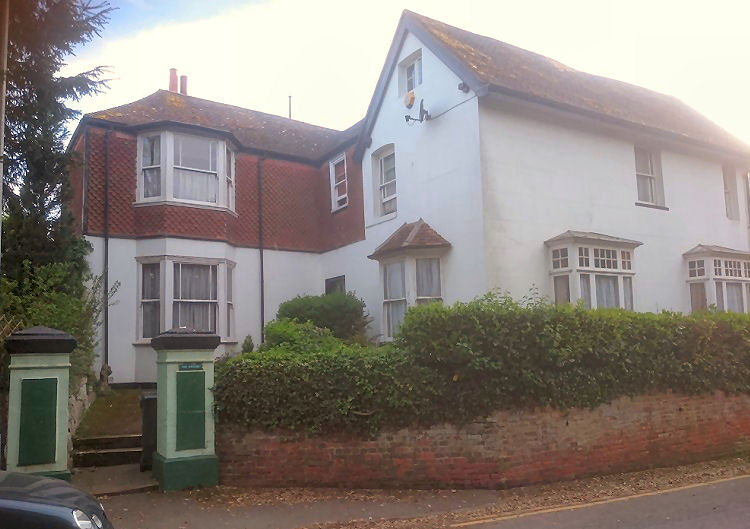
Former "Coach and Horses" 2018, kindly taken and sent by Rory Kehoe.
Now known as the Grange. |
|
|
|
The licensee list I have so far acquired identifies the pub trading in
1768.
According to Historic Harbledown, the "Coach and Horses" was originally
on the other side of the road, a bit further up Church Hill, opposite St.
Michael's Church than the "Old
Coach and Horses". So, there have been two of them over time with the
same name. I am hoping the licensee lists are correct for their respective
buildings.
This property is now called The Grange.
Exactly when the "Coach and Horses" ceased trading and crossed over the
road isn't currently known. However, it is known that what had been the
original pub was purchased in 1864 by George Neame Esq and the deeds state
that "All that messuage and tenement then lately used as a public house and
called or known by the sign of the "Coach and Horses." So the original
"Coach and Horses" had certainly closed by 1864.
In 1838 the St. Dunstan's Brewery of Flint & Kingsford's leased the
"Coach and Horses" from the Lord of the Manor of Hall Court and it seems
likely that they were responsible for the closure of the original pub
(probably sometime in the 1840s/50s) and the transfer of the name/licence to
a new building on the site of what had been the "Earl
Grey." Whether James Shaxby (baker/shopkeeper/beer retailer) of the "Earl
Grey" stayed on in the early years of the newly-located "Old
Coach and Horses" isn't yet known.
|
Kentish Gazette 9 October 1787.
CANTERBURY, Oct. 9.
On Saturday afternoon about five o'clock, as Mr. Curling, master of the
"Three Horse Shoes," public-house, at Hernehill, was returning home in
his cart from this city, just beyond the milestone on the Harbledown
road, the horse took fright and ran away, and he endeavouring to catch
hold of the reins, fell from the cart, and the wheel went over his body,
by which he was so much bruised that he was carried to the "Coach and
Horses" at Harbledown, where, in less than two hours, he expired in
great agonies. |
|
From the Kentish Gazette or Canterbury Chronicle,
Wednesday, 16 October, to Saturday, 22 October, 1768. Price 2d.
To be sold to the highest Bidder, on Saturday the Fifth of November
next, at Mr. Gibbons's the “Coach and Horses” at Harbledown near
Canterbury, beginning at two o'Clock in the Afternoon.
A strong Timber'd Smock Windmill, built with Oak, fit for the Flour
Trade, with two pairs of Stones, and a Boiling-Mill; or it may be turned
to Seed Work, or any Thing of that Kind.
For further Particulars enquire at the Place where it now stands, or
of Mr. Richard Goodchild, at Harbledown near Canterbury.
|
|
Kentish Gazette 8 May 1801.
Wednesday last died Mr. John Page, landlord of the "Coach and
Horses" public house, Harbledown.
|
|
From the Kentish Gazette, 8 June 1810.
DEATH.
June 6, at Harbledown, 66, Mrs. Lydia Page, landlady of the "Coach
and Horses" public-house, for 30 years.
|
|
From the Kentish Gazette, 8 June 1810.
DEATH.
June 5, Mrs. Lydia Page, one of the sisters of St. John's Hospital,
Harbledown, and formerly landlady of the "Coach and Horses" public
house, at that place.
|
|
From the Kentish Gazette, 9 November 1810.
MARRIAGE.
Same day, and at the same church, Mr. George Page, landlord of the
"Coach and Horses" public house, at Harbledown, to Miss Mary
Diamond, of Canterbury.
|
|
From the Kent Herald, 9 March 1826.
On Monday last, and inquest was held before T. T. Delasaux, Esq., Coroner, on
the body of Jane Bennefield, at the "Coach and Horses" public house, in the
parish of Harbledown.
This case was involved in mystery, so much so, that the surgeon (Mr. Thornton,
of this city,) was directed to open the body, when it clearly appeared that the
deceased had taken a quantity of arsenic.
The jury, after a patient investigation returned a verdict of Felo de se; there
being no evidence adduced to prove that the least symptom of insanity.
The Coroner there upon issued his warrant directing the constables to have the
body interred without burial service, in the churchyard, between the hours of 9
and 12, at night, agreeably in the late Act of Parliament.
|
|
From the Kentish Gazette 25 December 1838.
Yesterday eighty Sunday-school, children of the parish of Harbledown,
were bountifully regaled with roast beef and plum pudding, at Mr.
Pilcher's, at the "Coach and Horses Inn," the gift of Colonel Webb
and the Hon. and Rev. W. Eden. The village church bells rang a merry
peal during the festive repast. We hope the munificence of these
kind-hearted gentlemen will meet with imitators in every rural
parish in the county.
|
|
From the Kentish Gazette, 25 June 1839.
TO BE SOLD,
A Handsome Bright Bay Pony, Six Years old, stands 13 hands high,
warranted sound, and quiet to ride or drive.
Apply to Mr. T. Pilcher, "Coach and Horses Inn," Harbledown.
|
|
Kent Herald, 28 August 1845.
Coroner's Inquest.
An inquest was held yesterday at the "Coach and Horses," Harbledown, before T.
T. Delasaux, Esq., coroner for Kent, on view of the body of Margaret Tate, age
34, who had died the proceeding evening in consequence of having taken poison.
By the evidence of Isaiah Roberts and others, it appeared that deceased was a
married woman, but did not live with her husband, who had been a gentleman's
servant, but was at present out of employ; that deceased, had for some time
being living as cook in the family of the Hon and Rev. W. Eden, rector of the
parish of Harbledown, and that she, on Tuesday afternoon, requested Roberts to
procure for her two pennyworth of arsenic, which he said she wanted to poison
mice with; she also gave him a letter to post for her at Canterbury, directing
to her sister residing at Beakesbourne. The arsenic was procured as requested,
and delivered to one of deceased fellow servants; and the packet was duly marked
and labelled as containing "poison." When the packet was placed n the kitchen
table deceased observed that it was all right, and had been procured for the
purpose of poisoning the mice, and from that time the packet had not been seen
by any of her fellow servants. In the coming evening, between seven and eight
o'clock, deceased complained of being ill with the head-ache, a malady to which
she was very subject, and said she would go to bed, which she did. In about an
hour after the lady's maid went to a room and found her lying on the bed; she's
said she felt better but was disposed to sleep; she wished the door left open
that she might hear when the bell rang for family prayer. Deceased did not come
down to prayer, and on the same witness going up again into her room she found
her lying on the floor, apparently in much agony, and had been vomiting.
Mr. Eden was then informed of the circumstance, and medical assistant was
promptly procured; but the unfortunate woman died before the arrival of Mr.
Crawford, surgeon, of Canterbury, who stated on the inquest, that although death
not does not usually follow so soon after taking arsenic, as in this instant,
yet, occasionally, it did occur; he had no doubt that deceased a died by taking
poison, although he could not detect its presence in that which deceased had
thrown from her stomach by vomiting; but a mug was given to him from which
deceased said she had been drinking round the sides of which he had detected the
presence of arsenic.
Deceased was represented to have been much troubled in her mind, and also
afflicted by severe pains in the head, and that her mind had been apparently
more affected than usual during the past fortnight, and she was very melancholy.
A letter, which he had sent to her sister, was read, in which she complained of
illness, and as also of the trouble on her mind respecting her husband's
conduct.
The Coroner addressed the jury on the principal points of evidence adduced, -
giving his opinion that sufficient had been shown to satisfy them that deceased,
when she committed the rash act, was not in a sound state of mind. At the same
time he told them, the verdict they were about to give was theirs, not his, and
they were only to be ruled by the convictions on their minds from the evidence,
and in no way from the remarks which he had considered it is duty to make.
The jury immediately returns a unanimous verdict, that deceased poisoned
herself, being at the time laboring under temporary derangement.
Deceased was much respected by all who knew her, and had from her childhood
lived a servant in the family of the Hon. Mr. Eden at various times, as
childmaid and in other capacities, and eventually returned to that gentleman
service as cook, after having traveled as servant through both France and Italy,
and other parts of the Continent; during this time she married a fellow servant,
which union proved an unhappy one, she having been obliged again to go to
service, and at times was much annoyed by a husband visiting the neighbourhood
where she resided, and becoming a tax upon her small savings, as was the case in
the present instant, a few days ago she paid a debt created by him, but warned
the parties that she could not be answerable for anything more; but he still
persisted in his demands upon her, and to run up a considerable bill at the
"Eight Bells," in St. Dunstan's."
The witness Roberts, who is postman for the delivery and posting of letters for
Harbledown, had a presentiment on his mind that the arsenic was not wanted by
deceased for the purpose ascribed, and had contemplated purchasing magnesium, as
by mistake, but being told by another servant of the establishment that they
were much trouble with nice, he altered his attention and procured the fatal
drug.
|
|
From the Kentish Gazette, 28 April 1846.
CORONER’S INQUEST.
On Tuesday evening last, an inquest was held before T. T. Delasaux, Esq.
at the "Coach and Horses," Harbledown, on view of the body of Mrs.
Taylor, wife of Mr. T. Taylor, late of St. Dunstan’s Street, Canterbury.
By the evidence before the jury, it appeared that deceased was taken
suddenly ill on Sunday morning, April 5th, and complained of severe pain
in the head, and fell down while proceeding to her bed room, by which
she received a blow on her temple, but not of such consequence as to
cause serious apprehensions as to the result; since which time she had
been much indisposed, and for two days previous to her death which took
place on Sunday evening, she was confined to her bed.
By the evidence
adduced, no doubt could exist but the cause of death was apoplexy, and a
verdict of "Natural Death" was returned.
|
|
Kentish Gazette, 14 September 1847.
Harbledown Trap Club.
On Tuesday last this society, which numbers about 40 citizens, closed a
prosperous season by a dinner, which was set out in a neat tent in the
picturesque ground of the "Coach and Horses Inn." The day was
delightful, and so was the cheer provided by the experience of mine host
Pilcher, the members mustered strongly, and having done ample justice to
the truly English fare, commenced play, and continued till night "closed
around the conquerors' way," when an adjournment to the fireside was
carried, and the song and toast concluded the pleasures of the day. So
gratified were the members, that they unanimously entered for next
year’s season.
|
|
From the Kentish Gazette, 1 August 1848.
Pilcher.
July 27, at Harbledown, Mrs. Pilcher, wife of Mr. Pilcher, of the "Coach
and Horses."
|
|
Kentish Gazette, 14 May 1850.
Harbledown Trap Club.
This club held its first meeting for the present season, on Tuesday
evening last, at the "Coach and Horses Inn," and, notwithstanding the
unfavourable state of the weather, was numerously attended. The worthy
host (Mr. Pilcher) has left nothing undone for the comfort and
convenience of the members.
|
|
Kentish Gazette, 13 May 1851.
The celebrated trap club at the "Coach and Horses Inn," Harbledown,
opened the the season on Tuesday last. The number of
members is eighty. A goodly party assembler on the green, which has been
greatly improved, and from its situation, and the
splendid prospect over the fertile valley of the Stour, will be a
favourite resort for the citizens during the summer months.
|
|
Kentish Gazette, 9 September 1851.
Harbledown. Trap Club.
This society brought their season to a close on Tuesday last, when
nearly 80 members and visitors sat down to an excellent dinner, in a
spacious booth erected for the purpose, in the garden of the "Coach and
Horses Inn," adjoining the trap ground. A silver snuff-box, of excellent
design and workmanship, was presented to Mr. F. Duly, as a mark of
respect to him as their secretary.
|
|
From the Kentish Gazette, 9 June 1857.
HARBLEDOWN.
Suicide of the Parish Clerk.
Yesterday afternoon Mr. Delasaux held an inquest at the "Coach and
Horses," in this village, on the body of William Anderson, late
parish clerk, who committed suicide by hanging himself in the belfry
of the parish church yesterday morning. Deceased had of late been
ailing, occasioning melancholy, under the influence of which it is
supposed he committed the rash act. His wife having missed him a
short time she obtained the aid of Charles Bishop, a labourer, whom
she requested to go to the church in search of her husband, which he
did at half-past nine o’clock, and in the belfry found deceased
suspended by a rope to a beam. He was quite dead. Witness had known
him for forty years, and had never observed anything strange in his
conduct. He had seen him the previous day both in the morning and
afternoon doing duty in the church, which he performed as usual.
William Hammond, sexton of the parish, and who is also postmaster of
the village, had known the deceased from his birth, and that he had
done duty at the church for the past twenty years. On Saturday he
observed him to be very low spirited, and when deceased requested
him to attend as the next day at the church, and if finding him
falter to step in and assist him. He had done this before during
deceased's illness, which had been for the last two or three months.
Deceased was very eccentric in his habits, and on the Sunday (the
day previous to the inquest) after going into his desk he commenced
reading the service, which witness had never known him to do before.
Richard Maxted, on passing the gate at deceased's house at about
half-past eight that morning, saw him look about and run out, but
where he went to he (witness) did not know. He did not speak to
witness as he usually had done, which occasioned his surprise.
This was the last that was seen of the deceased, and there is no
doubt that he then proceeded to the church, where he was found by
Bishop an hour afterwards.
A verdict was returned of "Temporary insanity."
(From a Correspondent.)
A gloom has been spread over the neighbouring village of Harbledown,
by the death, under the painful circumstances detailed elsewhere in
our paper, of Mr. William Anderson, so many years the respected
clerk of that parish. The event was felt as a personal shock to all
in the place — a more worthy and upright man it would not be easy to
find. His uniform kindness of heart and open and cheerful
disposition made him a general favourite. It is not enough to say
that he had not an enemy; there was no one connected with him in any
of his various relations who did not feel disposed towards him as a
friend. In his office he was most intelligent and zealous. No
explanation can be given of the act, except as the effect of
hypochondriacal afflictions which ho had lately been suffering
under. He was happy in his home, and perfectly at case in his
circumstances.
|
|
From the Kentish Chronicle, Saturday, 17 September, 1859. Price 1½d.
ST. AUGUSTINE'S PETTY SESSIONS.
Saturday.
(Before W. Delmar, Esq. Capt Clarke, H. Kingsford, Esq., and H. Dennie,
Esq.) Three navvies, named Bishop, Holmes, and Smith were summoned to answer a
charge of using violent and threatening language. Smith did not appear. Mr. J. Gambrill:- The defendants Bishop and Holmes, with a men named
Smith, came into my house, the “Coach and Horses,” Harbledown on
September 3rd. I required Smith to spit in the spittoon instead of all
over the room, and then they abused me, using very bad language. They
threatened to bury me in the cutting, and empty dung upon me; also to
settle my hash. Mr. Gambrill called a witness, who corroborated his statement. The Bench bound over the defendants to keep the peace, each in
his own
recognizance of £5 for three weeks, and to pay the costs. |
|
From the Kentish Chronicle, 10 May, 1862.
THE TRAP-BAT CLUB.
These favourite resorts of the Canterbury citizens on summer evening
have commenced their meetings. And in each case seem to augur well for
successful seasons. The most ancient of them, the “Beverley,” held its
first meeting at the “Beverley Arms,” St. Stephen's, on Monday evening,
the 28th of April. The St. Thomas Hill Club, held at the “City of
Canterbury Tavern,” opened the campaign on May-day. The “Castle Inn”
Club commenced its meetings in the beautiful orchard of the “Castle
Inn,” on Monday evening last, the 5th inst.; and the next evening
(Tuesday) a good muster of the members of the “Harbledown Club”
assembled on the tap-green of the “Coach and Horses Inn,” which with the
pretty gardens attached, have been got into very nice order by the new
landlord, Mr. R. Eldridge.
|
|
From the Kentish Gazette, 5 September 1865.
ST AUGUSTINE’S PETTY SESSIONS.
Saturday. (Before Geo. Neame, Esq., Captain Slarke, T. H. Mackay,
Esq., William Plummer, Esq., T. G. Peckham, Esq., and P. Marten,
Esq.)
The Annual Licensing Day.
Applications for New Spirit Licenses.
There were twelve applications for spirit licenses, ten of which
were granted and two refused. The applications were as follows.
The Annual Licensing Day. HARBLEDOWN.
Mr. James Shaxby applied for authority to obtain a spirit license
for a newly erected house at Harbledown, which is intended to take
the place of the "Old
Coach and Horses." Mr. Neame stated that, there being no
public-house in the village, the one for which the application was
made would be a great convenience to the inhabitants. The
Magistrates granted the application.
|
|
|
The 1861 licensee, Joseph Gambrill, had previously lived in
Ash-next-Sandwich, where he resided at White Post Cottage and worked as a
maltster. In 1855 he was described as a brewer at the White Post Brewery. I
don't know when he left the "Coach and Horses" but in 1871 he was living in
Strood and was brewer the Frindsbury Brewery.
LICENSEE LIST
GIBBONS Mr 1768+

PAGE John 1780-May/1801 dec'd
PAGE Lydia to 6/June/1810 dec'd
PAGE George 1810+
PAGE Mary 1832+

PILCHER Thomas 1838-55+ (widower age 49 in 1851 ) )
 
GAMBRILL Joseph 1858-61+ (age 34 in 1861)

ELDRIDGE Richard 1862/Nov/63
 
WRIGHT G R Nov/1863+
To new building called the "Old
Coach and Horses."
Census
|

