DOVER KENT ARCHIVES

Sort file:- Canterbury, August, 2025.

Page Updated:- Saturday, 16 August, 2025.

PUB LIST PUBLIC HOUSES Paul Skelton

Earliest 1630s-

Queen's Arms

Latest 1741-

(Name to)

Stour Street

St. Mildred's

Canterbury

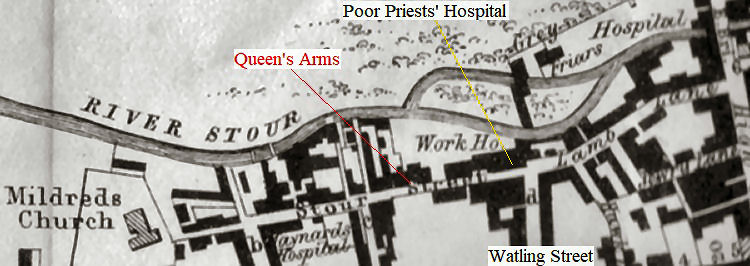
Queen's Arms map 1800

Above map circa 1800.


This one appears to be a different one from the "Queen's Arms" located in the Northgate area of Canterbury.

Rory Kehoe goes on to give the following information:- "The pub's exact location isn't yet known but it was possibly on the north side of Stour Street, maybe on/near the site of what later became the "Two Brewers." This "Queen's Arms" appears to have traded from the 1630s until the first half of the 18th century, in what was then part of the semi-rural western outskirts of Canterbury. This area was developed in the 18th century into what we now know as Stour Street, this being an extension of Lamb Lane, which ran from the High Street to the corner of Beer Cart Lane. The "Queen's Arms" was certainly within the parish of St. Margaret and was described as being "near Watling Street" and referenced (Woodruff) in an estate document:- "land belonging the to the Hospital for Poor Priests, next to the "Queen's Arms."" The above map circa 1800 indicates the approximate location of the "Queen's Arms, based on current information.


From a talk given by Charlotte Cornell, Friday 8 March 2024.

Aphra Behn, née Aphra Johnson, was born in Harbledown, Canterbury in 1640. Her parents were Bart Johnson a barber, and Elizabeth Dunham a wet nurse who came from a 'light aristocratic' Faversham family. Elizabeth’s marriage was not a particularly good match for her, not only due to Bart’s lower social status, but also because he was a drunk and was often before the courts. Bart Johnson was constantly applying for freedom of the city of Canterbury to set up as a barber. In the 17th century only, a freeman could legally ply their trade in Canterbury. But his application was refused by the mayor at least three times. Regardless, Bart Johnson sets up an illegal barber’s shop in Canterbury anyway, undercutting his contemporaries in the barbers’ guild who petition against him.

Meanwhile, Aphra’s mother Elizabeth obtains a position as nurse to the Culpepper family at Sturry House, now Junior Kings. It is thought that this is where Aphra learnt to read and write, was given access to a library and acquire some education, possibly alongside the daughter of the house. Nevertheless, Aphra complains bitterly in a poem written later that females are not given the chance to learn Latin, and to be able to study classics in their original form.

In 1649 Bart finally gets granted the freedom of the city but not as a barber. He applies as the innkeeper of the "Queen’s Arms," which was in Stour Street opposite the Poor Priests Hospital. A way of trying to dissuade an unwelcome applicant from becoming a freeman was to price them out of the market. Bart’s fee was set at £10.00 which was well beyond his means. However, he borrows the money which leads to him becoming a debtor when subsequently he is unable to pay back the loan.

A debtor in the 17th century was considered a moral failure in the community and could be punished by imprisonment until the debt was paid. Bart tries to petition The Lord Protector Cromwell to quash the debt which is not granted. Consequently, Bart moves the family including a teenaged Aphra, to London the following year and it is not thought that she ever returned to Canterbury.


LICENSEE LIST

JOHNSON Bart 1649+


If anyone should have any further information, or indeed any pictures or photographs of the above licensed premises, please email:-

TOP Valid CSS Valid XTHML