|
25 St. Dunstan's Street
Canterbury
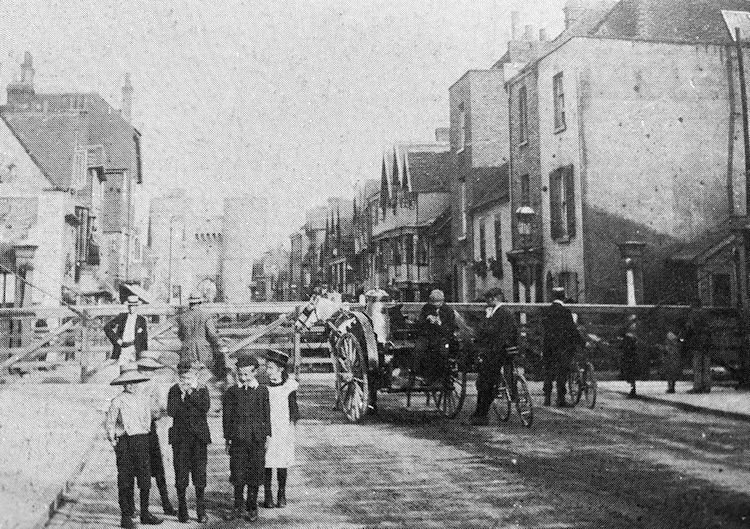
Above photo, circa 1904, kindly sent by Rory Kehoe. The building is the
third building on the left, opposite the House of Agnes. Prior to its
closure in 1920, the pub used to have a public right of way running
through it. Apparently, it was not uncommon for customers, as they were
enjoying a quiet pint, to have to make way for a horse being led from
the rear of the pub onto the street. Pubs with the name "Catherine
Wheel" derive their name from the badge of the Knights of St. Catherine,
who used to protect pilgrims on their way to/from the Holy Sepulchre at
Sinai. Inns along the route would offer pilgrims hospitality and
accommodation, indicating this by means of displaying a Catherine Wheel
sign. |
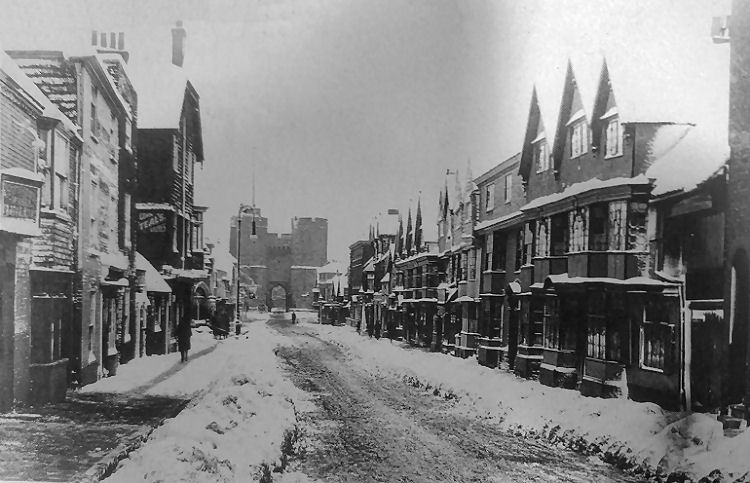
Above photo 1909. Kindly sent by Rory Kehoe. The pub is just seen on the extreme
left of the photo. |
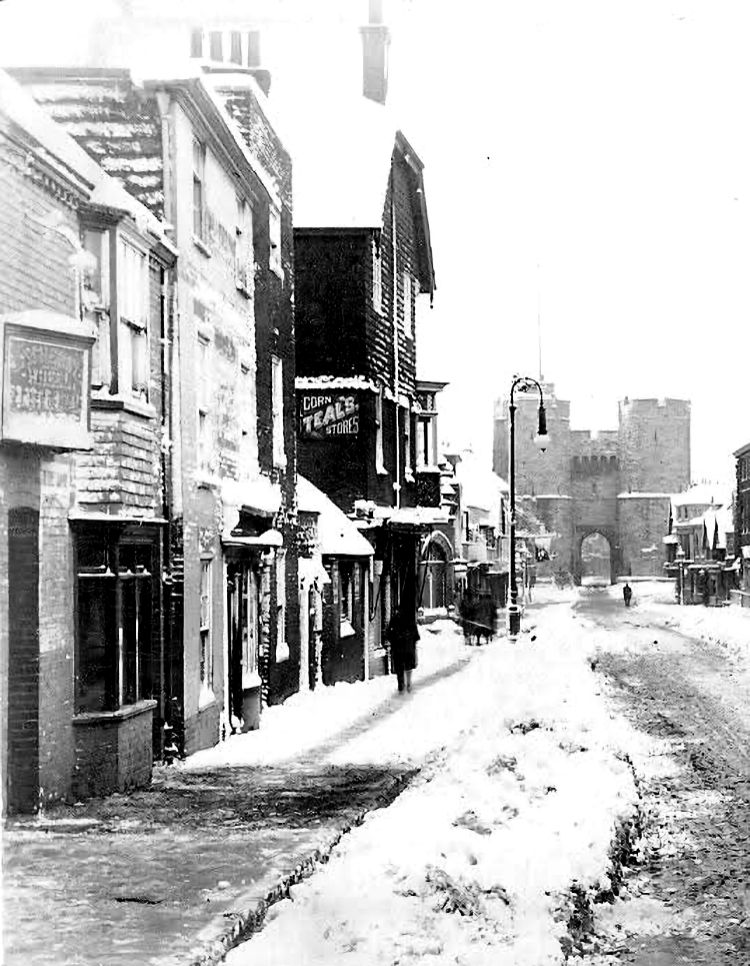
Above photo, circa 1909. |
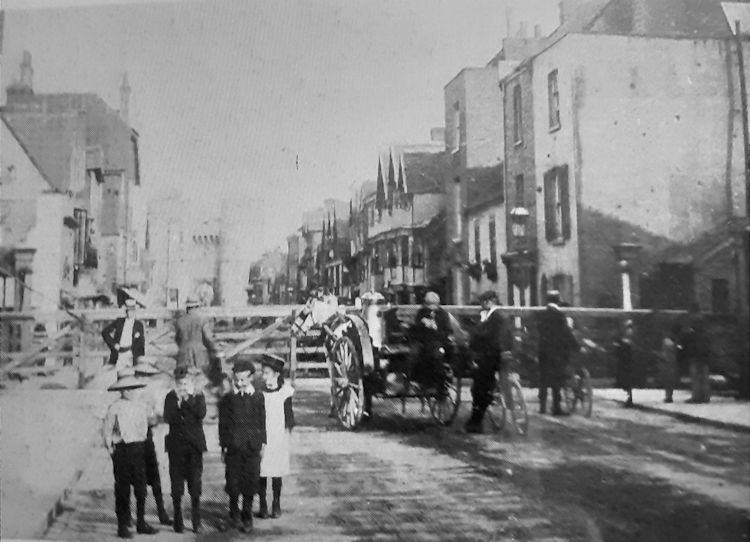
Above photo, pre 1914. |
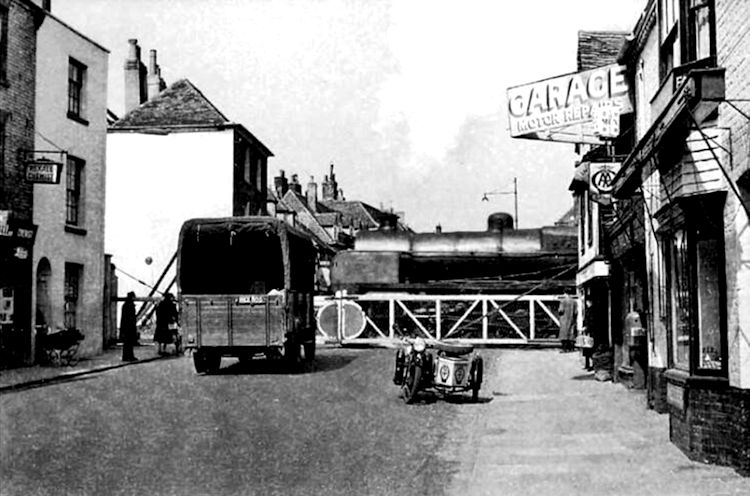
Above photo, circa 1954, kindly sent by Rory Kehoe. Showing the former
pub on the right (with the awning) trading, then as now, as Hedger's
butchers. |
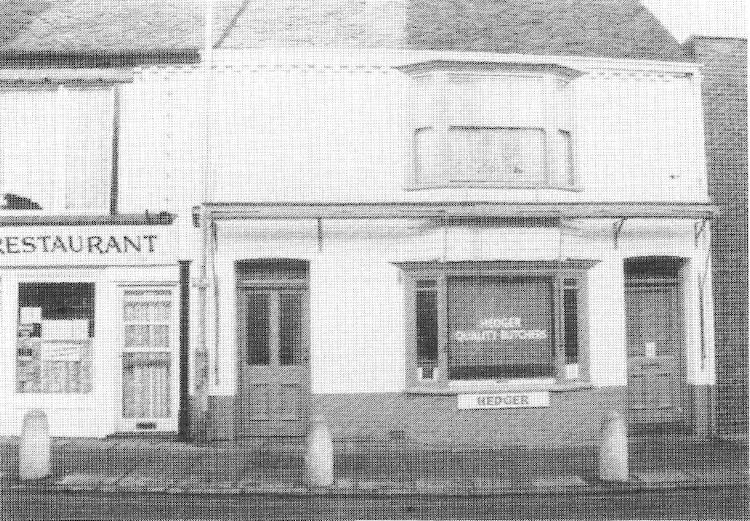
Above photo, circa 1992. |
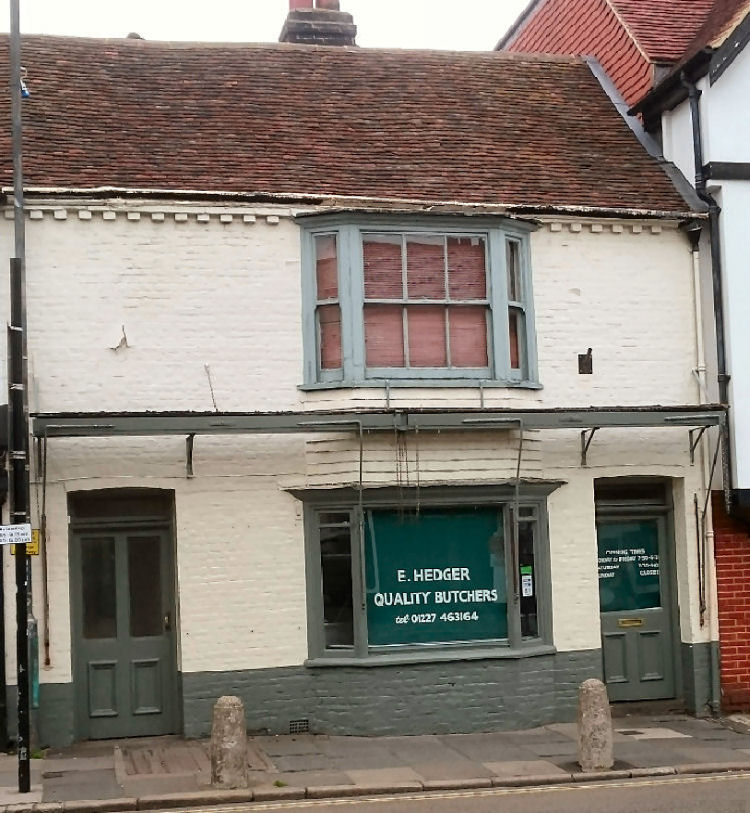
Above photo, August 2017, kindly sent by Rory Kehoe. |
This inn was included in the 1692 List of licensed inns in Canterbury
(Westgate Without). It accepted 6 soldiers from the Billeting Officer.
This has also been spelt "Katherine Wheel." I am told this was
situated three doors from the railway crossing.
I believe the premises closed as a public house in 1920, and in 1925 the
directory names the occupant of the premises as Edwin B Hedger. The building
from 1992 is, of course, Mr Hedger's popular butcher's shop.
At one
time there used to be a right of way that passed through the house, and it
was not uncommon to see horses being led past the customers.
|
Kentish Gazette, Tuesday 9 June 1772.
CHARITY ESTATES.
In St. Dunstan's, near and without the Walls of the City of Canterbury.
Whereas a Part of the House, Land, and Premises, known by the Name of
the "Katherine Wheel," also several Messuages, Lands and Tenements, in
the Occupation of Mr. Thomas Luckett, or his Under Tennants, in St.
Dunstan's aforesaid.
Also a Messuage or Tenament, Oast, and Premises, at Harbledown, which
said premises were formerly the property of Thomas Trensham, Gent. of
the Parish of St. Dunstan's aforesaid, and given by him at his Decease,
for the Benefit of the Poor of the said Parish, and of late years are
mixed and blended with other Estates, by having Buildings erected partly
thereon, and partly on other adjoining Estates; by which Means the said
Charity is liable to Encroachments, and in Danger of being lost.
THIS IS THEREFORE TO GIVE NOTICE,
That the said estates are ordered, by the Trustees, to be surveyed,
marked out, and planned, to prevent future disputes, and that the same
will be done on Monday next, the 15th instant; and all persons who have
land or premises adjoining, are desired to attend, to see they are not
encroached on by placing the said Marks.
John Hart,
Land, Timber, and Building Surveyors.
|
|
From the Kentish Gazette, 17 April 1810.
DEATHS.
April 16, Mrs. Holness, wife of Mr. Holness, landlord of the
"Catherine Wheel" public-house, St. Dunstan's, Canterbury.
|
|
From the Kentish Gazette, 20 April 1810.
DEATH.
April 16. Mrs. Hulness, wife of Mr. Edward Holness, landlord of the
"Catherine Wheel" public-house, St. Dunstan's, Canterbury.
|
|
From the Kent Herald, 25 September 1828.
On Thursday an inquest was held before the same Coroner, in the parish of St.
Dunstan, on the body of Robert Impett, aged 76, who was on the previous morning
found dead in his bed, at the "Catherine Wheel," in that parish.
Verdict - Died by the visitation of God.
|
|
From the Kentish Gazette, 16 July 1844.
PROVINCIAL INTELLIGENCE.
VICE-CHANCELLOR'S COURT—Monday, July 8. Before Sir J. Wigram.
THE ATTORNEY GENERAL v. FLINT
This was a bill filed by the Feoffees of the Poor of St. Dunstan,
Canterbury, in the name of the Attorney General against Messrs. Flint
and Kingsford, to recover possession of part of a public house called
the “Catherine Wheel,” in St. Dunstan’s street, which the defendants
claimed (except a part of a room) as bona fide purchasers of the late
Mr. Abbott, and which they had held for upwards of 20 years.
Mr. Cooper and Mr. Crofton appeared for the feoffees, and Mr. Romilly
and Sir W. Riddell for the defendants.
Mr. Cooper had commenced the case, when he was stopped by Mr. Romilly,
who took an objection to the bill in its present shape, and contended it
was defective, as the feoffees ought to have been made either plaintiffs
or defendants, which had not been done. The case was, therefore,
withdrawn, for the proceedings to be amended.
(Feoffees:- a trustee invested with a
freehold estate to hold in possession for a purpose, typically a
charitable one. Paul Skelton.)
|
|
From the Kentish Gazette, 19 November 1844.
VICE CHANCELLOR’S COURT. Wednesday.
(Before Sir J. Wigram.) ATTORNEY-GENERAL V. FLINT.
By indenture of feoffment, dated in 1584, Thomas Streiusham assured his
five houses and gardens, four of which were situate in the parish of St.
Dunstan’s, Canterbury, to trustees upon trust, to bestow the issues and
profits unto the poor householders and their natural children inhabiting
or abiding in, or that should inhabit and abide within, the said parish
of St. Dunstan’s, as to help and comfort the parents, clothe their
children, or set them forth to service. The charity property in St.
Dunstan’s had in the course of years been in the occupation of various
lessees and tenants, many of whom had taken under express agreements by
which they were allowed to erect buildings or make improvements on the
premises, and remove such erections again at the end of their terms.
Under these agreements, and from the necessity of rebuilding or
repairing the tenements in consequence of their decay, or of the
application of the premises to new purposes, the property had become
much altered. About 30 years ago the lessee of a part of the property,
who was also the lessee of adjoining premises, rebuilt the house called
the “Catherine-wheel Inn,” and, according to the allegations of the
information, so constructed the new promises that the parlour of the
inn, and a passage leading to the stables, over which some of the upper
rooms were placed, covered a part of the land belonging to the charity.
Various deeds and other documents were produced for the purpose of
proving the alleged conversion of the site, but in consequence of the
premises not being described in any of the instruments by metes and
bounds, the facts with reference to the ancient situation of the
property were very obscure. The defendants were the owners in fee simple
of the “Catherine-wheel Inn,” and they insisted — first, that the piece
of ground claimed by the information never formed any part of the
charity estate; secondly, even supposing that any part of the site of
the public-house formerly belonged to the charity, that the defendants
were purchasers of the premises for a valuable consideration without
notice of the title now alleged by the relators; and, lastly, that any
right which the charily trustees might have formerly had was barred by
the Statute of Limitations, 3 and 4 William IV, c. 27. The defendants
also, by the arguments of their counsel at the bar, contended, that the
case was not one for the interposition of a court of equity, but that
the right of the charity, if any, might have been shortly, and with
comparatively little expense, tried at law by ejectment.
Mr. Romilly and Sir Walter Riddell were heard for the defendants; and
Mr. Cooper replied.
Judgment reserved.
|
|
From the Kentish Gazette, 19 November 1844.
VICE-CHANCELLOR’S COURT, Nov. 16.
(Before Sir J. Wigram). ATTORNEY-GENERAL v. FLINT.
His Honour delivered judgment in this case, with respect to the claim of
Streinshaw’s charity to a part of the site of the premises culled the
“Catherine Wheel,” St. Dunstan’s, Canterbury, and held that under the
circumstances, neither the Statute of Limitations nor the purchase by
the defendants of the premises without actual notice of the title of the
charity (if any) was a defence to the information; and he directed an
issue to try whether the land lying on the north-west side of certain
walls, referred to in the evidence, belonged to the charity.
|
|
Kent Herald, 24 July 1845.
Nissi Prius Court.
Castleton and another v. Flint and another.
Mr. Sergeant Channell (with whom were Mr. Peacock and Mr. Addison,) stated to
the jury that this was an issue, directed by the Vice-Chancellor, to try the
right of the present defendant to a portion of the "Catherine Wheel" public
house, in Canterbury, which was now claimed by the plaintiffs as trustees of the
Strensham's charity.
The plaintiff's case was supported by various documents relating to the
different holdings of the property, and many witnesses were called to give their
recollections of various alterations, which had been made at different times
during the last 50 years. These alterations were explained by a very neatly
executed model of the premises, without witch the evidence would have been
altogether unintelligible. The plaintiffs' case occupied six hours. Mr. Sergeant Shee (with whom was Sir W. Riddle,) contended that, by the deeds
and the witnesses adduced by the plaintiffs, all they could claim of the
"Catherine Wheel" was a portion of the parlour, which had been taken into it
from the passage, which led to an oast at the back of the house. He concluded a
very able address by calling on the jury to give a verdict for the defendants.
Verdict for the plaintiff.
|
|
Kent Herald, 11 December 1845.
Before Sr J. Wigram.
The Attorney-General. Flint.
This case was heard in November, 1844 when the Court directed an issue to try
whether the certain premises, forming part of the "Katherine Wheel Inn" in the
City of Canterbury, belonged to a charity named Streinham's Charity, or to the
defendants, who were admitted to be the owners of all those parts of the
"Katherine Wheel" which did not belong to the charity. The site of the property
in question was first conveyed upon charitable trusts by indenture of feoffment
in ale in 1584. In the course of time the premises had undergone various
alterations from the decay and removal of old buildings and the erection of
others in their stead. A Mr. Abbott was the owner of the "Katherine Wheel" in
1820, and was also a trustee of the charity. Abbot sold his business of a brewer
and his brewhouses and public houses to the defendants, who took a conveyance of
them in July, 1823. The information was filed in May, 1843, claiming part of the
inn as having been built upon the site of the charity property. The jury before
whom the issue was tried that the site of the rooms in questioned belonged to
the charity.
Mr. Cooper (with whom was Mr. Crofton) now asked for a reference to the Master
to fix an occupation rent on the premises, and insisted that the defendants
ought to be charged with such rent for so many years as they had been in the
occupation of the property.
Mr. Romilly and Sir Walter Riddell, for the defendants, contended that the claim
for more than six years' arrears of rent was barred by the Statute of
Limitations. One of the defendants, however, was still a trustee of the charity,
and if the claim to the back rent was not barred as against him, it was so at
least against the other defendant.
Mr. Cooper, in reply, argued that in favor of a charity, the courts both of law
and equity excluded the plea of Statute of Limitations.
His Honour inquired how the question could arise at law? If the trustee of the
charity bought an action for insane profits, and the defendant pleaded the
statute, could the plaintiff reply that he was trusty for a charity, and so
removed the objection?
Mr. Cooper said that the Statute of Limitations, which must be pleaded
especially, excepted in cases of express trusts, which charity cases were; and
before the statutes there was nothing to limit the demand backwards to the
commencement of the time of legal memory, namely, the return of Richard I. This
Court had carried back the account in some cases to a very remote period, for
more than 100 years before the filing of the information.
His Honour reserved his judgment, requesting to be furnished with some legal
authority for the proposition that the trustee of a charity in an action of law
was not liable, like any other party, to be met by the Statute of Limitations.
|
|
Kent Herald, 25 December 1845.
Death.
Dec.19, at St. Peter's,
Thanet, Mr. James Back, baker, aged 59 years, formerly for many years landlord
of the "Catherine Wheel," St. Dunstan's, Canterbury.
|
|
From the Kentish Gazette, 30 December 1845.
DEATH.
Back:— Dec. 19, at St. Peter's Thanet, Mr. James Back, baker, aged 59,
formerly for many years landlord of the "Catherine Wheel," St.
Dunstan's, Canterbury.
|
|
From the Kentish Gazette, 8 February 1848.
MARRIAGES.
Groombridge - Morgan, Jan 30 at St. Peter's Street chapel, Canterbury,
Mr. Thomas Groombridge, to Mrs. Mary Ann Morgan, landlady of the
"Catherine Wheel," St. Dunstan’s.
|
|
Kentish Gazette, 18 March 1851.
Subscriptions for the Broadstairs Boatman.
A penny subscription has been opened at the "Catherine Wheel," Saint
Dunstan's Street, Canterbury by the Thursday night's
reading club, in aid of the fund for rewarding those meritorious and
hardy men. It will be open for three consecutive
Thursdays, and we have no doubt a liberal sum will be raised.
|
|
Kentish Gazette, 20 June 1854.
Wednesday.
Robert Wright was charged with having stolen a pint pewter pot from the
"Catherine Wheel."
Committed for trial.
|
|
From the Kentish Chronicle, 30 May, 1863.
STEALING A RABBIT.
Jeremiah Edwards was brought up on a warrant, charged with having, on
the 14th February last, stolen a live tame rabbit, the property of Isaac
Bedwell.
Prosecutor stated that on the 14th February he went into the “Catherine
Wheel” for the purpose of raffling a rabbit, and he there met the
prisoner, who agreed to take two chances. As they could not get enough
members there, the prisoner proposed that they should go to the “Eight
Bells,” kept by a man named James; but instead of doing so, they went
into the “Unicorn,” where the prosecutor called for a pint of beer. He
and the prisoner drank together, and the latter then suggested that he
should take the basket containing the rabbit into the parlour, and see
if he could find a sufficient number of members there. To this the
prosecutor consented; but on his going into the room about ten minutes
after, he discovered that the prisoner had left the house, taking with
him the basket and rabbit.
George Ancle deposed that on the 15th February he bought a rabbit of a
man at his door for 2s. The prosecutor had identified that rabbit as the
one the prisoner took away from him at the “Unicorn,” and it had been
returned to him on his paying witness 1s. Witness was unable to identify
the prisoner as the man who sold the rabbit to him.
Superintendent Davies said he apprehended the prisoner at the Faversham
lock-up on the previous afternoon, and asked him whether his name was
“Jerry” Edwards. He said it was; and witness then asked him what he had
done with the rabbit he stole. Prisoner stated that he knew nothing
about any rabbit. Witness then asked whether he did not take a rabbit
from the “Unicorn” public-house, and he said, “Yes; but that was given
me.” He (the Superintendent) said, “Yes, and you sold it to a man named Ancle, in St. Mildred’s,” to which he replied, “I sold it to a man in
St- Mildred’s; but I don’t know his name.” Witness then took him into
custody on a charge of stealing the rabbit.
The prisoner, on being asked whether he would be tried by the Bench or
sent to the sessions, replied, “Tried by you. Now you are at it you may
as well finish it.”
The Mayor, in delivering the decision of the Bench, told the prisoner
that the crime he was charged with committing was rather a serious one;
for he had been drinking with the prosecutor, and, taking advantage of
his friendship, walked off with his rabbit. To make the case worse, he
appeared to treat the matter as a joke. The Bench committed him for
three weeks’ hard labour.
|
|
From the Whitstable Times and Herne Bay Herald. 27 July 1867. Price 1d.
(Before W. Plummer, Esq., in the chair; Alderman Aris and J. Hemery,
Esq.)
BREAKING WINDOWS.
Eliza McGuire was charged with breaking two panes of glass, value 2a.
6d., in the “Catherine Wheel ” public house, on Saturday evening, the
20th inst. Eliza Whiddett, landlady of the "Catherine Wheel,” St. Dunstan's, stated
that defendant came to her house on Saturday evening, and purchased a
pint of beer. When witness supplied her with the beer, defendant, who
was drunk at the time, took up a pint pot, and threw it through the bar
window, breaking two panes of glass. The magistrates ordered defendant to pay 5s.
costs, 2s. 6d. expenses,
and 3s. 6d. fine; or, in default, to be imprisoned for fourteen days'
hard labour in Maidstone gaol. |
|
From the Kentish Chronicle, 30 April, 1864.
MONDAY. STEALING A MILITIAMAN’S KIT.
John Wright, pensioner, was sentenced to six weeks imprisonment with
hard labour, for stealing a kit and a quantity of regimental
necessaries, the property of Michael Ryan, a private in the East Kent
Militia. The prosecutor and the prisoner were drinking together at the
“Catherine Wheel” on Friday, and Ryan left his kit at that house till he
went to the barracks. On returning he found that his kit had been taken
away by the prisoner, who was traced to the “Roebuck” public house, and
it was discovered that he had been dealing with the property.
|
LICENSEE LIST
LUCKETT Thomas to June/1772
HOLNESS Edward 1803-10+
BIGGLESON John D pre 1828 (also butcher)
BAX/BACK James 1824-28+
 
SNELLING John 1832-40+
  
MORGAN John 1846+
MORGAN Mary Ann (widow) 1847-48+ ( "Wheel") "Wheel")
THEOBALDS John 1858+

DAWES Isaac to July/1861 (age 68 in 1861 )
(Stour Street) )
(Stour Street)
WHIDDATT/WHIDDETT/WIDDET William July/1861-91+ (age 46 in 1871)
   
FOULDS James 1900+
STEGGLES/STIGGLES Walter 1901-05+
(age 30 in 1901)
 
MARWICK Stephen
 before Dec/1909
COOMBS W 1913+

PITHER W 1917-18+
https://pubwiki.co.uk/CatherineWheel.shtml
From the Pigot's Directory 1824
From the Pigot's Directory 1828-29
From the Pigot's Directory 1832-33-34
Stapleton's
Guide 1838
From the Pigot's Directory 1840
From Bagshaw Directory 1847
From Melville's Directory 1858
From the Post Office Directory 1862
From the Post Office Directory 1874
Census
From the Post Office Directory 1882
From the Post Office Directory 1891
From the Post Office Directory 1903
From the Kelly's Directory 1903
From the Post Office Directory 1913
|

