|
18 High Street
Canterbury
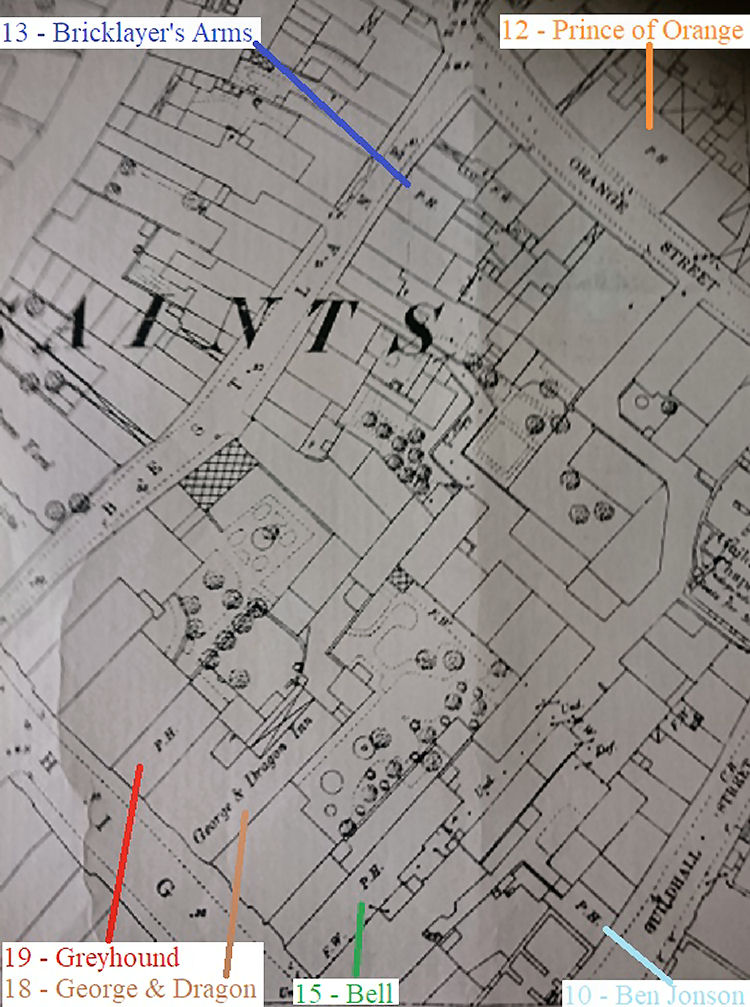
Above map 1874 identified by Rory Kehoe. |
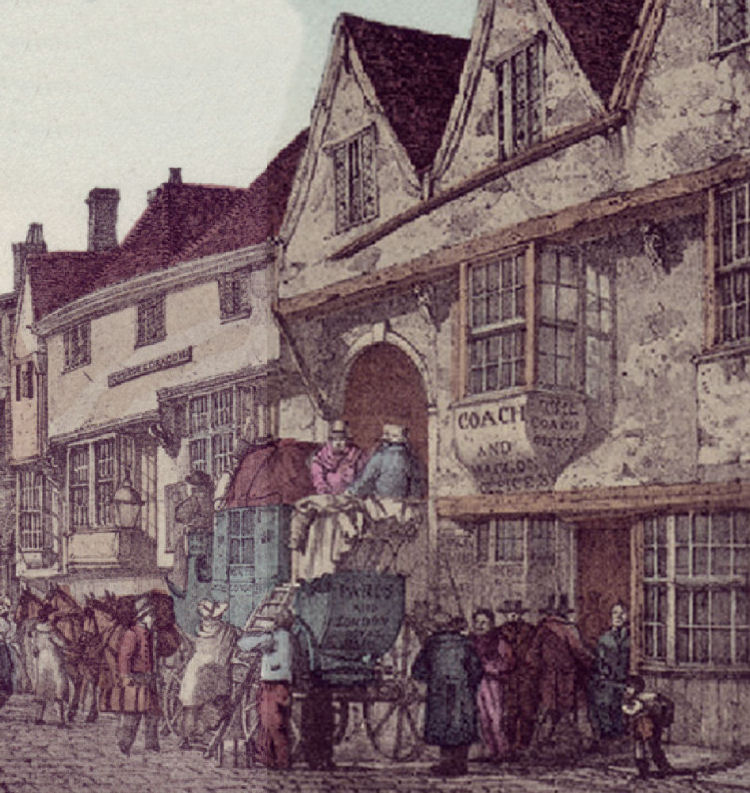
Picture above pre 1897 showing the "George and Dragon" left
. and the "Coach and Waggon" offices right. |
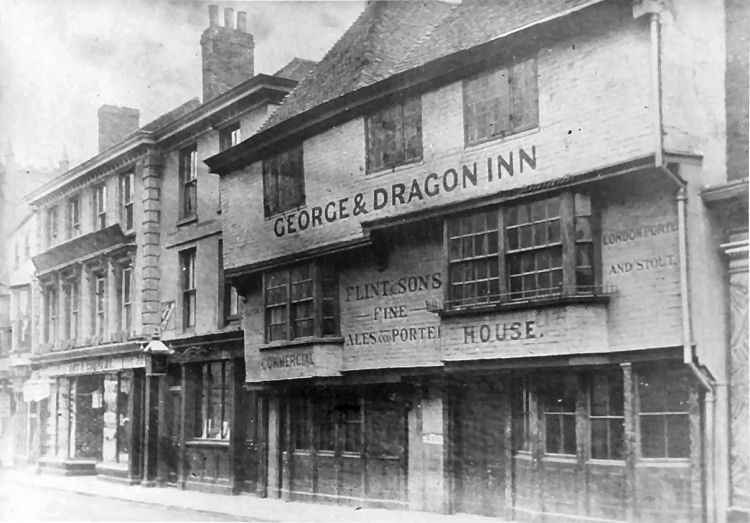
Above photo, date unknown, kindly sent by Tim Timpson. |
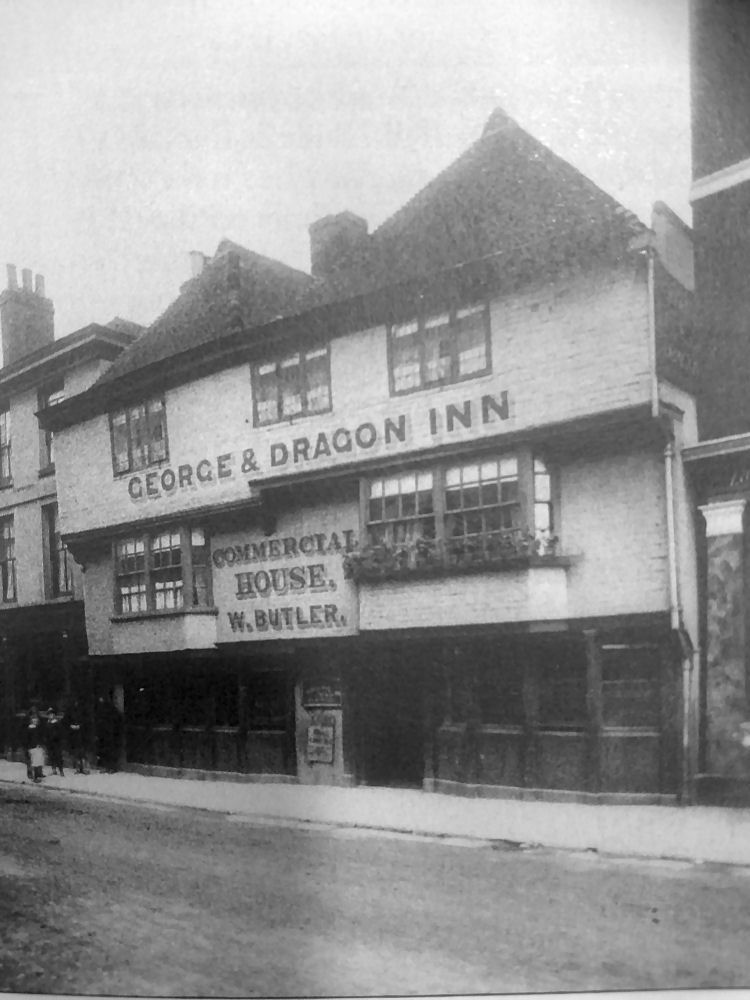
Above photo 1888, kindly sent by Rory Kehoe. |
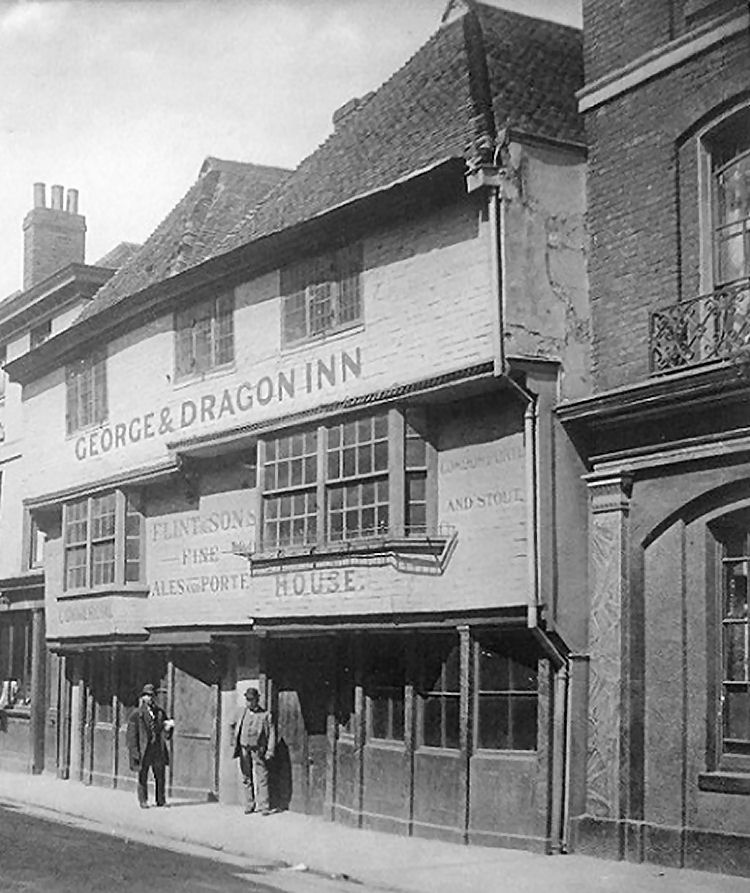
Above photo, circa 1888, kindly sent by Rory Kehoe. |
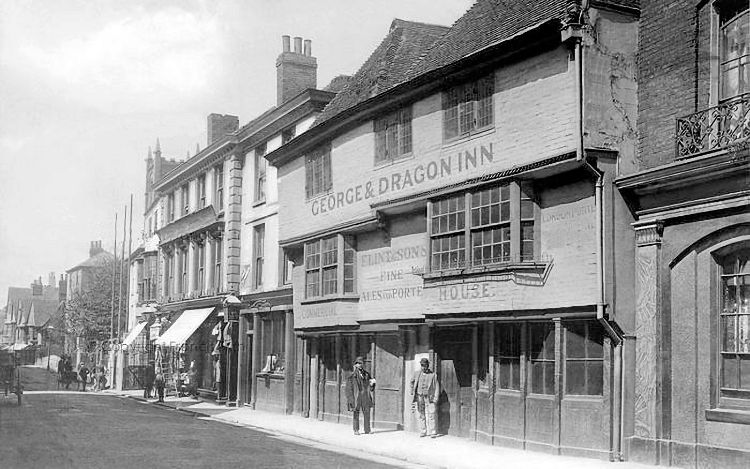
Abobe photo, circa 1888. |
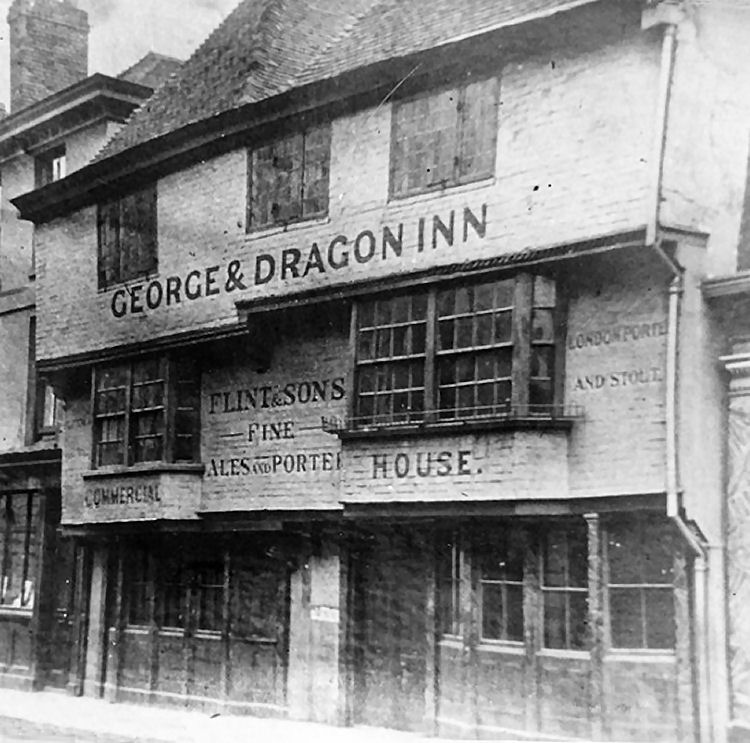
Above photo, circa 1890, kindly sent by Rory Kehoe. |
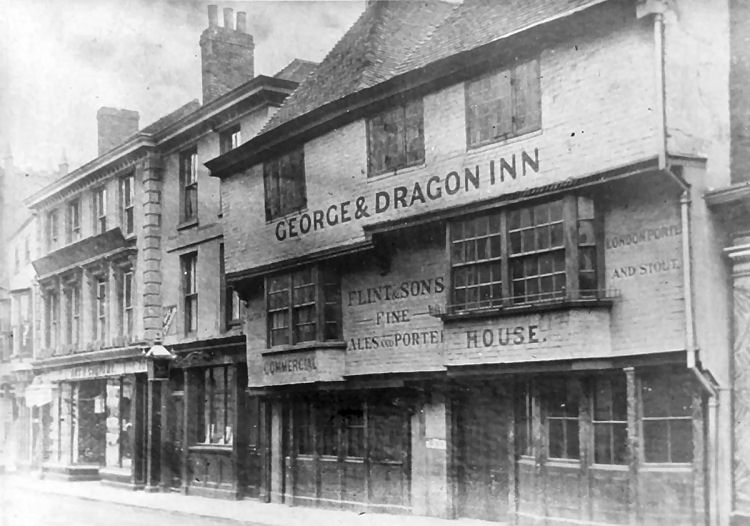
Above photo, circa 1890, kindly sent by Tim Timpson. |
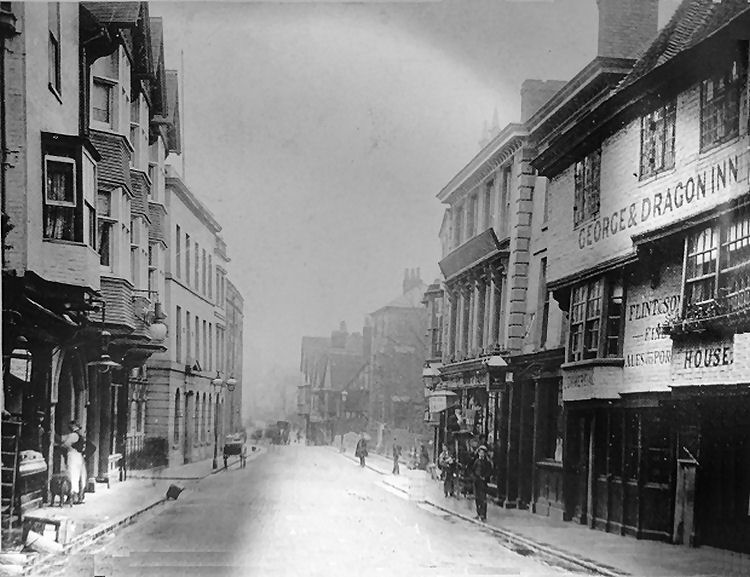
Above photo 1890, kindly sent by Rory Kehoe. |
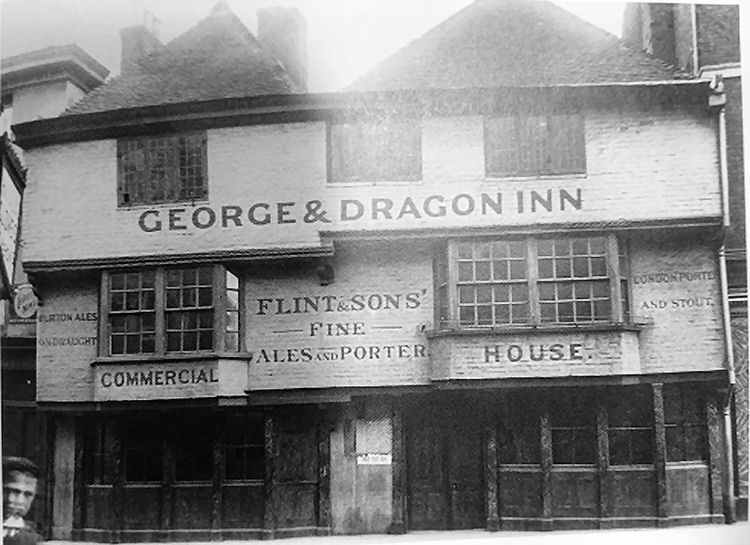
Above photo 1891, kindly sent by Rory Kehoe. |
|
From the National Archives CC/JQ/388 1587-1591
Walloon's wife living at the George, High Street, Canterbury mentioned
for encouraging her children in insanitary habits -
|
|
From the Kentish Weekly Post, 27 January, 1729.
To be Lett at Lady Day next.
The "George Inn" in High Street Canterbury, now in the occupation
of Richard Dancey. Enquire father of Mr. John Sawkins, junior,
Attorney and Canterbury.
|
|
From the Maidstone Journal, 14 September 1802.
Canterbury, Sept. 10.
Sunday a lad, son of one of the trumpeters of the dragoons, who fell from a hay
loft at the "George Inn," in High Street, and fractured his skull, was carried
to our hospital, where, from the care and attention paid him there is hopes of
his recovery.
|
|
From the Kentish Gazette, 9 January, 1810.
DIED
January 4, Mrs. Ann Igglesden widow of Mr. Stephen Igglesden, and
landlady the "George" public house, High-street, Canterbury.
|
|
From the Kent Herald, 10 June 1824.
Fatal Pugalistic Encounter.
The festivals of Whitsuntide, usually produce many boxing matches among the
working classes, and we regret to record one which took place early yesterday
morning, in the parish of Holy Cross, Westgate, that terminated fatally.
It appeared that Benjamin Barrett, a man who had resided in North Lane, in this
city, had been a marine, and lost a leg at the passage of the Dardanalles, had
been spending the evening and night at Wincheap Fair, and upon his return home
yesterday morning, with his wife, went into the "George and Dragon," High
Street, and called for some liquor. Mr. Easton, the landlord, knowing the man to
be of a quarrelsome disposition, and seeing him intoxicated, very properly
refused him any drink. He, however, went into the tap-room, and a quarrel soon
arose between him and some broomdashers, who were present. Barrett insisted upon
fighting a man named James Baker, and the part is proceeded down the street
towards the fields, to find an eligible spot to settle their dispute. Upon
arriving near Westgate Court they chose the Pound for their contest. Baker
observing, "you are a lame man, let us have a soft place to fall on, - you will
be hurt upon the hard stones." There was no between 20 and 30 people present,
none of whom, if we accept a man of the name of Simmonds, at all encouraged
them. They stripped and went into the Pound, accompanied by their wives, when
the men commenced fighting. After the first round, the combatants called out for
seconds, upon which Simmonds entered the ring for that purpose, as the friend of
Baker, and a young man who was casually present, of the name of Marrell, a
butcher stepped into perform the same office for the deceased, observing that he
"would have all fair." The men fought 6 or 7 rounds, with various success, when
in the last round, Baker struck Barrett, a severe blow just under the ribs upon
the left side. Its effects were tremendous. The deceased staggered a few paces,
and fell flat on his face. He breathed hard a few times, but spoke not, - and
was a corpse in two or three minutes. Mr. Brown, Surgeon, was sent for and
quickly arrived, but he was passed human aid. The wretched wife, who had been
but a few minutes before, with an infant in her arms, encouraging her husband in
his ill-fatal contest, now seemed in despair at its result, and gave way to the
most extravagant grief.
The body was conveyed to the "Cock" public house, in the
neighbourhood; and
Thomas Thorpe Delasaux, Esq. the Coroner immediately summoned an inquest upon
the body.
Coroner's Inquest.
The jury, after being empanelled, proceeded to take a view of the body, which
lay in an outhouse exactly in the state in which he died; - his face was
disfigured by blows; and upon the left side there was a mark of the blow which
caused his death.
Mr. F. S. Browne, Surgeon, deposed, that he attended an examined the body of the
deceased Benjamin Barrett, and found a mark of violence over the cardiac
extremity of the stomach, which was sufficient to cause instant death.
John Coverlid said, that a quarter past five in the morning, he heard the
deceased quarrelling in the street with other persons, and hearing they were
going to fight, he followed them, - saw the deceased and Baker begin fighting,
and after fighting for about 10 minutes, the deceased received a blow on the
left side, which caused him to stagger, and he almost instantly fell forwards on
his face, and expired in about three minutes. Witness did not think the passion
had time to cool from the commencement of the quarrel, till the fatal blow was
struck.
John Clackett corroborated the evidence of Coverlid, and said that there was
great reluctance in the bye-standers to second the combatants. The deceased was
the most violent, and use some shocking expressions about his determination to
fight the battle out, wishing "he might perish" if he did not beat Baker. In a
few seconds after, he received his fatal blow, - and did perish. Every
assistance was afforded him. - Baker was all along averse to fight him; he
observed when in the ring, or pounds, "I do not think I can beat you - you are
called fighting Barrett, but I will give you enough of it, not to insult me
again."
Stephen Marrell, after confirming the particulars as above, said the deceased
exclaimed "won't somebody come and pick me up," and a short time afterwards I
went into the pound, and acted a second to the deceased. The deceased lost his
life as stated by the other witnesses. - The witness instantly ran for the
Surgeon, the fight was fair, - both men were intoxicated - the deceased was very
violent in his conduct.
The Coroner addressed the jury, and pointing out the law upon the question. The
jury, after deliberating some time, delivered a verdict of Manslaughter, against
James Baker, who has however, absconded. The Coroner issued his warrant for his
apprehension.
Barrett as much addicted to quarrelling and fighting, and was possessed of a very
indifferent character. Not withstanding the loss of his leg, he was a formidable
boxer, and an extremely active, and muscular man. He had been seeking a quarrel
for some hours before he was engaged in the one which terminated so fatally for
him.
|
|
From the Kent Herald, 28 October 1824.
William Leach and Elizabeth Taunton, indicted for stealing four geese and seven
ducks, the property of John Steed, in the parish of Bridge.
John Steed, on the 25th of August, lost from his residence at Bridge, four geese
and seven ducks, and in endeavouring to trace the thieves, he found two couple of
the docks at Mr. Eason's, the "George Inn," High Street, Canterbury; the other
three were in possession of Mr. Sutty, as were also four geese, swore positively
to the identity of the property.
William Hockley bought four ducks of the woman Taunton on the 26th of August,
which he afterwards sold to Mr. Eason. Witness saw no more ducks.
Mary Hockley was present when her husband brought the ducks off the prisoner
Taunton.
William Eason keeps the "George and Dragon" in Canterbury; bought the four ducks
off Hockley, some time after which Steed came and claimed them as his property.
Mr. Sutty bought the ducks off a countryman (a stranger) about half-past eight
o'clock, on the 26th of August; he said he had four geese, which he afterwards
brought me about ten o'clock.
Sarah Cowland lives in Canterbury - saw the female prisoner talking with a man
in the street on the 26th of August; the man had a wheel-barrow; and afterwards
took a hamper into the prisoners house.
Thomas Dennis deposed to seeing the two prisoners together with a basket about
half past seven o'clock on the 26th of August.
The Jury, after some deliberation, acquitted both the prisoners.
|
|
From the Kent Herald, 25 November 1824.
On Friday evening as Mr. Easton, of the "George and Dragon Inn," in this City,
accompanied by Mr. T. Davy, were journeying from Ospringe, in a single horse
chaise, from some unknown cause, the horse ran the vehicle on the bank; and both
are driver and his companion were thrown out, and, we are sorry to are
materially injured.
|
|
From the Kent Herald, 14 November 1833
Death
Nov. 11, in London, John, the eldest son of Mendy, of the "George Inn,"
in this city.
|
|
Kentish Weekly Post or Canterbury Journal 18 March 1834.
DIED.
March 11, James Shrubsole, Borough of Staplegate, Canterbury, many years
Porter at the "George and Dragon," High Street, aged 71.
|
|
From the Kentish Gazette, 13 June 1837.
DEATHS.
After a long illness, Robert, son of Mr. Mendy, of the "George Inn,"
Canterbury, aged 37. |
|
Kentish Gazette, 25 May 1847.
DEATH.
Mendry:— May 22, Mr. Mendey, landlord of the "George and Dragon Inn,"
High-street, Canterbury.
|
|
From the Tourist's Guide, 1847
"I took up my quarters at the "George and Dragon," High Street, from
which coaches to London and all parts of the coast, leave four times a
day. It was quite a jubilee in old Canterbury, not only on account of
the races, but the ladies fair, for the benefit of the hospital, was
going on in the large square in which the hospital stands. The nobility
had come forward on this occasion, and Albion's fair, noble dames,
condescended to take tables and dispose of the finery and fancy articles
- and all who had a desire of partaking of their sweet smiles, and the
many good things spread out on their fancy tables for sale, and have a
chit-chat with noble dames, had an opportunity that week of so doing,
which was not lost to the East Kent commoners and yeomanry. Among these
ladies who had tables, were Lady Bagot, Countess of Nelson, Marchioness
Conyngham, Lady Bridges, Lady Dickens, Countess of Winchelsea, Lady Gray
de Ruthyn, Lady Harris, and the beautiful, young, and accomplished
Countess of Guilford, from all of whom I made small purchases, after an
introduction from Lord Sondes, who came over from Boulongne with me in
the steamer, and to whom I was indebted for my accommodation at the
"George and Dragon."
|
|
Kentish Gazette, 8 July 1851.
George and Dragon, High Street, Canterbury.
H. Bridges, (late of the "Gun," St Dunstan's.) Announces his removal to
the above old established house. It has recently undergone considerable
improvements, with a view of affording the best accommodation upon the
most reasonable terms.
Excellent stabling and coach houses and good beds.
The proprietor has every confidence, that all who may patronise his
establishment will find every essential comfort. The situation is
particularly desirable, and convenient to the railway station.
Omnibuses to and from the North Kent Railway 6 times a day, and
Conveyances daily to all parts of Kent.
June 27th, 1851.
|
|
Kentish Mercury 13 March 1852.
Thomas Brown (39, imp.) labourer, was charged with cutting and wounding
William Selby, at Canterbury.
Mr Maxwell, for the prosecution, stated the case, from which it appear
the prosecutor and the prisoner had been drinking together at the
"George and Dragon" public house, at Canterbury; and the prisoner on
leaving, being at the time much intoxicated, inflicted serious injury on
the prosecutor.
The evidence bore out these facts, and the prisoner in defence, that he
had not had any previous quarrel with the prosecutor (which the latter
admitted); and that he had no malice against him.
The jury returned the verdict of guilty of cutting and wounding; when
one of them said it was not his verdict; upon which they were directed
to reconsider. After a few minutes reconsideration, they returned the
verdict of guilty upon all counts.
His Lordship, in passing sentence, said the offence was of such as
serious nature, that it called for a severe penalty, and sentence the
prisoner to ten years transportation.
|
|
Faversham Gazette, 29 March, 1856.
Old Established Commercial Inn.
C. L. GIBBS, "GEORGE & DRAGON,"
HIGH STREET, CANTERBURY.
BEGS to assure visitors to the City and the Public generally, that
his house, from its central situation and superior convenience,
offers every accommodation combined with comfort, attention and
economy, and he feels confident that those who favour him with their
patronage, will find every advantage that can be secured by pood
management and the greatest desire to give satisfaction.
Refreshments, Wines, Spirits, Draught and Bottled Ales, Stout, ice.,
of the best quality. Omnibus conveyance to all parts of the County,
and to the North Kent Railway.
GOOD BEDS AID STABLING.
|
|
From the Whitstable Times, 17 December, 1870.
Weir v. Cooper.
This was a summons against Mr. W. J. Cooper, one of the representatives
in the Town Council of the Westgate ward, issued on the information of
Mr. Weir, of St. Peter's-street, Canterbury, under the Municipal
Corporation Act, 22 Vic, c 35, sec. 11 and 12, and 17 and 18 Vic., c.
102, sec. 23. The wording of the allegation was, “that the said W. J.
Cooper did order and cause to be supplied several gallons of beer or
other malt liquor to burgesses and voters of the said ward of Westgate
in the said city, on Monday evening, the 31st of October, 1870, at the
“George and Dragon Inn,” High-street, contrary to the statute in such
case made and provided.”
Mr. Minter appeared for the latter, and said the action was brought for
the recovery of a penalty of 40s. from the defendant, for treating at a
municipal election in this city. He found that the plaintiff had omitted
to subpoena an important witness in the case, which it was impossible to
proceed with on that account. It was requisite that the nomination and
election of members to the Town Council at the time stated in the
summons should be proved, and this could, of course, only be done by
calling the Town Clerk as a witness, and the production of the
nomination papers. As the action was for the recovery of a penalty, he
could not expect to get much favour shown him by the defendant, and,
therefore, he thought the best way would be for him to consent to the
case being struck out.
His Honour said of course it was only a matter of costs.
Mr. Minter said he understood that. He would agree to the case being
struck out, to enable the witness to be subpoenaed by next Court day.
The case accordingly stands over.
|
The original premises was demolished in about 1897 to make way for a new
building which was to become the Beaney Institute. The building opened on
September 11th, 1899, and was partly paid for by a legacy of £10,000 left to
the City by the late J.D. Beaney, M.D. of Melbourne, Australia who had been
born in Canterbury. He left the money for "the erection and endowment of an
institute for working men." It contains a free library and reading rooms on
the ground floor, a museum above and a natural history section in the
basement.
Next door at number 19 was the "Greyhound"
I believe this was also demolished to make way for the Museum.
|
Canterbury Journal, Kentish Times and Farmers' Gazette 17 August 1895.
THE BEANEY INSTITUTE.
The Surveyor produced before the Beaney Bequest Committee the plans of
the Beaney institute for the "George and Dragon" and "Greyhound" site,
the Sun Street Stores site, the Guildhall site, and the Cattle Market
site, and reported as to the accommodation which each site would
provide, and gave approximate estimates of the cost of same; and, after
a long discussion, the Committee recommended that the "George and
Dragon" and "Greyhound" site be purchased for the
erection of the
institute.
The Deputation of the Friendly Societies attended the meeting of the
whole House Committee and the Surveyor produced the plans prepared by
him for the proposed Beaney Institute.
The Committee recommended that the "George and Dragon" and
"Greyhound"
site be adopted and purchased for the erection of the Institute.
The Mayor proposed the confirmation of the minutes and Councillor
Russell seconded.
Councillor Harris asked if they knew how much they had to pay for the
site.
After some discussion the Town Clerk read the letters he had received on
the subject. Messrs. Flint and Son were willing to take £2,400 for the
"George and Dragon" with an Additional £300 for valuation and
compensation to the tenant. The owners of the "Greyhound" public house
were willing to sell for £1,200, but they said nothing about the
valuation for the tenant.
Councillor Warren thought they ought not to purchase before they had
more money in hand.
Councillor Harris suggested that the subject should be referred back to
the Committee.
Councillor Horsley suggested that they should not purchase the site
before receiving some more money.
Alderman Hart said there was nothing to be gained by delay.
Councillor Harris moved as an amendment that the question be referred
back to the Committee.
Councillor Goulden seconded.
The proposition was carried by eight votes to seven, and the minutes
were confirmed.
|
LICENSEE LIST
DANCEY Richard 1729+
IGGLESDEN Stephen 1795+
IGGLESDEN Ann (widow) 1800-10+
EASTON William 1824-28+


VIDGEN James 1832+
 
MENDEY John 1833-22/May/47 dec'd
 
BLISSETT John 1847-51+ (age 45 in 1851 ) )

GIBBS Charles L 1856-61+
(age 54 in 1861)
 
WELLARD Richard 1861+ (age 35 in 1861)
BUTLER & WINTER 1868

BUTLER William 1874-91+ (widower age 19 in 1891)
  
BLISSETT John date unknown
https://pubwiki.co.uk/GeorgeDragon.shtml
 From the Pigot's Directory 1828-29 From the Pigot's Directory 1828-29
From the Pigot's Directory 1832-33-34
Stapleton's
Guide 1838
From the Pigot's Directory 1840
From Bagshaw Directory 1847
From Melville's Directory 1858
From the Post Office Directory 1862
Greens
Canterbury Directory 1868
From the Post Office Directory 1874
Census
From the Post Office Directory 1882
From the Post Office Directory 1891
Historic
Canterbury web site www.machadoink.com
|

