|
10 High Street
Canterbury
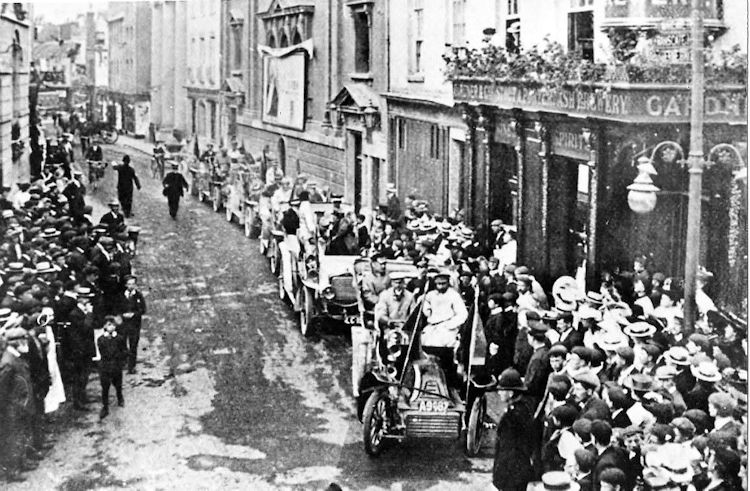
Above photo, Wednesday 2nd August 1905. Crowds gathering to witness
the visit of General William Booth, founder of the Salvation Army, kindly sent by Rory Kehoe. |
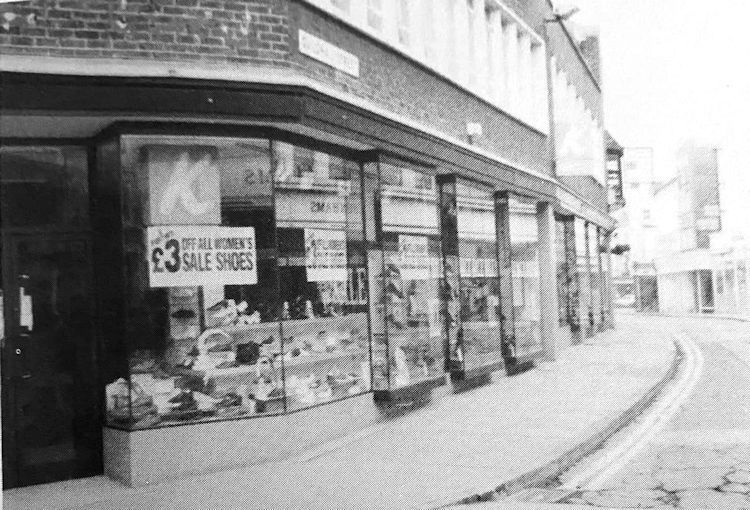
Above photo, date unknown, doesn't show the site of the pub, which
was on the other side of the road. The image actually shows where the
City Guildhall stood for c.700 years and where in 1765, a young Wolfgang
Mozart once performed. Sadly, after WW2, Canterbury City Council decided
not to effect necessary repairs on this ancient building and opted, in
1950, to order its demolition.
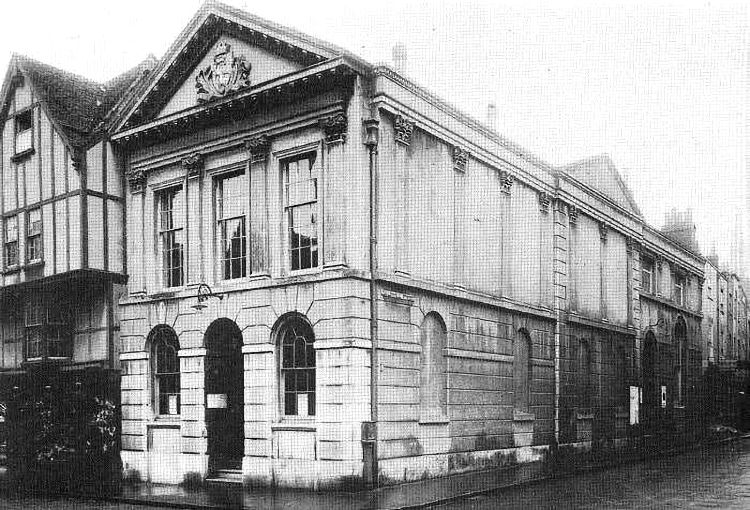
Above photo 1900 of Canterbury Guildhall, taken from more or
less the same angle as the other shot. Interestingly, at the very far
right of this photo, so at the rear of the Guildhall, stood a pub. In
its later days, this was known (unsurprisingly!) as the "Guildhall Tavern"
but prior to this, it may have been called the "Red Lion" - TBC. What I am
also unclear about is if the "Guildhall Tavern" then morphed into the "Ben
Johnson," or whether the "Guildhall Tavern" and "Ben Johnson" were
neighbours. Below is an annotated 1871 OS map of the Guildhall Street
area, showing the Guildhall and Guildhall Tavern.
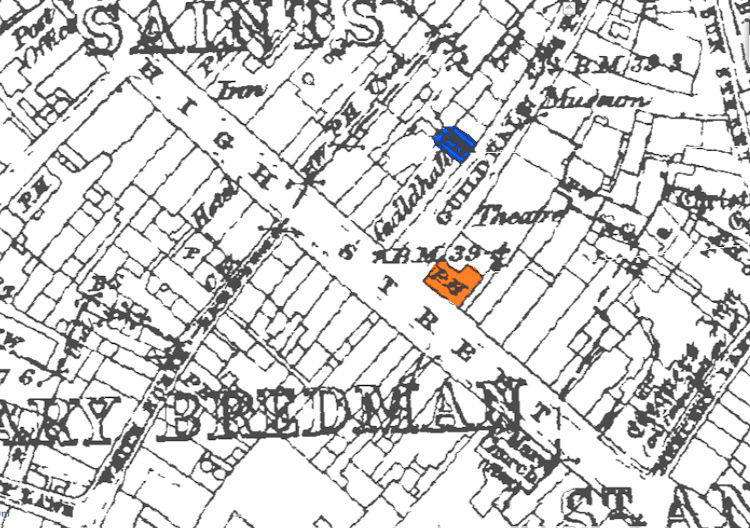
Blue is the Guildhall.
Orange is the Guildhall Tavern.
Kindly sent by Rory
Kehoe. |
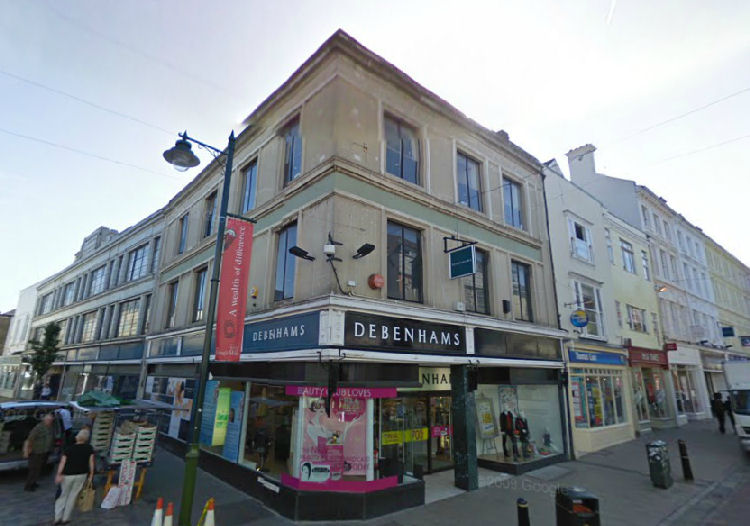
Above image from Google, July 2009, shows the building that is now
number 10 High Street. |
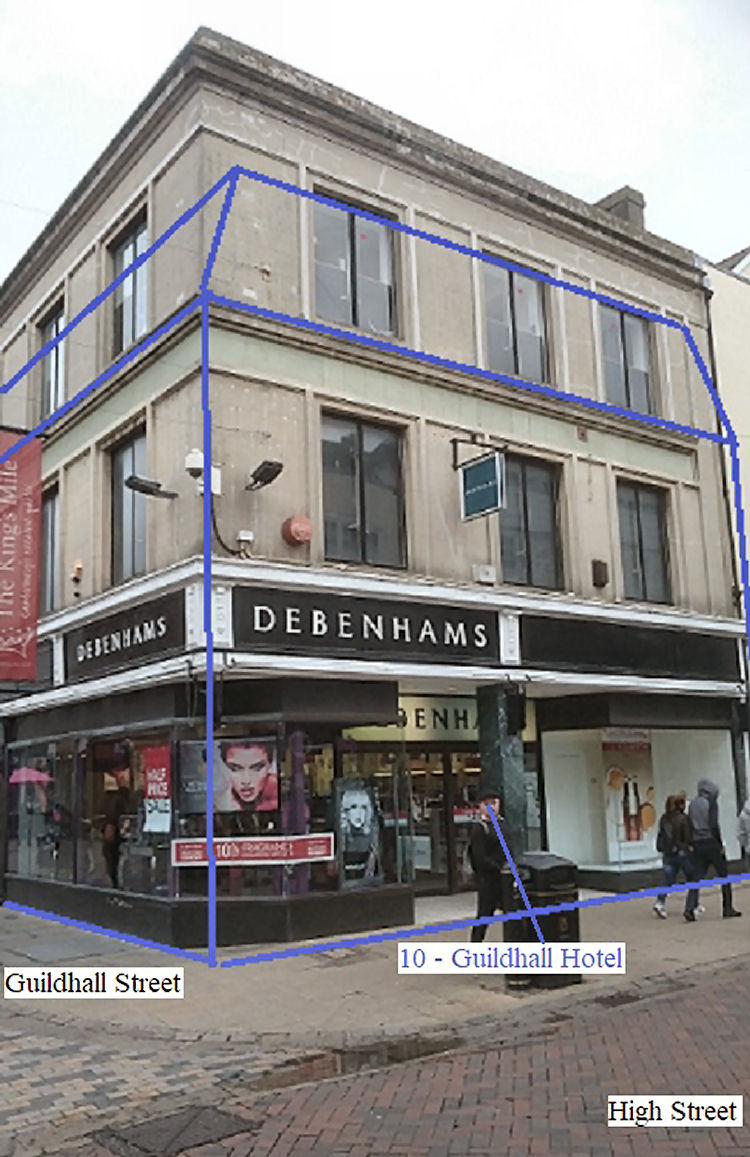
Above photo taken and sent by Rory Kehoe, October 2017. |
I have traced this establishment from between 1807 to 1908. Most if not
all the building has been demolished and rebuilt. In 1807 the premises was
host to a Masonic festival. By 1917 it
was operating as J. Hepworth and Son Ltd. Clothiers, outfitters and bespoke
tailors. The building is now part of Debenhams store chain the majority
being opened in towns and cities in the 1970s.
I believe there was also the "Guildhall
Tap" associated with this, under a different license.
|
From the Kentish Gazette, 27 July 1810.
About two in the morning of Wednesday last, the "Guildhall Tavern"
in this city, was providentially preserved from fire under the
following circumstances:- a person who lodged in the house, had gone
to bed and imprudently left a candle burning in one of the chairs
the flume of which communicating to his clothes, which were hung up
on the chair, set them on fire, and the stench of them burning
fortunately awoke him, when with a happy presence of mind, he
precipitated the remnants into the street from the window, and
thereby probably preserved the house with its inhabitants. The loss
upon this occasion, besides the whole of the clothes of the party
and the chair, is also 12 pounds in bank notes, which were in the
pocket of one of the garments consumed; trifling, however, compared
to the risque of the life of the persons at the Inn, none of which,
however, were aware of the event till their usual hour of arising in
the morning.
|
|
From the Kentish Gazette, 31 July 1810.
On Tuesday night, a person who occupied one of the bed-rooms at the
"Guildhall Tavern," in this city, incautiously left a candle burning
on a chair near the bed-side, where he had placed his clothes, which
in a short time after he had fallen asleep caught fire, and were in
part consumed before he was alarmed, he had the presence of mind on
awaking to stop the circulation of air through the room, and
prevented the fire from spreading, by flinging the burning remnants
of his garment a out of the window. The only damage sustained was
the loss of his clothes and bank notes to the amount of about twelve
pounds, which were in one of his pockets.
|
|
From the Kentish Gazette, 21 August 1810.
An unfortunate occurrence took place in this city about five in the
morning of Saturday last.
As two of the London night conches were passing up the High-street,
one of them drew up at the "Guildhall Tavern," and in endeavouring
to avoid the other, (which either from accident or design, pressed
too close on it; but which from the various reports stated to us we
are not able to judge), ran on the kerb of the pavement and was
overturned, at the moment when the coach which followed passed, and
the wheels went over one of the outside passengers (Mr. Buckenridge,
a Deal Pilot) one of whose legs was in consequence broken in two
places; he was immediately taken up, and with the assistance of some
of the inhabitants, who were awoke by the crash, curried into the
Tavern, where the bone was set, and we have the satisfaction to
state he is now in a fair way of recovery.
|
|
Kentish Gazette 1819.
Civil Side.
Wiltshire v. Evans.
Before Mr. Justice Park.
The Plaintiff in this case is proprietor of the "Guildhall Tavern"
at Canterbury; the defendant is a linen-draper residing in the same
city.
Mr. Gurney stated the case, and said that this action was brought to
recover the sum of of £12 the amount of a tavern bill incurred by
the defendant and others, for which he had undertaken to pay, but
when the bill was delivered to him he refused to do so.
It appeared that the defendant had invited several friends to dine
with him, that he ordered the dinner at the "Guildhall Tavern,"
which was had, and after dinner they took wine, fruit, &c amounting
to the sum now sought to be recovered.
Upon the evidence of one of the plaintiffs witnesses, however, it
appeared that a credit for the account was also given to one Dennis
Griffiths, as well as to defendant, who have become insolvent, and
the account was sent into Evans.
Mr Justice Park said:- "In my opinion the plaintiff cannot sustain
this action, on account of the credit being given to Mr. Griffith
and Mr Proctor.
Call the plaintiff."
|
|
Kentish Weekly Post or Canterbury Journal - Tuesday 21 January 1823.
Guildhall Tavern. High Street, Canterbury.
Henry Jones, having recently taking the above Tavern, lately conducted
by W. Wiltshire, respectfully informs the public that it will be his
endeavour by unremitting attention, and superiority of accommodation at
moderate charges, to merit a share of their support.
Wines and spirits of the best quality direct from a docks.
Very fine flavoured London Porter, and Ale of superior quality.
Dinners, Suppers, &c. provided on the shortest notice.
Families in the City and Suburbs supplied with Porter and Beer at any
hour.
Orders taken at the bar will be punctually attended to.
A horse and chaise to let. An ordinary every Saturday at 2 o'clock.
N. B. Good Beds and Stabling.
Superior travelling by the Telegraph Light Four Inside Post Coach, at
reduced fares. Every morning at a quarter before 9, from the above
house, in 7 hours, to the Saracens Head, Skinner Street, Snow Hill;
Shepherd's Globe Office, Gracechurch Street; Gloucestershire Coffee
House, Piccadilly; and Green Man and Still, Oxford Street.
Coaches regularly to Dover, Deal, Margate, and Ramsgate every afternoon.
|
|
From the Kent Herald, 3 January 1828.
On Saturday se’nnigbt Sarah Marrable was committed to the gaol of this City,
charged with stealing a silver table spoon, the property of Mr. Jones, of the
"Guildhall Tavern." The spoon being missing, search was made for it at the
various silversmiths' shops, without success; at length it was traced to the
possession of Mr. Mordica Hart, silversmith, broke in pieces. On the examination
it appeared, that it had been offered to another person, in three pieces; but
Mr. Hart declared that he only purchased two, which on weighing, proved to be of
less value than he had given for them; he accounted for this circumstance by
saying, that be made it a practice to give the utmost value to poor persons. The
circumstances appearing to the Mayor and Justices very suspicious, held Hart to
bail in the sum of £40, and two sureties in £25 each, to answer to any
indictment at the Sessions.
|
|
From the Kentish Gazette, 12 July 1836.
TO BE LET, With Immediate Possession.
THE "GUILDHALL TAVERN and ASSEMBLY ROOMS," situate in the centre of the
City of Canterbury.
The above Tavern, at which the Union London and Herne Bay Coaches, and
Margate, Sittingbourn, and
Hythe Vans start from, possesses every convenience for carrying on a
good Tavern business, which,
combined with the commanding situation, presents a favorable opportunity
for an active person. The Catch
Club is held in the above Rooms every Wednesday during the season.
For particulars, &c. apply, if by letter, post paid, to Mr. H. Jones,
Guildhall Tavern, Canterbury.
|
|
From the Kentish Gazette, 15 May 1838.
Meeting of the Commissioners of Pavement.
On Wednesday a meeting of the Commissioners of the Canterbury Pavement
was held at the "Guildhall," Mr. Christian in the chair.
Mr. Matthews moved that £500 be paid in liquidation of the debt. This
was seconded by Mr. Chenoweth. Mr. Ridout moved, as an amendment, that
threepence in the pound be laid aside for this purpose. Seconded by Mr.
Williamson. Mr. J. S. Browne thought that no money ought to be set apart
until they knew the exact state of their funds. Alderman Cooper was of
opinion that it would be better to contribute the surplus, if any, to
assist in paying the police of the city. After some discussion, both the
motion and the amendment were withdrawn. Mr. J. S. Browne then moved
that the accounts of Northgate-street and North-Lane be audited by the
Committee, to see if any, and what, allowances could be granted, and
report the same to the next meeting. Seconded by Alderman Masters.
Alderman Cooper moved that the Repair Committee examine the pavement of
Castle-street, from Rosemary-lane to the "Castle Inn," the same being in
a very dangerous state, and that it be McAdamized. Seconded by Mr. J. S.
Browne. Also that a barrel-drain be made in Castle-row.
Mr. Smith applied for a barrel-drain from Gravel-lane to Watling-street.
Alderman Cooper proposed it be submitted to the Repair Committee.
Mr. J. S. Browne stated that he would give the Court notice at the next
meeting of their arrangements which had been commenced for improving
Saint George’s-street, and the probable amount of the whole cost; and
that at the next meeting he would move for a grant of money to carry
into effect the contemplated improvements in St. George’s-street, in the
purchase and removal of the premises now occupied as the "Globe Tavern,"
&c.
|
|
From the Kentish Gazette, 18 August 1840.
Mr. M. Jacobs, the celebrated illusionist and ventriloquist exhibited
his surprising powers to a very numerous audience last evening at the "Guildball
Tavern." We believe we may safely affirm Mr. Jacobs to be the most
talented man of his profession now in England. The Mayor patronizes the
performances on Thursday evening.
|
|
From the Kentish Gazette, 19 September 1843.
VALUABLE AND IMPORTANT FREEHOLD ESTATE.
The "GUILDHALL TAVERN" and CONCERT ROOM, KENT HERALD PRINTING OFFICE,
modern DUELLING HOUSES, WINE VAULTS, and other Premises, in the City of
CANTERBURY, producing a Rental of £300 per Annum.
Messrs. WHITES and GOULDEN Have received instructions to submit to
PUBLIC AUCTION, ON THURSDAY, the 5th of October, 1843, at Two o'clock in
the afternoon, at the "Royal Fountain Hotel," Canterbury, in One Lot (by
the direction of the Mortgagees under their power of sale.)
A very desirable FREEHOLD PROPERTY, the whole of which is of modern and
substantial erection; comprising the "GUILDHALL TAVERN" and spacious
CONCERT ROOM, with the Wholesale and Retail WINE and SPIRIT
ESTABLISHMENT and extensive WINE VAULTS, the KENT HERALD PRINTING
OFFICES, with excellent and modern DWELLING HOUSE, BANKING OFFICES, with
superior accommodation, and other extensive Premises, eligibly situated
for business in the leading thoroughfare (being the corner of Guildhall
Street and High Street) of the City of CANTERBURY.
The Premises occupying a frontage in Guildhall Street of 131 feet, and
in High Street of 52 feet; are in good repair, upwards of two thousand
pounds having been expended on them in recent improvements; and are in
the respective occupations of the Trustees of the London and County
Bank, the Proprietors of the Kent Herald Newspaper, and of Mr. Henry
Jones and his undertenants.
The whole Estate will be sold subject to the payment of at Annuity of
£150 per Annum during the life of Mrs. Elizabeth Wiltshier, who is now
in her 78th year.
May be viewed on application to the several Tenants; and printed
particulars and conditions of sale had of Messrs. Robert and George
Furlky, Solicitors, or the Auctioneers, Sun street, Canterbury.
|
|
From the Kentish Gazette, 14 May 1844.
DEATH.
May 5, George Frederick, son of Mr. George Oakenfull, landlord of the
“Guildhall Tavern,” in this city, in his fourth year.
|
|
South Eastern Gazette,10 January, 1860.
THE GUILDHALL TAVERN AND HOTEL.
IN the centre of the HIGH STREET, CANTERBURY, is NOW OPEN.
GEORGE STONE, Proprietor.
|
|
From the Kentish Chronicle and General Advertiser, 15 February, 1862. Price 1 1/2d.
CANTERBURY POLICE COURT. MONDAY.
A man named Thomas Wraight, a maltman was charged with creating a
disturbance on Saturday night, P.C. Fowler deposed that, on Saturday
night, he was called to the bar of the “Guildhall Tavern,” where he
found the defendant creating a great disturbance. He was the worse for
liquor. It appeared that the defendant is known to be quiet and
generally a peaceably deposed man. Several of the police offices spoke
to his good character, and the Bench accordingly ordered him to be
discharged.
|
|
From the Kentish Chronicle, 2 January, 1864.
GUILDHALL TAVERN, CANTERBURY. MARY ANNE STONE.
Begs leave to return her sincere thanks to the Inhabitants of Canterbury
and its neighbourhood, for the kind support bestowed for so many years
upon her late husband. Mrs. Stone intends continuing on the business
herself, and trusts that by giving every attention to the comfort of her
Friends, and by supplying Articles of n First-rate Quality, to continue
to receive their kind support.
December 30th 1863.
|
|
From the Kentish Chronicle, 26 March, 1864.
ROBBERY AT THE GUILDHALL TAVERN.
A robbery was committed at the house of Mrs. Stone, the “Guildhall
Tavern,” Canterbury, on Friday night. Property to a considerable value
was stolen, and we regret to add that the thieves have, as yet, escaped
detection. It appears that, on the third floor there is a room used
generally as a dressing room by Miss Cooper, niece of the landlady, and
on Saturday morning, when the servant went to dust the things in this
room she found the door locked. The circumstance excited attention as it
was very unusual, and on enquiry being made it was found that Miss
Cooper had not locked the door. The key could not be found, but with the
assistance of a workman from Messrs. Saxby’s, ironmongers, an entrance
was obtained. It was then discovered that a robbery had been committed.
Miss Cooper’s writing desk was found broken open. All the drawers had
been ransacked—three or them, which had been left locked, having been
broken open. Property to the value of £15 or £16, including a purse
containing £1 6s. 6d. was taken. The articles stolen comprise a massive
black chain, three brooches, seven bracelets, two pairs of ear-rings, a
scent bottle with a silver top, a silver pencil-case, a number of old
coins, &c., and several articles of apparel. Various conjectures have
been thrown out respecting the way in which the robbery was effected.
|
|
From the Kentish Gazette, 22 August 1865 Canterbury
1.bmp"
GREAT FIRE IN CANTERBURY.
£15,000 WORTH OF PROPERTY DESTROYED.
The observation we have so frequently heard of late respecting
the few casualties from fire in Canterbury is true no longer. There
have been three serious fires in as many months, and the last, the
particulars of which we are now about to record, exceeds in
magnitude any similar visitation during the present century. About
half-past 8 o’clock on Friday night a fire was discovered to have
broken out in High Street, and before its ravages could be stayed
the extensive shop and premises of Mr. Pout, auctioneer and
upholsterer, as well as those of Mr. J. Abrahams, glass and china
dealer; Messrs. Colcock, confectioners; the South Eastern telegraph
office; and Mr. Eastes, music seller and pianoforte manufacturer,
were reduced to a smouldering heap of ruins; the house and premises
of Mr. Harvey, chemist, were gutted and otherwise so much injured
that they will have to be rebuilt; and the Kent Herald office was
partially taken down to have the "Guildhall Tavern," the shop of Mr.
Stapleton, in Guildhall Street, and the Theatre Royal. But the
catalogue of destruction is not yet complete. The shops in
Mercery-lane had a narrow escape. Indeed the flames had at one time
got rather strong hold of Grafton House, occupied by Mr. Wood,
draper, and the back of the premises of Mr. Hal Drury, bookseller,
both of which are greatly damaged. Mr. Wood’s stock was very much
injured by water. The establishment of Messrs. Higham and Hunt was
also in imminent danger, and a considerable portion of the stock was
removed as a precautionary measure. The back premises extended to
within a few feet of the burning buildings, and it was only by the
untiring efforts of a number of willing assistants that the fire was
prevented from communicating to the mantle and show rooms. Mr.
Cladish, grocer, Mr. Matthews, dealer in fancy wares and toys, and
Messrs. Claris and Sons drapers, were also sufferers to a minor
extent from the action of water and the adoption of precautionary
measures. The residents in Sun Street were in a state of the
greatest excitement and alarm, and some of them also removed
portions of their stock and furniture.
The property facing into Mercery-lane and also into High-street,
as far as Mr. Pout's premises shown on the plan, was an hostelry,
known as the "Chequers" in the days when the shrine of Thomas a
Becket attracted such numbers of pilgrims to the City. By the
pilgrims the hostelry was mainly supported, and it is recorded that
its accommodation comprised dormitories containing over a hundred
beds. The hostelry was immortalised by the poet Chaucer, who was
among the celebrities drawn to Canterbury by the fame of its
antiquities and religious associations. After the falling off of its
trade the "Chequers" became divided into different properties, for
the purposes of general trade, the partitions in many cases being of
a rather enatic character. This will account for the complicated way
in which some of the premises run into and overlap each other. A
great portion of the front shops have been re-built and adapted to
modern requirements; but the workshops of Mr. Pout were an
unmodernized portion of the dormitories of the original "Chequers"
the roofs especially were of a very curious character, and few
visitors of note have left Canterbury of late years without
inspecting them. The portion of the wall now standing among the
ruins is part of the original building, traces of which may also be
seen on the premises of Mr. Wood, Grafton House, and on other
premises in Mercery-lane.
So far as we have been able to ascertain, the fire broke out in
Mr. Pout’s workshops, which, as may be seen from the plan, extend
along the rear of Messrs. Colcock’s bakery, and over a portion of
the premises of Mr. Joel Abrahams, glass and china merchant, which,
together with the South Eastern telegraph office, and the shop and
workshops occupied by himself, belong to Mr. Pout. The premises
occupied as well as owned by Mr. Pout were three storeys high to the
front, and over the workshops in the rear were extensive attic rooms
used for the storage of hair and feathers. The workshop in which the
fire broke out was lighted from the passage shown on the plan in the
rear of the houses in Mercery-lane, and the names were first
observed by a domestic servant in the employ of Mr. Wood. An alarm
was at once raised and a crowd speedily collected. Messengers were
dispatched for the fire engines, several of which arrived on the
spot in a short time, but some delay occurred before they got into
play. The Cathedral engine was the first in position, and was ably
handled by the Cathedral workmen aided by a squad of the 6th K. R.
V. under Ensign Flint. The Corporation engine, under the control of
the police, and the engines of the Kent and Phoenix Fire Offices,
the South Eastern and London, Chatham, and Dover Railway Companies
successively arrived and took up commanding positions, and ere long
the engine of the Barracks, with a strong body of military under the
command of Colonel Custance followed suit. We may take this
opportunity of saying, that though, owing to some misunderstanding
the military fire brigade were not on the spot so early as they
might have been, they worked admirably during the night not only
with their engine but in removing property. Several officers also
took a prominent and active part. Later in the night engines arrived
from Ashford, Faversham, and Ramsgate, but not in time to be of much
service.
When first discovered the fire had got firm hold of the building
in which it originated, and during the time which elapsed before the
engines got into play it spread rapidly. The removal of stock and
furniture from the shops in High Street was carried on vigorously,
the church of St. Mary Bredman, on the opposite side of the street,
being kindly thrown open by the Rev. T. S. Huxley, and temporarily
converted into a warehouse. Henry Mount, Esq., and others also
kindly threw open their houses to receive goods, and large
quantities of stock and furniture were saved, though to some extent
in a damaged state. From Mr. Pout’s workshops the fire extended
first to Mr. Abrahams’s premises, and afterwards in rapid succession
to those of the Telegraph Office, Messrs. Colcock, and Mr. Pout’s
front shop, and by half-past eleven o’clock nothing was left
standing of these except a portion of a wall and two stacks of
chimneys which towered up from the wilderness of blazing ruins. From
10 to 11 o’clock, when it became evident that nothing could save the
above buildings, the attention of the firemen was directed to saving
the shops in Mercery-lane, from which large quantities of stock had
been removed, and in this they were successful, though at one time
the flames had got considerable hold of Grafton House, and the rear
of Mr. Drury’s shop. Such of Mr. Wood’s stock as was not removed,
was very much damaged by water, and Mr. Drury, Mr. Cladish, Messrs.
Higham and Hunt, Mr. Matthews, and Messrs. Claris and Son suffered
heavily from the same cause. The hose from two fire engines were
conveyed through Messrs. Higham and Hunt’s shop to play on the
blazing pile behind, and these, together with the hose from an
engine in Sun Street, carried over the adjoining buildings, rendered
very material service.
But it was in the direction of Guildhall-street fire appeared to
extend most determinately, and not withstanding the most energetic
and well-sustained efforts to arrest its progress, fears were at one
time entertained that the "Guildhall Tavern," Mr. Stapleton’s shop,
the Theatre Royal, and the Working Men’s Club would all be
destroyed. About twelve o’clock the fire got firm hold of the
premises of Mr. Eastes, beating back the firemen who had previously
occupied positions on the roof; and about the same time orders were
given to pull down the premises occupied by Mr. William Davey, jun.,
publisher of the Kent Herald. About two o clock the front of Mr.
Eastes’ house, the last portion to succumb to the fire, fell down
with a tremendous crash, an officer and two soldiers narrowly
escaping being buried in the ruins. From this time the engines
appeared to make head against the fire, which was got under by three
o’clock; the back and upper portions of Mr. Harvey's premises were
gutted, and the whole so much damaged, that they will have to be
taken down. The ruins continued to burn all day on Saturday, and
even so late ns Sunday night the fire-engines had to be got out
again to extinguish flames which had burst out afresh. We understand
that on Sunday night there was some difficulty about obtaining
water, the authorities at the Gas Works declining to set the men to
work the pumping engine without being guaranteed the "payment of
something extra for the men." This involves a complaint of a very
grave character against some one, and we trust the circumstances
will be strictly investigated.
We have heard various, and some very extravagant estimates of the
value of the property destroyed; but at computation we do not think
that, at a moderate calculation, it will exceed £14,000 or £15,000.
The loss will fall most heavily on the Sun Fire Office; but portions
of the property destroyed and stock damaged were insured in the
Kent, the Phoenix, the Norwich Union the Law, the County, the
London, and the Royal Fanners' Offices. Mr. Pout, who, as above
stated, was the owner of the premises in his own occupation, and
those of Mr. Abrahams and the Telegraph Office had an insurance in
the Sun for £2,600 on the buildings, and £2,135 on his stock; and
Mr. Abrahams had an insurance of £600 on his stock, being very
little more than one-third of its value. Messrs. Colcock had an
insurance of £900 on their premises; but their stock, a portion of
which was saved, was not insured. The premises occupied by Mr.
Eastes, owned by Mr. Pemell, were insured in the Sun for £700, but
we have not ascertained whether any portion of the stock be insured.
Mr. Harvey, who is the owner of the premises occupied by himself,
was insured in the Norwich Union, for building and stock, to the
amount of £---- The Kent Herald office, which, together with the
"Guildhall Tavern," the shop occupied by Mr. Stapleton, and the
theatre belong to T. S. Cooper, Esq., was insured in the Phoenix for
£250, and the stock in the Kent for £300; Mr. Davey had a separate
insurance in the Phoenix for £450. Grafton House, belonging to Mr.
W. Plummer and Mr. Parrot, and occupied by Mr. G. Wood, draper, is
insured — Mr. Plummer's portion of the building, in the Kent, for
£1,400; and Mr. Parrot's portion, in the Sun, for £800. The damage
done to the building is confined mainly to the portion belonging to
Mr. Plummer. Mr. Wood, the tenant, has an insurance for £2,500 on
his stock. The premises occupied by Mr. Drury, owned by Mr. T.
Blackburn, are insured in the County for £1000, and those of Mr.
Cladish, grocer, who is the owner and occupier, in the Sun for £600
and the stock in the same office for £1,200. The premises of Messrs.
Higham and Hunt, owned by Mr. M. Martin, are insured in the Sun for
£1,400, the tenants insuring their stock to the extent of £8,000,
£2,000 in the Norwich Union, £1,200 in the Sun, £2,600 in the
London, and £2,500 in the Royal Farmers.
The church of St. Mary Bredman and the houses on the south side
of High-street, were considerably damaged by the heat, and fears
were at one time entertained that they would catch fire.
|
|
From the Whitstable Times and Herne Bay Herald, 20 April, 1867. Price 1d.
EVADING THE CITY TOLLS.
Thomas Dalby Reeve, a lemonade and soda water manufacturer, of Margate,
was charged with an offence, viz., refusing to pay a toll of 1s. for a
cart which was driven to and from Canterbury and Margate, for the
purpose of hawking lemonade and soda water in the city.
Mr. Flint appeared for Mr. Solomon, and said this case was somewhat
differed from the others, and it would therefore require more
consideration.
Mr. Reeve pleaded not guilty, and defended himself. He said that under
the 49th section of the Markets Act, and under the 109th section of the
Public Health Act, the Bye-Laws were compelled to hung up for
inspection. He said, before going into the case, it was necessary to
prove that the Bye-Laws had been printed and hung up.
Mr. Flint was then sworn and deposed that the printed Bye-Laws had been
hung up in a conspicuous place ever since the Local Board passed them.
He then called George Stone, who said he assisted at the “Guildhall
Tavern.” His mother dealt with Mr. Reeve for lemonade and soda water.
Mr. Reeve generally called on them once or twice a week and asked if
they required any of the articles he dealt in. He thought the cart was
in Canterbury on the 8th of April, the day named in the indictment. He
was sure the cart was in last week. They always paid for what they had
at the time of its delivery.
Cross-examined by Mr. Reeve:- I do not know the defendant is a wholesale
dealer. We have always paid for the articles at the time they were
ordered.
The witness not being able to swear to what day defendant was in last,
the Magistrates dismissed the case.
(Read a further case against Thomas Dalby Reeve)
|
|
From the Whitstable Times and Herne Bay Herald, 4 May, 1867. Price 1d.
ASSAULT.
George Stone was charged with assaulting his mother on the 24th inst, in
the “Guildhall Tavern.”
Mrs. Stone, who appeared in a fainting state, said that on the night in
question defendant and his wife were in her house. She heard a
disturbance in one of the rooms, and on her going to see what it was
defendant struck her. She then gave him in charge to P.C. Marsh, who was
passing at the time.
Prisoner said he was in the hones with his wife, and P.C. Marsh came and
interfered with them. He was very sorry for having struck his mother.
The Mayor said it was a very painful thing to see a man in such a
position charged with striking his mother. He intended to dismiss the
case if defendant would promise to leave the house.
Defendant haring consented to this.
The Mayor asked Mr. Davey, who attended on behalf of Mrs. Stone, if he
thought she would be content with this.
Mr. Davey said that prosecutor only wished for authority from the
Magistrates to deny defendant admission to her house.
Prisoner again promised that he would not enter the house again.
|
|
Canterbury Journal, Kentish Times and Farmers' Gazette, Saturday 23 September 1882.
Sudden Death.
Henry Port, aged 72 years, one of the employees of Messr's Shaxby,
of the "Guildhall Hotel," died very suddenly
on Saturday. Deceased who was highly esteemed by his fellow workmen,
started to drive to Faversham, but was
seized with a fit before he arrived at his destination. This
entirely bereft him of speech and motion, but the
horse knowing the road the journey was safely accomplish.
Ascertaining the condition of Port, Mr. Henry Shaxby
at once drove him to Canterbury, but the poor man died soon after
his arrival at home. Deceased was a married
man.
|
LICENSEE LIST
WILTSHIRE William 1807-23
JONES Henry 1823-40+
     
GILES Thomas 1841+ (also oyster merchant age 45 in 1841 ) )
OAKENFULL George 1844+
CLEMENTS Henry 1851-58+ (age 39 in 1851)
VINCER Edward to Mar/1860

 STONE George Mar/1860-Jan/64
(age 56 in 1861)
STONE George Mar/1860-Jan/64
(age 56 in 1861)

STONE Mary Ann Jan/1864-67+

SHAXBY BROTHERS 1868+

SHAXBY Harry 1871+ (age 30 in 1871)
SHAXBY BROTHERS 1874-82+
  (Soda water and lemonade manufacturers) SHAXBY Robert (age 35 in 1881)
STRATFORD G Russell 1889-91+
 (Wine and Spirit merchants)
O'GRADY Edmund 1901+ (age 31 in 1901)
FALCON Graham 1903+
 
https://pubwiki.co.uk/Guildhall.shtml
http://www.closedpubs.co.uk/guildhall.html
From the Pigot's Directory 1824
From the Pigot's Directory 1828-29
From the Pigot's Directory 1832-33-34
Stapleton's
Guide 1838
From the Pigot's Directory 1840
From the Post Office Directory 1862
Greens
Canterbury Directory 1868
From the Post Office Directory 1874
From the Post Office Directory 1882
From the Post Office Directory 1891
From the Post Office Directory 1903
From the Kelly's Directory 1903
 From the Post Office Directory 1913 From the Post Office Directory 1913
 From the Post Office Directory 1922 From the Post Office Directory 1922
 From the Post Office Directory 1930 From the Post Office Directory 1930
 From the Post Office Directory 1938 From the Post Office Directory 1938
Historic
Canterbury web site www.machadoink.com
Census
Kentish Gazette
Kentish
Chronicle
|

