|
12-14 Tower Hill
31 Tower Hill

Dover
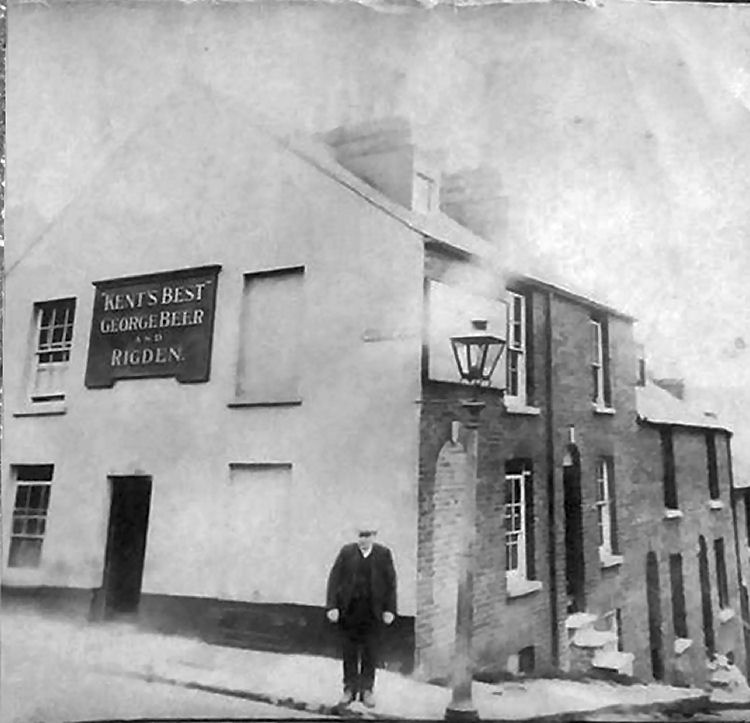
Above photo date unknown, kindly sent by Ann Bates. |
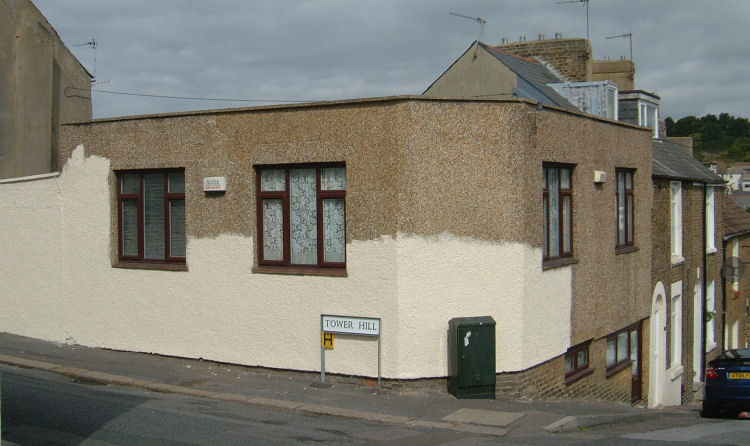
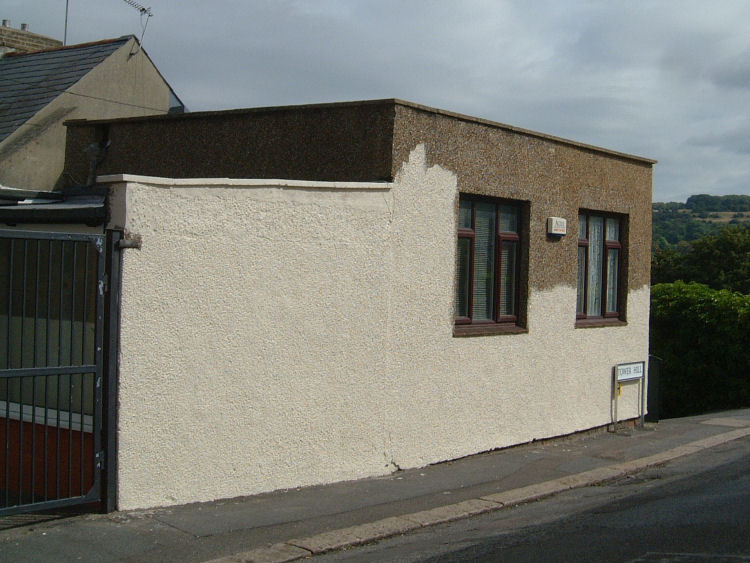
Photos above by Paul Skelton, 12 August 2009.
You can see from the top photo where the bomb must have his the
corner pub. Tower Hill actually goes along the road as well as down the
hill. The house next door on the left being number 10. |
Active previous to 1850. I saw it referred to several
times as "William 1st" and earlier in the century the number was 31. It was
an outlet of George Beer and Rigden when it was struck by an enemy shell on
10 December 1942.
|
From the Kentish Gazette, 23 May 1865.
DOVER. Sale of Property.
At the sale of property by Messrs. Worsfold and Hayward, on
Thursday, only Lot 1 was disposed of, the "King William"
public-house, Tower Hill, in the occupation of Mr. J. Burbridge,
which sold for £220. The remainder of the lots are to be disposed of
by private contract.
|
|
From the Southeastern Gazette, 16 January 1866.
Shocking Suicide of a Young Married Woman.
On Tuesday an inquest was held at the “King William,” Dover-hill, on the
body of Ann Dixon, of 45, Tower-street. It appeared that the deceased,
who had been in but indifferent health, had got into arrears through
loosing a small sum of money a short time ago, and having concealed the
circumstance from her husband, it preyed upon her mind in such a way as
to bring her into a state of morbid dejection. Although she relieved
herself on Sunday by confiding to her husband, said to be an honest,
kind-hearted, labouring man, what had weighed upon her spirits, it did
not serve to dissipate the effects of her previous concealment, and on
Monday afternoon she was found in the garret of the house she occupied
with a frightful gash in her throat, inflicted by a razor which was
lying by her side as it had dropped from her hand. To all appearances
the unhappy woman must have deliberately laid herself down on the floor,
and having first obtained a pillow to support her head, inflicted upon
herself the terrible injury which caused her death. The coroner, in
summing up, remarked as to the evidence of deceased’s state of mind,
that it was quite possible she had been unduly affected by the
circumstance of her losing the money as described; for although it was a
small sum, it seemed that it was sufficient to interfere with her weekly
payments. If she was a woman of high principle — and she seemed to be
well spoken of by her neighbours — this might have been sufficient to
interfere with her composure and morbidly affect her mind. The jury
returned a verdict of Temporary Insanity.”
|
|
From the Dover Express and East Kent Intelligencer, 23
December, 1870. Price 1d.
DEATH FROM EXCESSIVE FEEDING
On Wednesday evening last the borough coroner, W. H. Payn, Esq., held
an inquest at the "King William" public house, Tower Hamlets, on the
body of an infant, William John Brace, the child of a journeyman
carpenter living in Tower Street, which had been found by its mother
lying dead upon her arm, on awaking the previous morning. It appeared
from the evidence, that the child had been weakly from its birth, and
that the mother, contrary to the recommendations of the doctor who had
attended it (Dr. Gill), persisted in giving it thickened food; and as
the doctor considered that this practice had accelerated the child's
death he declined to give a certificate, and an inquest thus became
necessary.
Mr. P. Mackleden having been chosen foreman of the jury, and the body
of the child having been viewed, the following evidence was given.
Mary Ann, wife of Osborn Brace, a carpenter, in the employ of Messrs.
Adcock and Rees: The deceased, who was five months and a fortnight old,
was my youngest child. It had been very delicate from its birth. I have
always nursed it myself. I did not notice anything more than usual the
matter with it up to yesterday morning, when, on awaking, I found it
dead upon my arm. My husband was not at home at this time. He is working
at Eastry, and returns only on Saturday. I nursed the child last thing
the night before, and it went to sleep on my arm, where it remained all
night. I was not aware, on waking, that it was dead; but on endeavouring
to shift it from my arm I found that its head was stiff, and I then
discovered what was the matter. I sent for Dr. Gill, who came between
ten and eleven; but he did not see the child. I told him it was dead,
and he went away. Dr. Gill said that it had died because I had fed it. I
told him what I had given the child, viz., corn-flour and milk, and
biscuits. I had given it some of this food at nine o'clock the night
before.
The Coroner: How much?
Witness: A large cup, a breakfast cup, full.
Coroner: Were you in the habit of giving it so much as that?
Witness: Yes, I have always given it about that quantity.
The Coroner: And your other child, when it was young?
Witness: Yes.
The Coroner: Had you found any ill effects from such food before?
Witness: No, sir.
Examination continued: The corn-flour was well boiled - for ten
minutes - and was cooled with milk. I am quite sure I did not lie upon
the child. It was upon its back, on my arm, when I awoke, and the face
was turned away from my body. I did not know the cause of death.
By the foreman: The child was alive at 5 o'clock when I suckled it.
Dr. J. B. Gill: I am a surgeon residing and practising in Dover.
Yesterday morning I was sent for to see the deceased child. On arriving
at the house, the mother informed me that the child was dead. I attended
the child some three or four months ago, and I then informed the mother
that it was naturally a weakly one, and that if fed on anything other
than its natural food it could not live. I have this day examined the
child's body, and state that I believe it to have died from congenital
weakness and that its death was hastened by improper food. I have
refused a certificate in this case in order that, if it is made public,
many other obstinate mothers may be deterred from the practice of
feeding their children on this description of food.
Dr. Gill, after his disposition had been taken, explained to the
Jury that he had taken the unusual course of withholding a certificate
in this case in consequence of the great prevalence of the practice he
had referred to. Mothers would insist on feeding their children with
thickened food, and the consequences was that the weakly ones, one and
all, died. Some survived in spite of their unnatural treatment; but the
weaker ones infallibly perished.
A Juryman enquired what a mother was to do, if, she was unable to
nurse the child herself.
Dr. Gill replied that, the next best thing to the natural diet of the
child was milk and water sweetened. The natural diet of the infant was
animal food in the lightest possible form, and the most unnatural was
vegetable food. In the case of delicate children its digestion was
impossible, and here was a case in which a child had actually been
famished with its belly full of food.
After the retirement of the medical witness, the Jury deliberated for
some time upon their verdict. Most of them remained unconvinced by the
theory advanced by Dr. Gill, one Juryman stoutly persisted that his
children were the most delicate children possible, but had not
withstanding survived the ordeal of corn-flour - "made thin and from a
bottle." The only thing which seemed to strike the Jury was the quantity
of thick food which had been given in this case; and they all concurred
in thinking that a breakfast cup was too much. Hence they considered
that, if they submitted the word "improper" in the doctor's evidence
for the word "excessive," they would be arriving at the real cause of
death.
The following, therefore, was the verdict: "That the death of the
infant, William John Brace, arose from congenital weakness, accelerated
by excessive feeding.
|
|
From the Whitstable Times, 31 December, 1870.
CORONER’S INQUEST.
On Wednesday afternoon W. H. Payn, Esq., borough coroner, held an
inquest at the “King William Tavern,” Tower-hill, Charlton, on the body
of a child named William John Brace. The mother of the child, Mary Ann,
wife of Mr. Osborn Brace, carpenter, deposed that deceased was 5 months
and fourteen days old, and had always been very delicate. She gave the
child the breast at five in the morning, which was lying on her arm when
she dosed into a sleep. At ten minutes to seven she awoke; the child,
with its face from her breast, was lying on its back, quite dead but not
cold. As usual, the previous evening at nine o’clock she gave it a large
cup full of cornflour and milk. Dr. Duke, who was immediately sent for,
said the child was naturally weak, and that he attended it three or four
months ago; he then told Mrs. Brace if she continued to feed the child
on any other diet then natural food, it could not live. It died from
congenital weakness, its death being hastened by improper food. He said.
“I refused a certificate in this case in order that if it were made
public, many other obstinate mothers might be deterred from the same
practices, verdict accordingly.
|
LICENSEE LIST
TERRY Charles 1847
DOWLE 1850
 BRACKENBURY William Palmer 1850-52
 (age 43 in 1851
 ) )
HUDSON George H 1852
POUT 1860-Mar/64 
BURBRIDGE John Edmund Mar/1864-82 (age 42 in 1881)  
FASSUM John William 1891-1910 (age 58 in 1891)
 (
also general stores) (
also general stores) 
FASSUM Miss Emily Jane 1913-Apr/1914

GORE George Apr/1914-30+
   (Former railway parcels carman)
TOZER T 1932+

COLE A J 1936-41 end
 
From the Post Office Directory 1874
From the Post Office Directory 1882
From the Kelly's Directory 1899
From the Post Office Directory 1901
From the Post Office Directory 1903
From the Kelly's Directory 1903
From the Post Office Directory 1913
From the Post Office Directory 1922
From Pikes Dover Blue Book 1924
From the Post Office Directory 1930
From Pikes Dover Blue Book 1932-33
From the Post Office Directory 1938
From Pikes Dover Blue Book 1938-39
From the Dover Express
Census
|

