|
Victoria Parade
Ramsgate
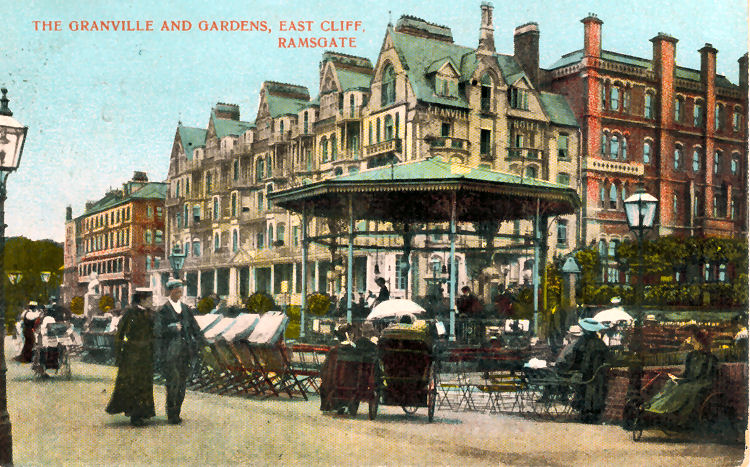
Above postcard date unknown, kindly sent by Michael Coomber. |
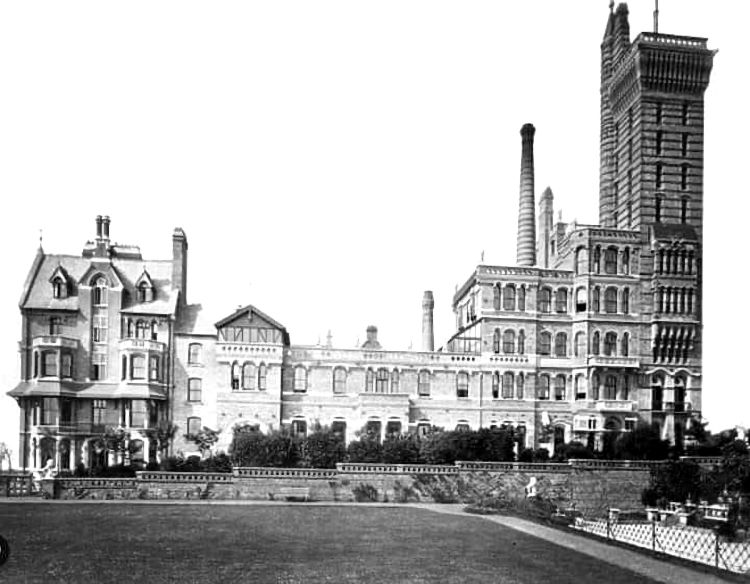
Above photo, date unknown. |
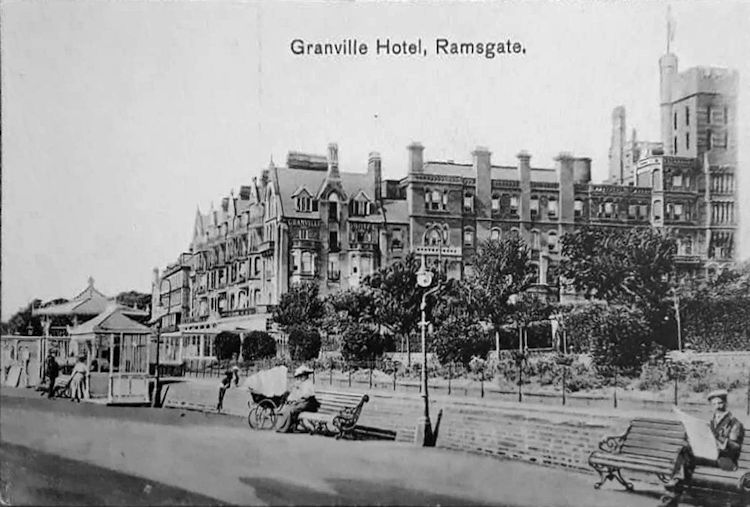
Above postcard, date unknown. |
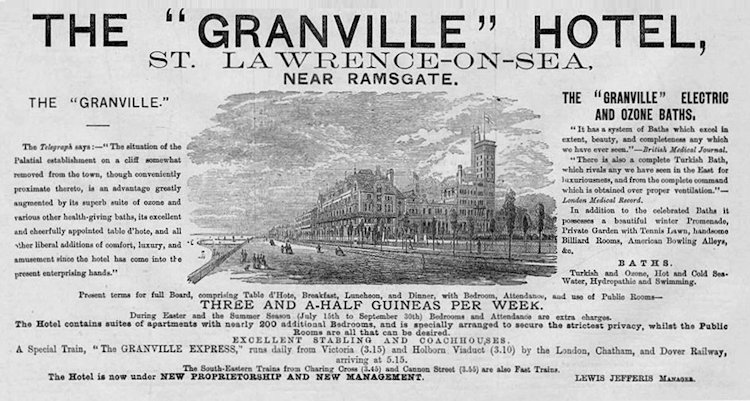
Above advert, circa 1877. |
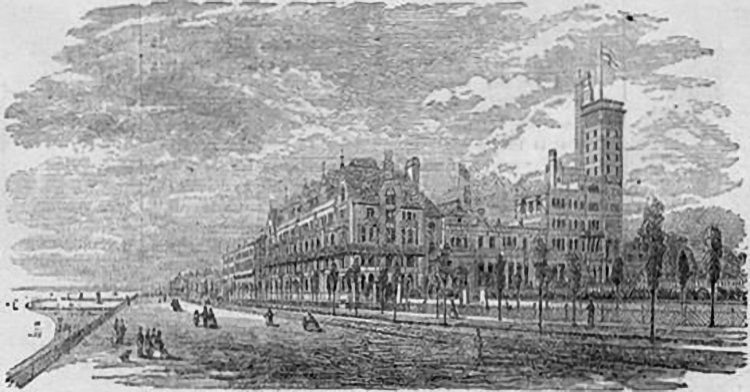
Above advert 1877. |
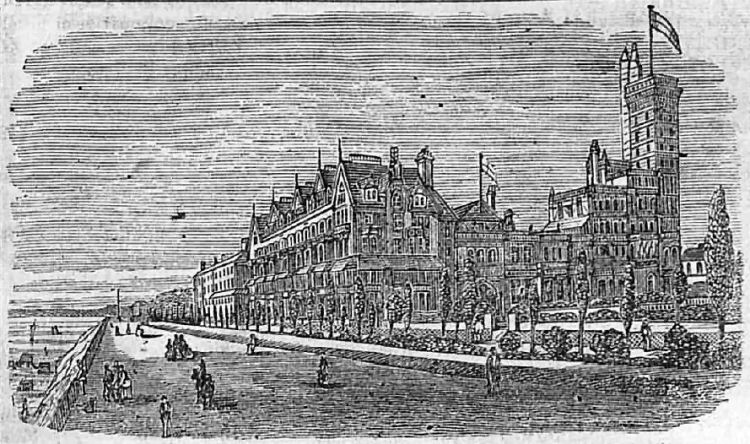
Above engraving 1878. |
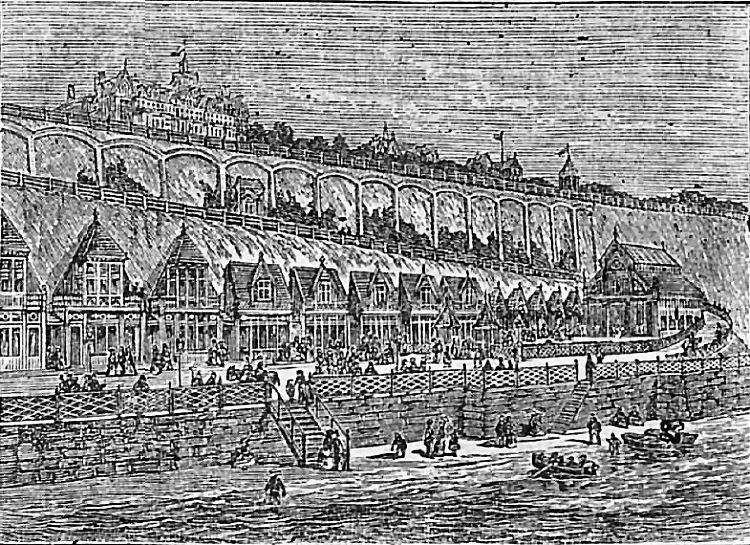
Above engraving showing the Granville Marina 1878. |
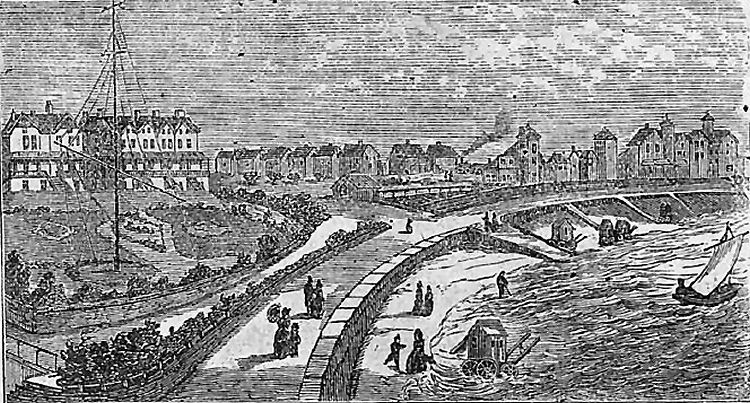
Above engraving showing the Granville Marina 1878. |
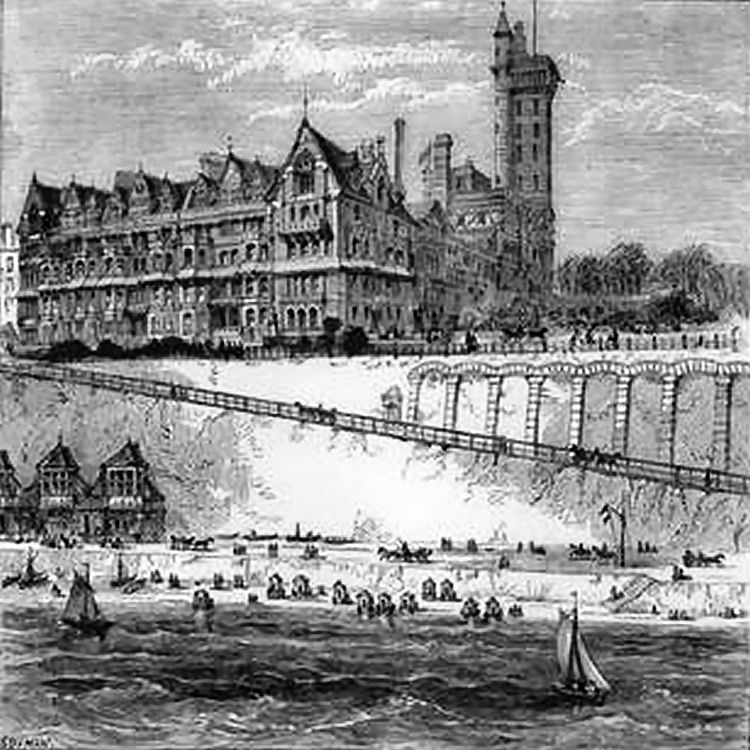
Above engraving, date unknown. |
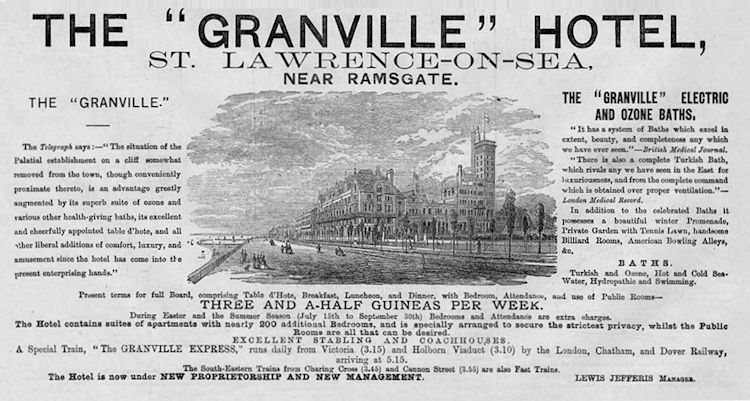
Above advert, circa 1882, kindly sent by Rory Kehoe. At 10/6d per day,
for full board, the Granville was quite a pricy place to stay in 1882!
The 2026 equivalent of 3.5 guineas (£3.67) per week works out at around
£2,100! |
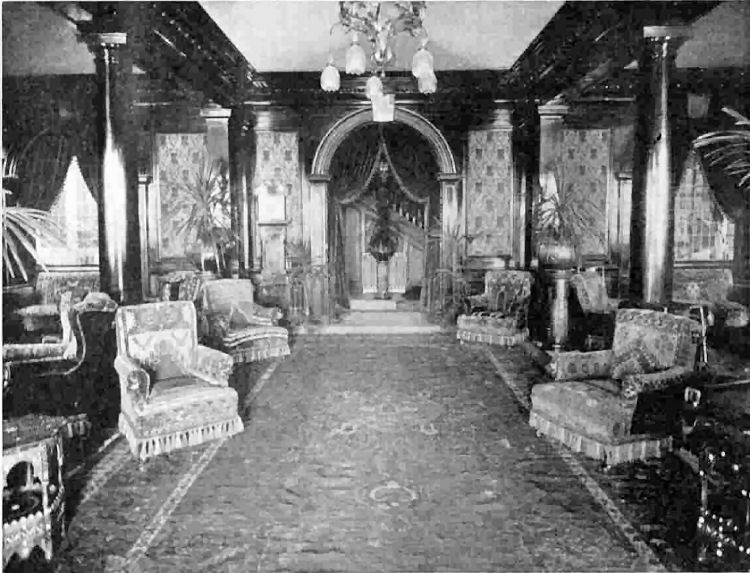
Above photo showing the entrance hall, 1900. |
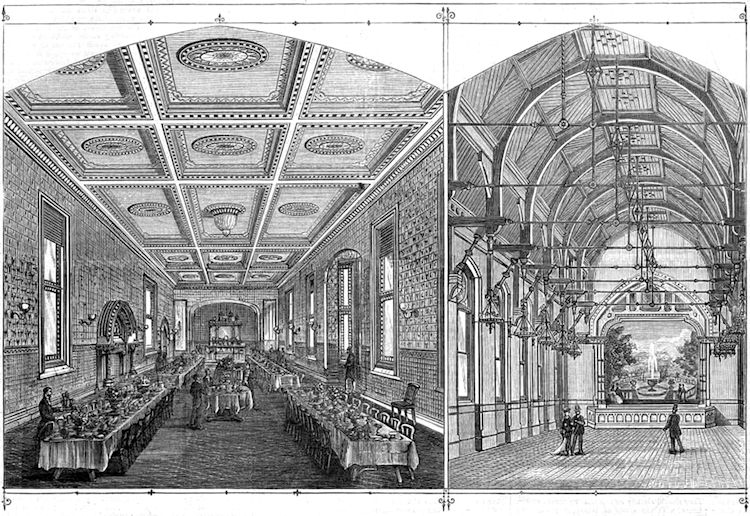
Above sketch, date unknown, showing the Large Dining Room (left) and
Theatre (right.) |
|
The Sketch, Wednesday 14 April 1909.
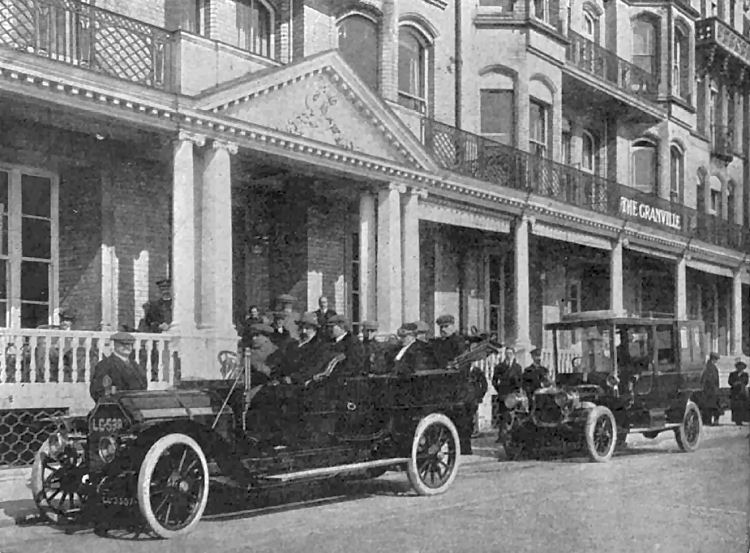
HOTEL MOTORS FOR WEEK-ENDS, CARS LEAVING THE GRANVILLE HOTEL,
RAMSGATE, ON THE RETURN JOURNEY.
Messrs. Spiers and Pond, proprietors of the well-known Empire Hotels,
have devised a new and attractive form of week-end holiday. They will
convey visitors from London to Ramsgate by motor, through the lovely
Kentish scenery, for a week-end stay at their "Granville Hotel," at the
modest inclusive charge of £2 2s. These trips promise to be very
popular, and the scheme will probably be extended to their other hotels,
and for longer periods. |
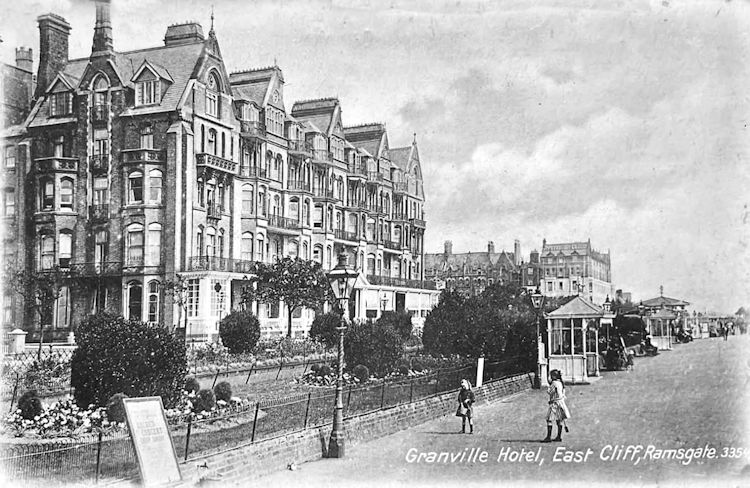
Above postcard, 1913. |
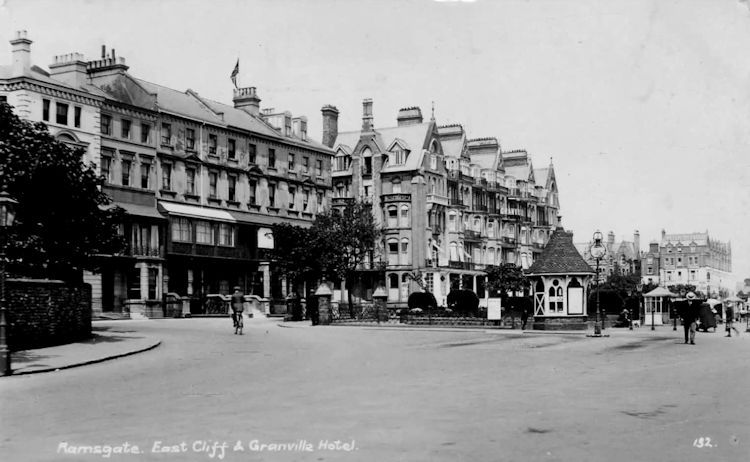
Above postcard, 1914. |
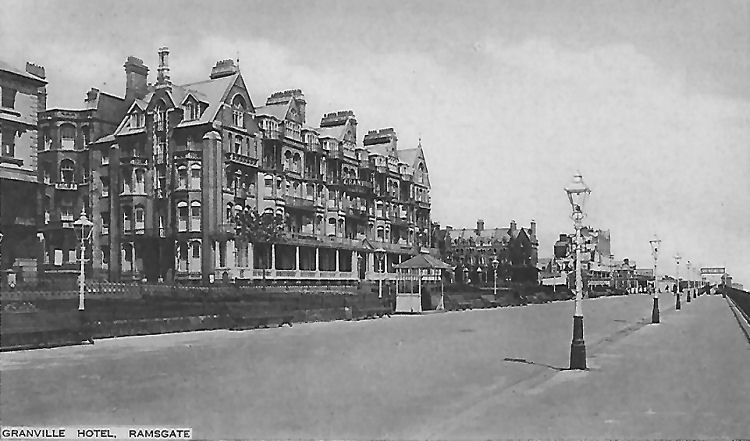
Above postcard, 1919, kindly sent by Rory Kehoe. |
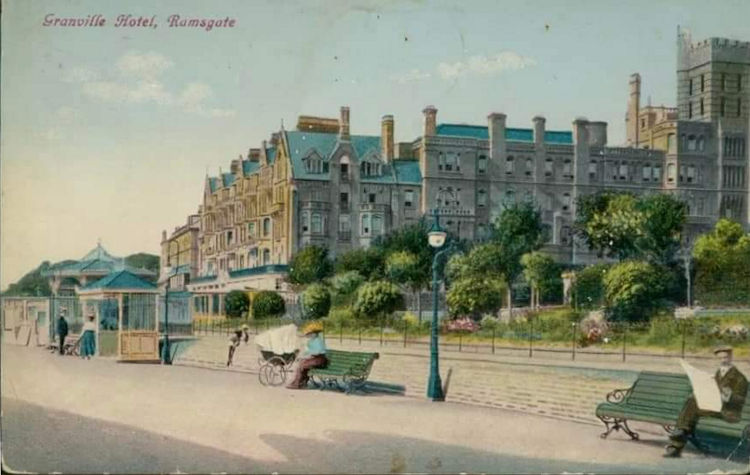
Above postcard, postmarked 20 July 1929. |
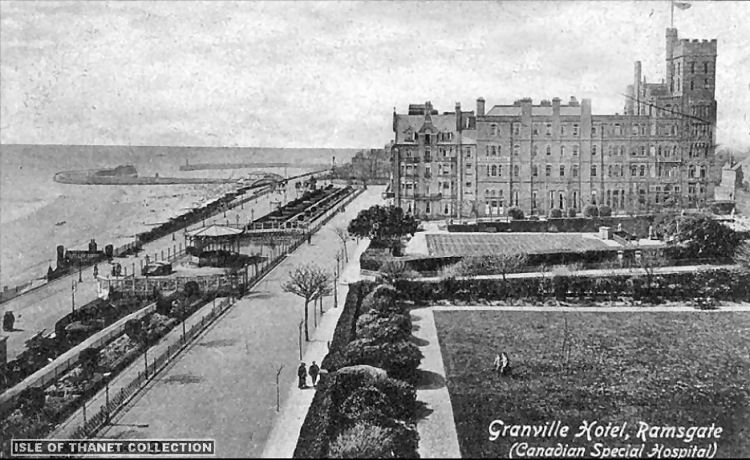
Above postcard, date unknown, from the Isle of Thanet Collection. |
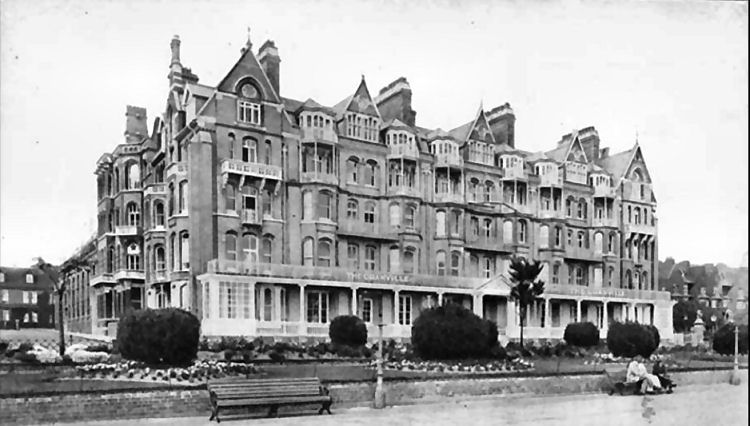
Above photo, date unknown, by kind permission Roy Moore,
http://www.kentphotoarchive.com. |
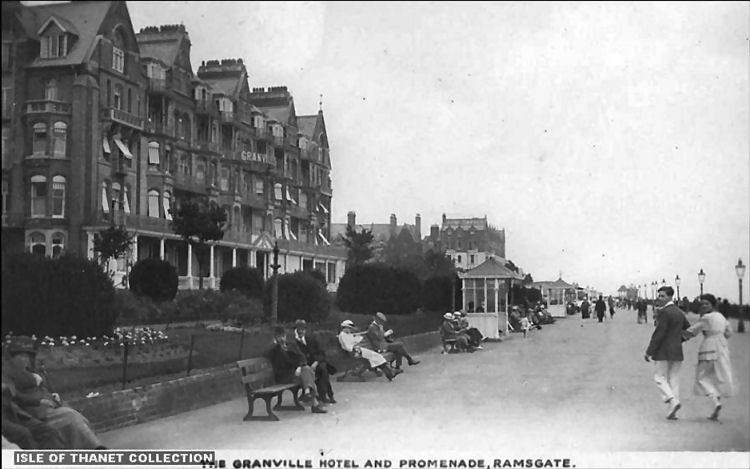
Above postcard, date unknown, by kind permission Roy Moore,
http://www.kentphotoarchive.com. |
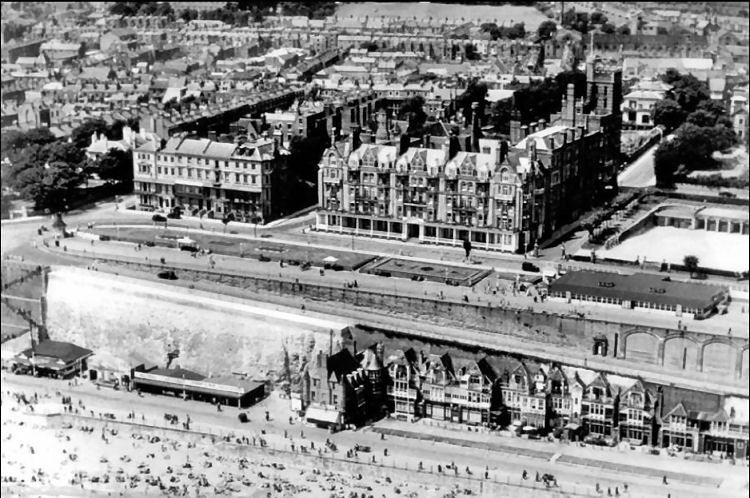
Above postcard, date unknown, by kind permission Roy Moore,
http://www.kentphotoarchive.com. |
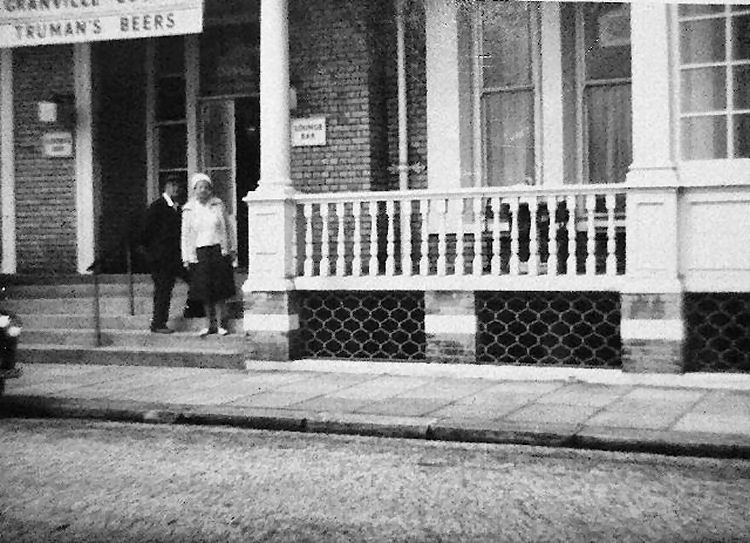
Above photo, date unknown by Benedict Kelly. |
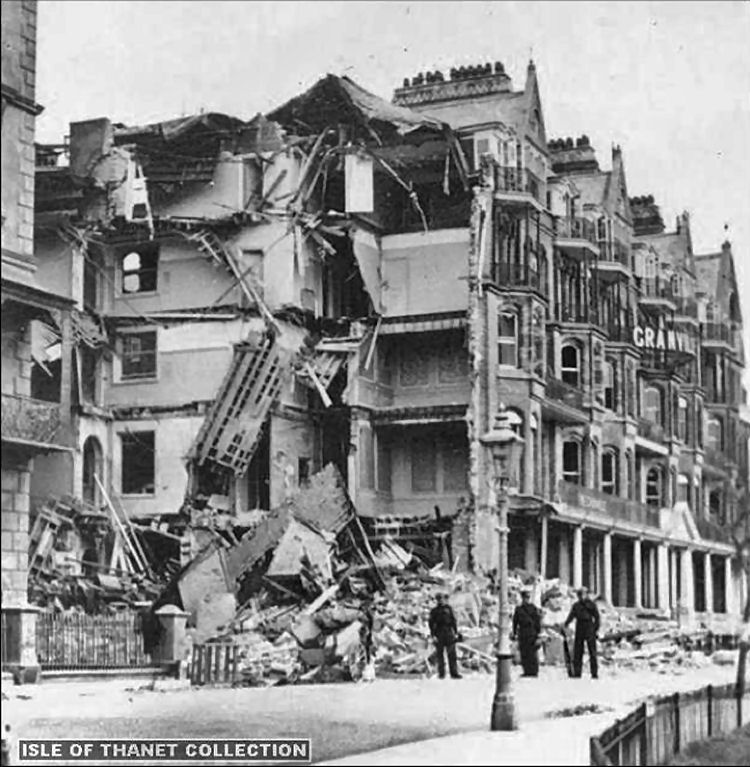
Above photo, circa 1940, by kind permission Roy Moore,
http://www.kentphotoarchive.com. |
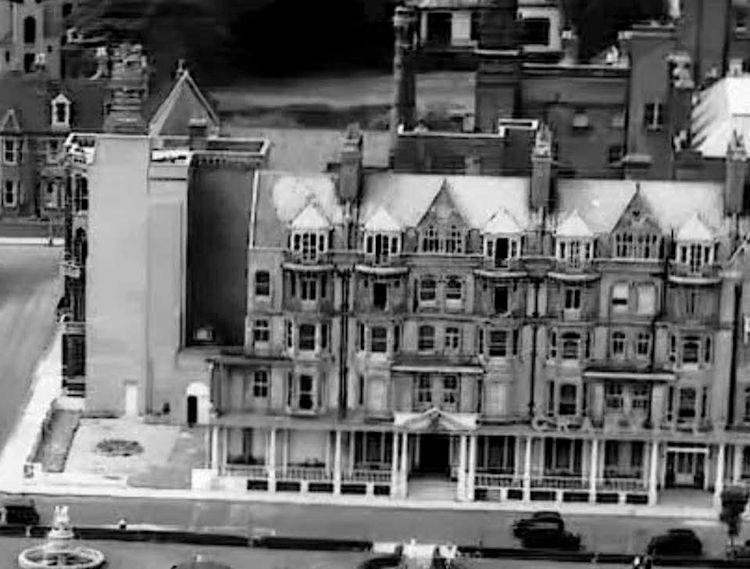
Above photo, date unknown. Notice the left side missing after war damage. |
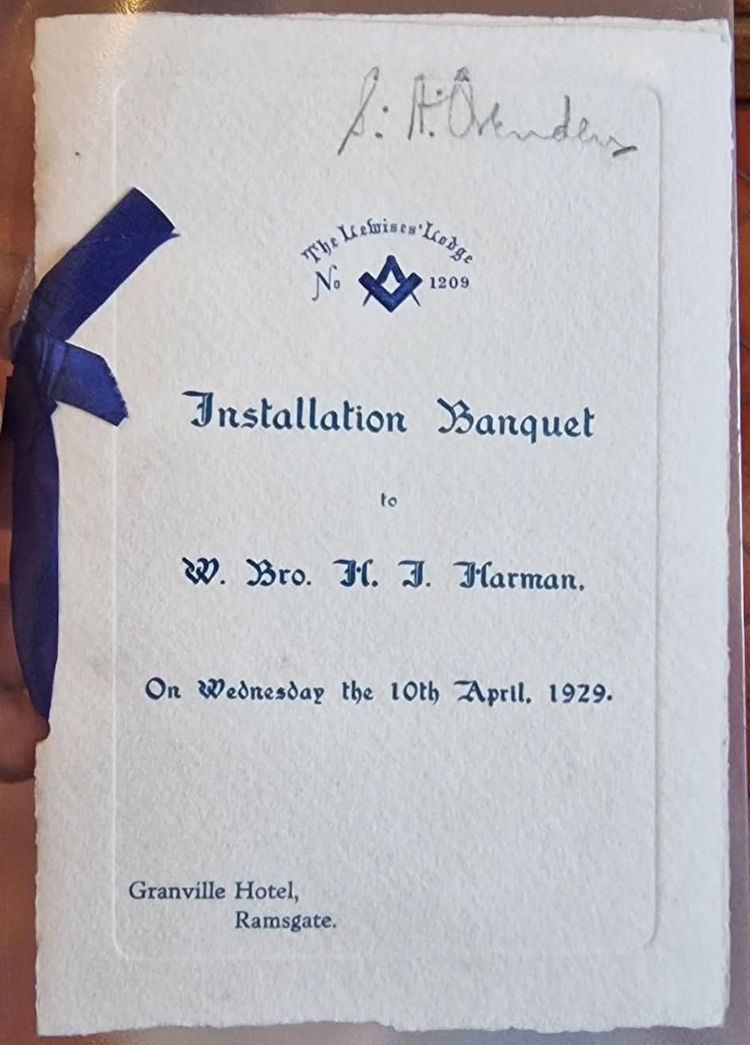
Above Masonic Banquet programme, 1929. |
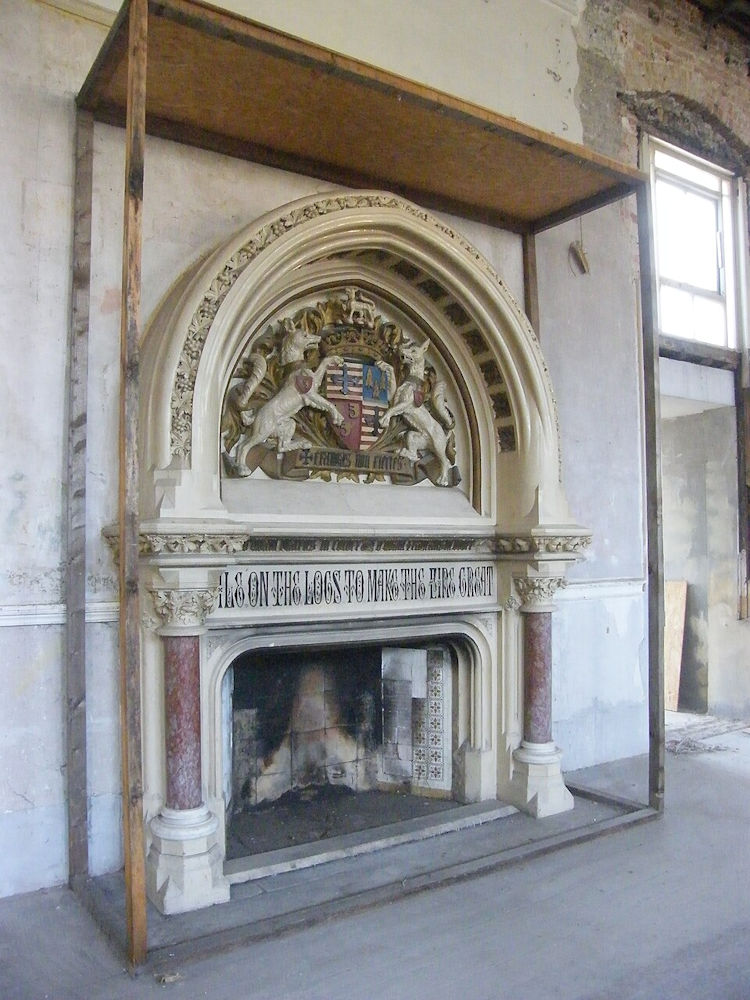
Above photo showing Edward Pugin's fireplace inside Granville House.
Supported on red marble columns with the mantel carved in Caen stone, it
bears the Granville coat of arms and the motto "pile on the logs to make
the fire great". Built circa 1869. |
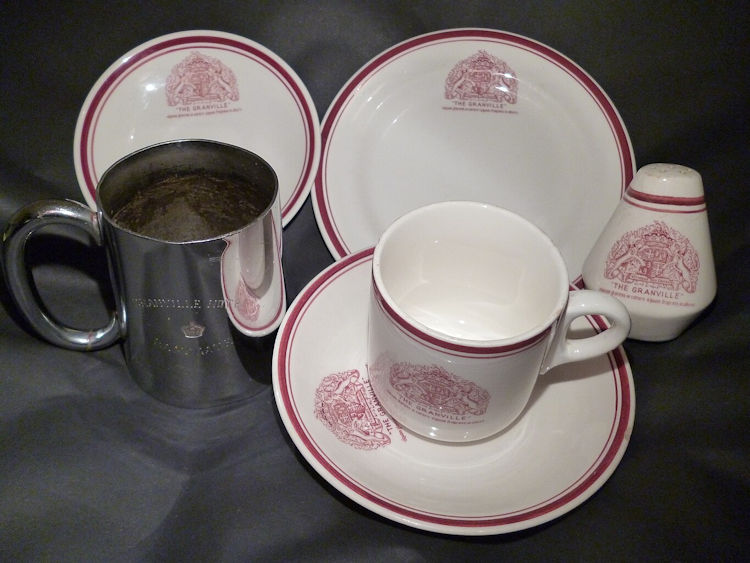
Above showing crockery from the hotel. |
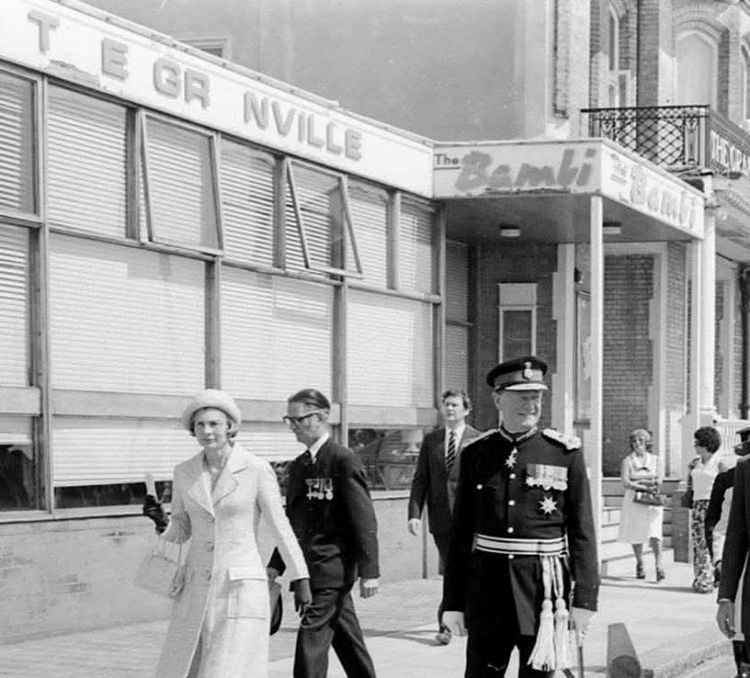
Above photo, date and event unknown. The Bambi was used as their
children's' room. |
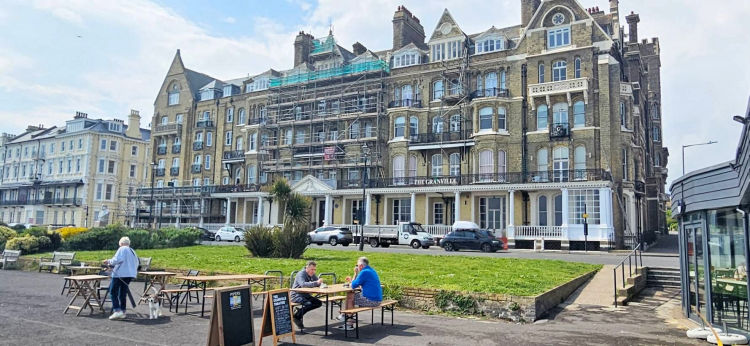
Above photo, circa 2026. |
Opened in 1869, also addressed at Victoria Parade, East Cliff and Victoria Road in 1890.
The Granville Hotel, was designed by Edward Welby Pugin, son of Augustus
Pugin, built in 1867 as a terrace of eight houses. It was operating as an
hotel between 1869 and 1946 before being sold by proprietors Spiers & Pond.
The building is now (2025) Granville House, a private residence containing
48 self-contained flats that are managed by the leaseholders.
After the death of Augusta Emma d'Este (Lady Truro) on 21 May 1866, the
remainder of the land from the Mount Albion Estate was sold off to
developers. Business partners Robert Sankey, John Barnet Hodgson and the
architect Edward Welby Pugin purchased a plot of land on Ramsgate's east
cliff for £9,250. In 1867, they built an eight-house terrace in the Gothic
style. These were substantial properties, with four floors and a basement,
and each had a private entrance. The houses were marketed as exclusive
villas, to be let for weeks at a time to wealthy visitors to Ramsgate who
were expected to arrive at the nearby Ramsgate Sands station below the
cliff.
The terrace is described by Catriona Blaker in her book Edward Pugin and
Kent, his life and work within the county, 2012: "Seen from the front, the
main elevation of these very substantial five floor stock brick residences
was Gothic – definitely an urban, modern Gothic, not even picturesquely
asymmetrical. Each end was the same, grandly gabled, with carefully detailed
stone balconies and a large and elegant Gothic window on the fifth floor,
and there were bold structural bays and chimneys on the side elevations."
In 1869, the owners decided to convert the building into an hotel that
was formally opened with an inaugural ball on 7 December 1869. The new hotel
was named "The Granville" in honour of George Leveson Gower, 2nd Earl
Granville.
The Granville was a spa hotel with Victorian Turkish baths amongst over 25
different kinds of bath. Opened on 24 December 1870, the baths, the "everflowing
sea-water plunge", and hydropathic establishment were the main features of
the hotel throughout its life. The baths were demolished in 1980.
The Granville may have contributed to Edward Pugin's bankruptcy in 1873. In
the following years the hotel was owned by the bankers Coutts. An additional
hall (New Granville Hall) was designed and completed in July 1874 by the
architect J T Wimperis. The hall was demolished in 1982.
The hotel was purchased in 1877 by Edmund Francis Davis, a solicitor and
business tycoon who twice contested the Isle of Thanet constituency for the
Liberals. Davis developed the Granville Marina below the east cliff, and
inaugurated the Granville Express – a daily train service from Charing Cross
to Westgate and Ramsgate Sands. Davis also laid a marble skating rink in the
Granville Gardens (now Poldark Court), and completed a tunnel begun by Pugin,
from the gardens to the sands. The tunnel exits at number 3, Granville
Marina.
Throughout the 1880s and 1890s, the hotel suffered frequent bankruptcies
before being purchased by Spiers & Pond Ltd in December 1898. The front
elevation was altered by the architect Horace Field in 1899, the Granville
Tower was lowered and the inside of the building was extensively remodelled.
In January 1915, the Granville was requisitioned by the Government and
became The Granville Canadian Special Hospital. It mainly treated patients
suffering from shell shock, nerve injuries and injuries to bones and joints.
In April 1917 the hospital accommodated 809 wounded Canadian soldiers. The
hospital closed in the same year and was relocated to Buxton, Derbyshire.
The Granville reopened in 1920 after a £60,000 modernisation. It was leased
to the Empire Hotels Group in the 1930s.
A corner of the hotel was destroyed by enemy action on 12 November 1940.
The building had closed and was empty during the raid. The building sits on
a network of caves and nearby tunnels that were modified in 1939. In 1947,
the hotel was converted into flats and renamed Granville House. For the next
30 years, the building was managed and then owned by William and Florence
Hamilton. The Granville was a popular venue for ballroom dancing in the
1950s and 1960s, as William Hamilton had installed a sprung floor. This
hall, demolished in 1982, was also used for counting votes during elections
and to host private and civic functions. In February 1956, the basement
became a jazz club called The Cave.
The building was designated as Grade II listed in 1973. From 1974 until
the 1990s, it passed through a number of owners and financial backers.
A fire was ignited at the bottom of the staircase on the night of Thursday
25 April 1985. The flames were prevented from spreading by newly
installed fire doors. The teak staircase was destroyed but was later
restored in a £1.5 million restoration programme.
The building includes a former public house named the "Granville Bars," on the
seafront corner. The bar closed around 1991 and is currently leased by Punch
Taverns.
Adjoining the bar area is the banqueting hall, completed in October 1869 by
Edward Pugin. The centre-piece of the hall is a massive fireplace inscribed
with the motto "pile on the logs to make the fire great". The fireplace is
still in situ and cost over £250 in 1869. The hall has a segmented
ceiling, and the floorboards are laid with New Zealand pine. The banquet
hall is listed on The Ramsgate Society's Buildings at Risk Register.
The bomb-damaged west end of the building was rebuilt as apartments in 2004
by Oakleigh Developments Ltd and became Granville Court.
In 2010, the leaseholders of Granville House gained the Right To Manage and
are now responsible for looking after the building themselves. On 18
December 2012, at a public auction, the freehold of Granville House was
purchased by Mr Eliasz Englander for £156,000.[19]
The Granville Cinema, opposite, is named after the building.
|
Whitstable Times and Herne Bay Herald, 25 June 1870.
THE RAMSGATE SEASON.
The season of 1870 was ushered in with a flourish of trumpets. Generally
it comes upon the inhabitants, not unawares, nor at all unwelcome, but
somewhat gradually. On Tuesday its advent was proclaimed by music and
pageant, and Ramsgate, with eyes folly rubbed and broad awake, after a
long winters repose, smiled at the tokens of promise. Much of the
popular excitement arose from a deeper motive, however, than the
occurrence of a holiday. The day was intended to herald a new era for
Ramsgate, to deal a death-blow to the hum-drum monotony of the dead
past, and at the same time to give a trifle of help to the living
present, and make a dear highway for a lively future. So far as Ramsgate
is concerned, we will adopt Mr. Loogfellow’s recommendation, and let the
dead past deal with its own affairs. Ramsgate is to be for the future a
new town, a city upon the hill, bearing the name of St. Lawrence-on-Sea.
This is the idea which Mr. Welby Pugin, son of the celebrated architect,
is carrying out at an immense cost of money, and we are told that the
inhabitants of Ramsgate, so far from being jealous of the innovation,
recognise the seeds of prosperity in it. Ramsgate was part of the parish
of St. Lawrence until it became a separate parish between 60 and 70
years since. The East Cliff is in St. Lawrence, and upon the late Lady
Truro’s estate Mr. Pugin has begun his city, as they do in the Far West,
by building an hotel. The "Granville" is just such a building as
Ramsgate wants, and we were not surprised at being told that, instead of
robbing the smaller hotels of custom, it had attracted visitors who
would not otherwise have come, and after becoming full had sent the
surplus to find accommodation in the town. The hotel, having been
designed, furniture and all, by Mr. Pugin, is of course to the backbone
Gothic, after saying which, it is perhaps necessary to add that this,
great comfort is equal to its elaborate adornments. The sea ebbs and
flows 90 feet beneath. There are Turkish baths, sea-water laid on to
every floor, south, east, and west aspects, sea-water plunges, a tanned
ride before the front door, and a croquet and promenading lawn excavated
to a considerable depth to meet the requirements of invalids. This
device, it is said, makes the temperature "equal to that of Nice." The
jubilation of Tuesday consisted, first, in the public opening of this
large croquet lawn, where band music assisted the promenaders. The
visitors were next taken through a long dark tunnel from the top of the
cliff to the sands—a novel and easy, though to the originator expensive
and troublesome, way of saving distance. A new road towards the Foreland
is being laid down parallel with the beach. A drive through the town
brought the visitors to the steam works, where screeching saws, and
flying wheels, and whistling plains were manufacturing the fittings and
furniture which Mr. Pugin intends to introduce into the mansions now
being built on his property. The charming little church of St. Augustine
on the West Cliff fell in the route, and another halt was inevitable.
Mr. Pugin kindly permitted such visitors as desired it to see the
principal rooms in his own house, which are modelled on the same
architectural style as his father's church and the Benedictine College
near. A banquet, of course, was on the afternoon programme, and, equally
of course, the programme in this respect was not departed from. Mr.
Pugin, in a post-prandial speech, enthusiastically pictured prosperity
for Ramsgate, and a great future for the new city which he wishes to see
covering the breezy cliff. After more music and promenading, there was
an operatic concert in a large new hall attached to the hotel—an
exceedingly pretty room fitted up for theatrical as well as musical
representations. There was a numerous, fashionable, and well-pleasing
audience, and the singing of the Sisters Doria, Miss Lyndhurat, Mdlle.
Elise, Mr. Bell, Mr. Sutcliffe, and Mons. Waldeck, under the
conductorship of Mr. Lansdowne Cottell, roused them to continual
applause. After the concert the company promenaded on the lawn and on
the promenades till midnight. Chinese lanterns by the handled
illuminated every part of the grounds, coloured fires at intervals lit
up the surrounding buildings, and over the sea the moon, rising higher
every moment, marked a diamond-studded pathway miles in length. Here
Ramsgate held revelry by night, the young folks talked sentiment and
dreamed dreams on the edge of the cliff, or romped and sung on the dry
sward, and the oldest inhabitants filled the seats, and looked on with
placid content. Outside of the grounds crowds gazed at the pretty sight
within, much pleased that although they could not mingle with the
festive throng they could hear the music and see the lanterns free of
cost. Under the personal management of Mr. Pugin himself, Mr. Clemson of
the hotel, and M. Lavigiere, who in a gorgeous uniform and gold
epaulettes, took charge of the artistic portion of the entertainment,
the inaugural day passed off without a hitch. Even in the small hours
Ramsgate was "keeping it up." At one in the morning we heard—did any one
ever go to the seaside without hearing said or sung—" What are the wild
waves saying?" They were saying nothing whatever, but noiselessly
stealing in as if, in the face of that other tide in the affairs of
Ramsgate which the good people were now taking at its turn, common
politeness impelled a decent silence and glassy flow.
|
|
Illustrated London News. Saturday 02 December 1871.
NATURE'S CURE for RHEUMATISM, GOUT, and DEBILITY.
OZONODISED BATHS at the "GRANVILLE HOTEL," Isle of Thanet. Boarding Terms for the Winter
Season, now commenced, 10s. 6d. a day. Address the Manager.
|
|
From the Kent and Sussex Courier and Southern Counties Herald. 25 July 1873. Price 1d.
THE 'HORNET' AT RAMSGATE.
The Hornet last week had the following on
Ramsgate:— The "Granville Hotel" is not to be transformed into a
monastery at present.
|
|
From the Illustrated Sporting and Dramatic News, Saturday 4 August 1877.
It is with great pleasure we announce the fact that Mr. Boulter, the
gentleman who has been so successfully running the "Orleans" coach
between the New Orleans Club at Twickenham and London, has, with a party
of very influential friends, arranged to run the coach from the
"Granville," St. Lawrence on Sea, to Canterbury, commencing on 6th
August next. The coach will start at ten o'clock daily, and will take up
passengers en route to the "White Hart Hotel," Margate, and again at the
"Beach House Hotel," Westgate on Sea, at which place the horses will be
changed. It will then proceed by Upstreet and Sarre to Canterbury. This
will be a very great addition to the pleasures already so plentifully
showered upon visitors to the Isle of Thanet, as it is a well-known and
undoubted fact that a finer team of horses or a better appointed coach
does not run out of London.
|
|
From the Illustrated Sporting and Dramatic News, Saturday 4 August 1877.
The Granville Hotel.
Our readers will be surprised to hear that the "Granville" has again
changed hands. It appears that the successful management of Mr. Jefferis
has enabled the proprietors to leave, on very favourable terms, both
this and the "Beach House Hotel", at Westgate. The new tenant is Mr. Quartermain East, of the "Queen's Hotel," St. Martin le Grand, to whom
we beg to offer a hearty welcome to Ramsgate. Mr. Jefferis, on retiring
from the appointment of which he has held with such success and
popularity, will carry with him the hearty good wishes of a large number
of his fellow townspeople and we believe he will be missed at the local
board, where he has evinced a great interest in the welfare of the Town
generally his chief aim having been to secure the drainage, and other
improvements, of the Sir Moses Montythore Ward, which he represents, and
a better approach to the Sands and the East Cliff.
|
|
Illustrated Sporting and Dramatic News 24 May 1884.
THE GRANVILLE, RAMSGATE.
The re-decoration of this hotel is now complete, and under entirely new
proprietorship. It is highly recommended by many medical men, and is
patronised by the nobility, members of Parliament, county families, and
professional men generally. Present terms 10s. 6d. per day (except at
Whitsuntide), including attendance, bed room, and full board. The
Granville express runs daily, leaving Holbom Viaduct 3.10 p.m. and
Victoria 3.15 p.m. arriving at Ramsgate at 5.15 p.m.
Tariff on Application.
The Granville Band plays daily during table d’hôte.
Turkish, ozone, plunge, needle, hot and cold, sea water,
and pine baths.
|
|
Illustrated London News, Saturday 25 May 1889.
THE GRANVILLE HOTSE, ST. LAWRENCE-ON-SEA, NEAR RAMSGATE.
TWO HOURS FROM LONDON BY THE GRANVILLE EXPRESS.
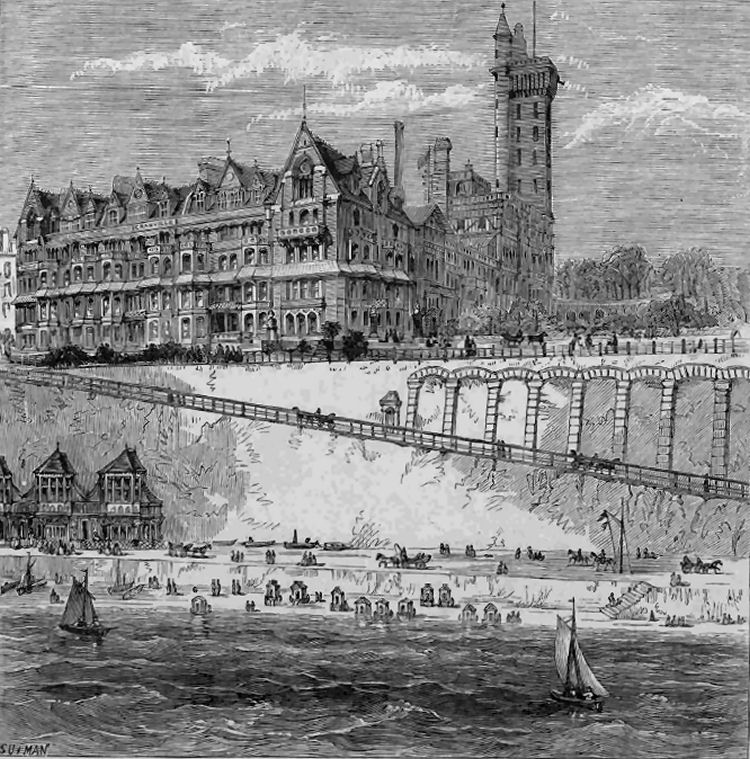
This Hotel possesses every modern and sanitary improvement. It is finely
situated on the East Cliff facing the sea, and commands splendid views
of the Downs, the Gull Stream (the great nautical highway of the world),
the South Foreland. the valley of the Stour, and, in clear weather, the
coast of France in the distance. It contains all the accommodation of a
high-class Hotel, together with a suite of Baths which for extent and
completeness are unequalled in the world, all of which can be reached
without leaving the Hotel. They comprise Ozone, so specially useful in
the treatment of rheumatism, and rheumatic gout; Turkish, Douche,
Sea-Water Plunge, Hot and Cold Sea-Water, Electric and all descriptions
of Hydropathic Baths. Masseurs (male and female) reside on the premises.
There is also a well-appointed Table-d’Hote, Billiard-Room, Private
Garden with Lawn Tennis Ground, and good Coachhouse and Stabling. In
addition to the Public Rooms there are numerous Suites of Private
Apartments, together with nearly 200 additional Bed-Rooms.
A SPECIAL TRAIN.
“The Granville Express." runs daily from Victoria (3.15) and Holborn
Viaduct (3.10), by the London, Chatham, and Dover Railway, arriving at
5.15, and from Charing-cross (3.25) and Cannon-street (3.33) by the
South-Eastern Railway.
Opinions of the Press.
“The Granville at Ramsgate is flourishing, to judge by the run upon it.
The hotel itself is a monument of reckless expenditure by that Early
English architect, Mr. Pugin; but this, of course, is to the benefit of
those who use it. The food, which used to be so-so, is now excellent;
the air is so fresh and crisp, even during the spell of hot weather,
that eating is a positive pleasure.”— Truth.
"From having been a long suffering victim to sciatica and rheumatism, I
have tried most of the Continental waters with no such satisfactory
result—except in the solitary case of Aix-les-Bains, perhaps—as the
ozone baths at the hotel (the Granville), which afford the most
efficacious relief to both complaints. As a hydropathic establishment,
at which Turkish and other description of baths can be obtained, the
Granville has undergone vast improvement since its occupation by Mr.
Quartermaine East and his son. Mr. Bateman East; while the cuisine will
compare with the Schweitzerhof at Lucerne, or any other renowned
Continental hotel."— Morning Post.
“ Certainly no English hotel can produce the equal of its chef. The
attendance is excellent. and if you wish to dine table d'hote-ically,
you may do so with luxury and solid comfort.”
To Golfers. The St. George's Club Links are within Twenty Minutes'
journey by Rail - constant Trains.
|
|
Mid Sussex Times - Tuesday 01 July 1913.
DEATH OF MAJOR A. HILL.
The death occurred on Friday, at the "Granville Hotel," Ramsgate, of
Major Arthur Hill, only son of Lord Arthur Hill, and cousin of the
present Marquess of Downshire, who formerly resided at Wakehurst Place.
The deceased, who was 39 years of age, belonged to the 5th Royal Irish
Rifles, and was M.P. for West Down from 1898 to 1905. The funeral took
place yesterday (Monday) at Easthampstead, Berkshire.
|
|
From The Yorkshire Evening Post, Monday, 10 February 1919.
Explosion of German Mine at Ramsgate.
Damage estimated at £4,000.
The explosion of a huge German mine near the Marine Pier at Ramsgate,
briefly reported in our latest
additions on Saturday, did great damage over an acre of at least 1
square mile. The receding tide had left
foreshore between Ramsgate and Broadstairs strewn with sacks and flour,
packets of lard, and timber,
presumably from the wreck of the American vessel Piave; but the object
which excited most interest was a
mine standing 4 feet high.
It proved to be German, containing about 300 lb of explosive. When it
was inspected by the naval
authorities, it was found that one of the 6 horns containing the
detonators was deeply embedded in the
sands. Warned by the police of the possibility of an explosion, the
inhabitants of houses and shops on the
Marine Parade, about 200 yards away, evacuated their dwellings, and it
was fortunate they did so, for no
sooner had the waves, still backed by a bitterly cold Easterly wind,
reached the mine than it turned over
and exploded with a report heard all over the town.
The concussion was so tremendous that it was felt throughout an area of
at least a square mile. Nearly
every window in the houses on the Marine Parade was blown into the
roadway, and much of the fabric
damaged. Had they still been occupied at the time, the casualties would
undoubtedly have been great.
Despite the height of the cliff, the premises on the upper promenade of
the East Cliff suffered severely. The
extent of the damage in this quarter spread from Wellington Crescent to
Thanet Road embracing many
boarding houses, the "Granville Hotel" (now unoccupied), and the "Hotel
St. Cloud."
A rough estimate of the cost of replacing windows alone shows that the
figure will be in the vicinity of
£2,000. In addition probably almost as much will be required to cover
the damage to the woodwork of
frames and doors, and plaster ceilings, walls and furniture, to say
nothing of the effect of the concussion on
foundations and brickwork. The Corporation carts were required to remove
the shattered glass. It is said
that the mine was of a new type.
|
|
Thanet Advertiser, Saturday 20 October 1923.
Ramsgate. Going from Granville.
Yesterday the Ramsgate Bench granted the temporary transfer of a licence
of the "Granville Hotel" from Mr. Arthur Skelsey to Mr. Amos Piper. In
giving the decision the Chairman of the Bench (Mr. H. H. Green) said:-
We are very sorry to think you are going. Mr. Skelsey.
|
Finally closed in 1946, although the bar continued till 1991. The premises has
since been converted into 48 self-contained flats but still has a Grade 2
listing which it gained in October 1973.
LICENSEE LIST
LEVLALL William 1871+ (age 36 in 1871 ) )
JEFFERIS Lewis to Aug/1877
HENDERSON John 1880-81+ (manager age 50 in 1881 ) )
EAST Quatermaine 1877-89+
EAST Samuel Bateman 1890-91+ (age 33 in 1891)
BLOTT Richard H 1901+
 (age 27 in 1901) (age 27 in 1901)
???? 1903+
SKELSEY Arthur to Oct/1923
PIPER Amos Oct/1923+
http://www.closedpubs.co.uk/granvillebars.html
Census
|

