|
38 Watling Street (Dane John Place 1824 ) )
Canterbury
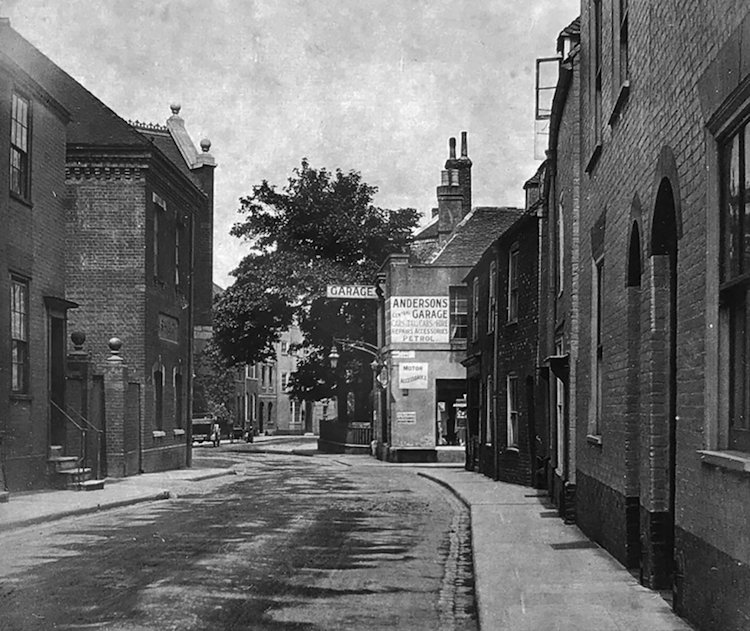
Above photo, circa 1905, kindly sent by Rory Kehoe. This photograph was
taken looking NW along Watling Street, towards Stour Street. Just left
of centre is the front of Ash's Dane John Brewery. To its left is a
gated entrance, which appears to have disappeared by around 1907. The
building on the extreme left, with steps leading to its front door, is
likely to have been the original location of the Toby Filpot. In 1865,
the City Magistrates approved an application (presumably submitted by
Ash's Brewery?) to move the pub two doors down the road, in the
direction of the city wall. Ash's brewery was designated as No.36 and
it's not clear if the pub was also 36 (i.e. part of the brewery) and
moved to No.38, or if it had originally been No. 38 and relocated to No.
40. Perhaps further research and the unearthing of some more photographs
will make this clear? |
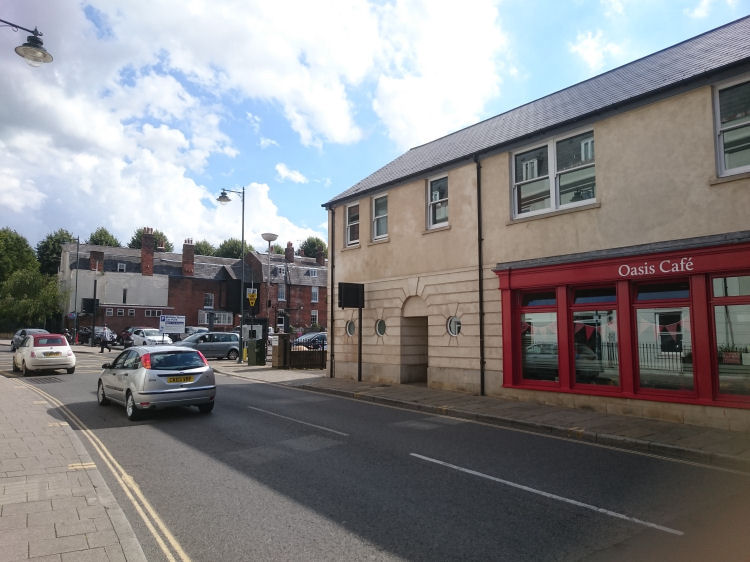
Above photo, kindly sent by Rory Kehoe. Showing the location in 2017.
If the buildings were of "normal" size, then the "Toby Fillpot" would
have been to the left of the Oasis Cafe and the "Dane
John Tavern" where the street lamp is. Tina M's site supports the
idea that the numbering ran then (late 19th Century) as it does now:
consecutively. That puts 38 and 41 on the same side of the road as the
entrance to the Dane John Gardens, opposite the Bus Station.
Further information says it was situated opposite the Countess of
Huntington Church. |
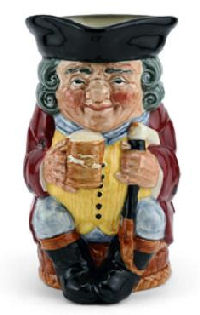
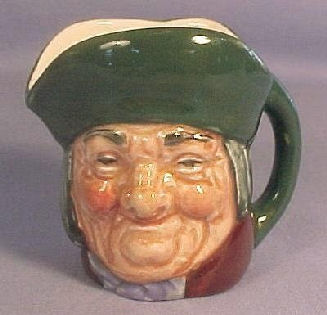
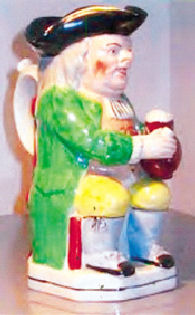
Above pictures showing some typical Toby Jug designs. |
A Toby Fillpot or Philpot is another name for the famous Toby Jugs. There
are many theories in regard to how Toby Fillpot was brought into the world
as a character. The name "Toby" was used originally to describe jugs which
were made in the form of a seated male figure in a tri-cornered hat. He
usually held a beer jug on his knee and sometimes held a pipe or glass in
his hand. These hats acted as spouts and often had a lid seated inside that
could be used as a cup.
In 1761 a London print shop, Carver and Bowles, published an engraving of
a fictional character they called “Toby Fillpot.” The print depicts Toby as
a jovial, obese, and intoxicated older man seated at a table enjoying a jug
of beer and a pipe. English Staffordshire potter Ralph Wood of Burslem, who
has been credited with designing and molding the first Toby jugs may have
been inspired by this image. His earliest Toby Jugs, dating to the 1760s,
look extremely similar to the engraving. One collector has described the
Toby portrayed in Wood's jugs as “a short, corpulent, unsmiling old man with
long, lank hair. He wears a full, long coat…a spacious waistcoat, a
solitaire neckcloth left to dangle, knee breeches, stockings, and shoes
ornamented with buckles. Sitting on a seat concealed beneath his coat
skirts, Toby balances a jug on his left knee while his right hand raises a
drink.”
Toby was dressed in the style of the 1700s, which consisted of a full
length coat with low set pockets, waistcoat, cravat, knee breeches,
stockings and buckled shoes. An interesting feature of the early jugs is the
hollow cap which fitted into the top of the hat and was used as a cup.
He has been associated with the fat boisterous Sir Toby Belch in
Shakespeare's "Twelfth Night," and "My Uncle Toby" from Laurence Sterne's "Tristam
Shandy." This book did appear about the same time as the earliest Tobies,
around 1700.
Other characters who may have helped bring Toby into existence include
Harry Elwes, a Yorkshire man who is alleged to have drunk two thousand
gallons of strong ale from a brown jug, and who bore the nickname of Toby
Fillpot. He died in 1761.
The name Toby Fillpot occurred, probably for the first time in print in
the song "The Brown Jug," published in 1761 in a volume of "Original Poems
and Translations" by the Reverend Francis Fawkes.
This establishment at 38 Watling Street was obviously named after this
character, although whether their drinking vessels were actual Toby Jugs
remains to be seen.
The premises was operating as a public house from between 1828 and
1858 so far confirmed, although I do have the name W. Swain who was living
at that address in 1917, but no information regarding whether this person
was a licensed victualler was mentioned.
|
Canterbury Journal, Kentish Times and Farmers' Gazette, Saturday 23 September 1843.
DEATHS.
September 19, in Watling Street, Canterbury, Mr. R. Randall,
landlord of the "Toby Fillpott," and proprietor of the Canterbury and
Ashford van, aged 62.
|
|
From the Kentish Gazette, 26 September 1843.
DEATH.
Sept. 19, in Walling street, Canterbury, alter a long and painful
illness, Mr. Richard Randall, landlord of the "Toby Fillpot," and
proprietor of the Canterbury and Ashford Van, aged 62.
|
|
Kentish Gazette, 13 November 1849.
SUDDEN DEATH.
An inquest was held at the "Toby Philpot," public-house, Watling-street,
on Saturday last, before T. T. DeLasaux, Esq., to inquire into the
circumstances attending the death of Mr. G. P. Goldsmith, aged 62,
which had taken place suddenly the previous evening.
Edward Fairbrass, on being examined, said he saw George Payn, (a
young man employed at the brewery of Messrs. Ash), go into the shop
of deceased on Friday evening, in a state of intoxication, and heard
him use abusive and disgusting language. Payn was desired to leave
the shop, but refusing to do so was put out by witness and deceased.
Payn returned into the shop, pushed deceased against the counter,
and was again removed.
Mr. Allen Engeham deposed to living next door to deceased. While at
work on Friday evening, witness heard groans in the yard of
deceased, which adjoined his own. Witness immediately went out, and
found deceased lying on his back. As he approached he heard deceased
say "May the Lord have mercy upon me!" Witness immediately opened
his shirt collar and sent for a surgeon.
Mr. Major, surgeon, deposed to being sent for to attend deceased,
whom he found dead. There were no external marks of violence on the
body; he considered death to have been occasioned by the rupture of
some large vessel near the heart, in consequence of the over
exertion and excitement the circumstances called forth, deceased
having been subject to violent palpitation of the heart.
The coroner, in summing up to the jury remarked that Payn, though
not legally answerable for the death of the deceased, was so
morally; and having laid down the law to the jury that, "to put a
person in such a passion that he suddenly died is not such killing
as the law can notice, because there is no damage or external
violence," the jury consequently returned a verdict of "Natural
Death," at the same time strongly reprehending George Payn for his
disgraceful conduct.
|
|
Kentish Gazette, Tuesday 9 April 1850.
Richard Adams, a man who had many years been in the employment of
Mr. Headdy, of the Hoy-office in this city, went into the stable of
the "Toby Philpott" public house, in Watling Street, on Tuesday
last, and, complained of a pain in his inside, asked permission of
the ostler to lie down in the stable, which was readily granted him.
On the ostler returning, about an hour and a half afterwards, he
found Adams hanging to the rack, and quite dead, he having suspended
himself with a cord, which did not belong to the stable. It was
evident from this, and conversation he had with other person's, that
he had premeditated destruction, he having often spoken about the
matter to his own son, in whose company he was on the previous day,
when he appeared to act so strangely as to lead the son to apprehend
some such acts as this. Deceased had lately been discharged from Mr.
Headdy's service.
At an inquest holding before Mr. Delasaux, a
verdict of "Temporary Insanity" was returned.
|
|
Kentish Gazette, 27 August 1850.
Sudden Death.
Thomas Newington, a dairyman, of Watling Street, in this city,
suddenly expired on Tuesday last. Deceased had been his usual rounds
with milk, and returned home to breakfast in apparent health;
shortly after which he was seized with severe pain in his chest, and
before medical aid could be obtained, he expired.
An inquest was held in the evening at the "Toby Filpott," before T.
T. Delasaux, Esq. Mr. Major, surgeon, who had attended deceased for
many years for an affection of the heart, stated that he was called
in, and considered deceased's death to have resulted from the
diseased action of the heart.
The jury returned a verdict of "Natural Death."
|
|
From the Kentish Gazette, 13 October 1857.
Monday. (Before Alderuen Brent & Plummer, and E. Holttum, Esq.)
Thomas Winstall was charged with annoying Major Neame in the public
streets.
Major Neame said that yesterday, as he was passing along Watling-street,
the defendant rushed out of the "Toby Philpott," came up to him, and
began to abuse him. Defendant was very violent, and followed the
complainant all down the street until given in charge.
It appeared that the prisoner was under a delusion that Major Neame
owed him money, and wished to injure him.
Prisoner made an incoherent statement of his imaginary wrongs, and
the bench directed him to find two sureties in £10 each, and himself
in £20, to keep the peace till next sessions. In default he was
locked up.
|
|
Kentish Gazette, Tuesday 29 October 1861.
Canterbury Police Court.
Tuesday:- (Before E. Holttum, Esq., Mayor, and John Brent, Esq.
Thomas Philpott Esq., and Edward Wootton, Esq.)
Interfering with the police. Attempting to rescue a prisoner.
John Burbage, veterinary surgeon attached to the Cavalry Depot in
this city, appeared in compliance with the request from the bench,
to answer a charge of obstructing the police in the execution of
their duty, and also attempting to rescue a prisoner from custody,
on the morning of Sunday, the 20th.
Mr. Delasaux appeared for the defendant.
Sergeant Andrews deposed:- On Sunday morning last, in conjunction
with P.C. Fowler, I had Ensign Spencer in custody. On the way to the
station house the cry was raised "they are coming to rescue him."
That was when we were near the "Toby Philpott," in Watling Street. I
directed P.C. Fowler to draw his staff and use it if necessary. This
was in consequence of seeing a crowd approaching as. I charged
person's to assist. The defendant at the bar, with other officers
previously convicted, were among the crowd. The defendant walked on
the right hand side next to Mr. Strouts, whom I had charged to
assist me. When at the corner of Beer Cart Lane I was knocked down by
someone. A gentleman blocked the way up going into Beer Cart Lane.
he stood right in front of us. I told him not to annoy us. The cry
was raised, "Now then," and on my turning my head round, I was
knocked down. When I got up I collared Ensign Keogh, who struck me a
violent blow on the eye, and at the same time called out, "Assist
me." The defendant came up and grasped my stuff with both hands, and
tried to wrest it from me. Keogh then ran away, but Burbage still
held his hold on my staff. I, however, wrenched it from him, and
said, "All right Mr. Burbage; I know you," and I then went in
pursuit of Ensign Keogh.
By the Bench:- I had seen the defendant in the crowd previously.
By Mr. Delasaux:- They were probably about 50 persons in the crowd.
I was not much excited at the time. I was a little excited after I
have been knocked down. When Fowler had Spencer in custody, I had no
recollection of hearing the defendant say to Spencer, "Go quietly."
I did not hear him say, "Never mind your hat, come along." He tried
to pull my staff out of my hand. He might have held it to prevent my
using it violently. I have not made a mistake in stating that the
defendant took hold of my staff. I could not have done so, as there
was no one within 5 or 6 yards of us at the time we were struggling.
I did not collar the defendant, but afterwards, in Beer Cart Lane, I
put my hand on his shoulder, and said, "I have a good mind to take
you, but I did not wish to be too fast." He said he would go with me
to the station house.
Thomas Strouts, grocer, Northgate Street, deposed:- I know the
defendant at the bar, and have done so for about 3-months. About
12:10 on Sunday morning I left the "Crown and Anchor" booth, in the
Cattle Market. There was a crowd, and I heard some person say "Don't
stand that." I then went towards Andrews, the who had Ensign Spencer
in custody. P.C. Fowler was with them. This was near the "Toby
Philpott." I was charged by Andrews to assist. There was a large
crowd of persons, and I first saw Mr. Burbage near the "Toby
Philpott." I expected an attack, and I said to Mr. Burbage "Do not
come too near me, I know you. He replied, "Is not the road as free
for me as for you?" I told him I was charged to assist the police. I
then lost sight of Mr. Burbage, who fell back among the crowd. We
then proceeded as far as St. Margaret's, where an attack was made
upon us. Andrews was knocked down, and I took hold of the prisoner
Spencer. I did not see the defendant Burbage afterwards till we were
at the station house.
By Mr. Delasaux:- I cannot form any idea of the number of persons
who were in the mob.
P.C. Fowler deposed:- I was with police sergeant Andrews on Sunday
morning. We had charge of a prisoner, and were taking him to the
station. We were followed by a crowd of persons. I saw the defendant
near the "Queen's Head," walking alongside Andrews and Mr. Strouts.
Mr Strouts told him not to push about. I then missed the defendant,
and the crowd went forward to where Andrews was knocked down. Mr.
Burbage afterwards came up to me and the prisoner Spencer in Beer
Cart Lane, and said to Mr. Spencer "Come on."
Edwin Carey, compositor deposed:- On Sunday morning I saw a rush of
the crowd down Watling Street. I went after them and overtook
Sergeant Andrews and P.C. Fowler with Ensign Spencer in custody.
There was an attack upon the police, and among the crowd I saw the
defendant Burbage. I afterwards saw Burbage wrestling with Sergeant
Andrews and Keogh. He was apparently trying to rest the staff from
Andrews.
By Mr. Delasaux:- There were a great many there. I went to the
"Crown and Anchor." I heard Mr. Burbage talking very loudly. I did
not see him use any violence. He said to Andrews, "You can't take
me; I've not done anything."
Mr. Delasaux then address the bench for the defence. He contended
that the evidence was not sufficient to justify conviction against
his client. The bench, however, did not adopt this view of the case,
and Mr. Delasaux proceeded to call evidence for the defence.
William Wilson, 18, tailor, deposed:- I know Mr. Burbage. I have
seen him before. I was at the "Crown and Anchor" on Saturday night,
and saw the disturbance on leaving. I saw some people at the corner
of Castle Street interfering with the police. Defendant was a little
way in Castle Street. I saw Mr. Burbage there the whole time. Mr.
Burbage did not interfere with the police.
Mr. Brent: That is, you did not see him do anything to them.
Witness:- If he had I must have seen him. Andrews came up to Burbage
and said, "I know you, Mr. Burbage." Mr Burbage said, "I've not done
anything. Andrews then collared him, when defendant said, "Let go,
and I'll go with you." Defendant did not do anything. If he had I
must have seen him, of course.
Mr. Brent:- How close were you?
Witness:- I was about 2 yards off.
Mr. Brent:- Were there many there?
Witness: Between 50 and 80.
Mr. Brent:- Mr. Burbage was there?
Witness:- Yes, sir.
Mr. Philpott:- You never lost sight of Mr. Burbage from the
beginning of the fight to the end of the road?
Witness:- No, sir.
Mr. Brent:- Have you ever been defended before?
Witness:- Yes, sir.
Mr. Brent:- Did you see anything anyone struggling with Andrews?
Witness:- Yes, sir.
Mr. Brent:- Was it the defendant?
Witness:- No sir.
Mr. Brent:- Do you know who it was?
Witness:- No, sir, it was a tall gentleman whom I saw struggling
with the police.
Sergeant Andrews:- Did you see the defendant speak to P.C. Fowler?
Witness:- I saw him speak to a gentleman who was with Fowler.
The Mayor:- Did you see him attempt to get the staff?
Witness:- No.
The Clerk:- Did you see the tall gentleman with Andrews doing
anything?
Witness:- Andrews and he was struggling together.
The Clerk:- Did you see Mr. Burbage then?
Witness:- Yes, sir.
The Clerk:- How far was the off?
Witness:- About 20 yards.
Sergeant Andrews:- How far was I in Castle Street when I was
struggling with the defendant?
Witness:- You were not in Castle Street at all.
Sergeant Andrews:- You say you were 20 yards off when I start was
struggling with Keogh?
Witness:- I don't know the exact distance.
Sergeant Andrews:- I was knocked down in Beer Cart Lanem opposite to
Mrs. Wood's slaughter house. Keogh ran up Castle Street.
By Mr Brent:- When did defendant tried to get my staff I was 5 or 6
places up Castle Street. I have just explained the reason why I was
in Castle Street.
Thomas Dutnall, shopman to Messr's. Saxby, said:- On Sunday morning
I was in St. Margaret's Street, and hearing the sound of a great
number of people coming, I went up Watling Street, and saw a mob
running after Sergeant Andrews and Police-constable Fowler. I got to
the end of the mob, where I saw the defendant, and asked what was
the meaning of this. He took me; and we walked behind them on the
pavement as far as Castle Street, where I stood beside him on the
pavement. He did not interfere with the police at all. He did not
leave my side all the time the police were there. Sergeant Andrews
came up afterwards and said, "I know you, Mr. Burbage, I've a good
mind to take you;" to which the defendant replied, "I've done
nothing."
Mr. Brent:- What was the nature of the struggle with the police
sergeant?
Witness:- I was behind and therefore could not see.
By the Clerk:- When I first saw Mr. Burbidge he was beside the "Toby
Philpott."
By Andrews:- I could not have seen him if anyone had taken your
staff. I did not see you struggling with anyone.
By Mr. Philpott:- At the time the struggling was going on Mr.
Burbage was with me. He had not spoken to Fowler not anyone else.
By Andrews:- There were several persons near us, but I do not know
any of them.
William Filmer, compositor, supposed:- I was at the "Crown and Anchor" on Saturday night. Hearing a noise on leaving, I followed
the direction of the sound, and came up with the mob beside the
Riding Gate. I saw the whole disturbance. If I am not very much
mistaken, P.C. Fowler was at the "Crown and Anchor
Inn" in
character. Mr. Burridge was not in the row. He was on the pavement
beside Mr. Twyman's shop. He was there the whole time.
Ensign G. A. Spencer, 64th Regiment:- I was in custody on the
morning in question. I was pushed down and there were two or three
"peelers" on the. Mr. Burbage took no part in the proceedings.
Mr. Brent:- Have you had any application to withdraw this case
Andrews?
Sergeant Andrews:- Mr. Delaxaux called on me yesterday, and asked me
whether I had any ill feeling towards his clients, and whether I
could withdraw from the prosecution. I said I'd speak to the
Superintendent, but the case was in the hands of the Magistrates.
Mr. Brent:- You have had no money offered you?
Sargeant Andrews:- No, sir; and if I had I should not have taken it.
Mr. Delasaux:- Andrews has stated nearly word-for-word what passed
yesterday. I certainly called on him, and I hoped even when this
case came into court this morning that it would have been stopped.
This is a case of mistaken identity, for Ensign Spencer has just
told me that he knows the party who tried to get the staff. He will
not tell the Bench who it is, but he most positively said it was not
Mr. Burbage. Andrews has made a mistake, but not a wilful one. He
has done his duty in the best way that he could.
The Magistrates consulted for a short time in Court, but there
appeared to be some difference of opinion among them. Mr. Philpott
said he could not vote for a conviction, but the weight of it
appeared to be in favour of the defendant. Andrews might have made a
mistake with regard to the identity of the defendant.
After some further consultation the Magistrates left the Council
Chamber, in which the case had been heard, and were absent nearly
half an hour. On the return it was remarked that Mr. Philpott was
not with them.
The Mayor announced that the bench decided to find the defendant
guilty and to find him £5 and 14s costs.
Mr. Delasaux:- Will the fine be remitted if I produce the very man
who attempted to get the staff?
The Mayor:- You should have done that before.
The money was paid.
|
|
Maidstone Journal and Kentish Advertiser, Monday 11 September 1865.
Application for New Licences.
Mr. George Potter, landlord of the "Toby Philpott," which has
recently been sold, and is about to be turned into offices, applied
for a licence for a house close by the "Toby Philpott," and which he
proposed to be called the "Dane John Tavern," this application was
granted.
|
|
From the Kentish Gazette, 12 September 1865.
The Annual Licensing Day.
On Thursday the City Magistrates held a special Petty Sessions
for the renewal and granting of public house licenses, the
Magistrates on the bench being the Right Worshipful the Mayor (Peter
Marten, Esq.), Aldermen Philpott and Brock, Win. Plummer, Esq., Wm.
Mount, Esq., and John Brent, Esq. There being no complaints,
authority was granted for the renewal of the licenses of all the
existing public houses, that of the "Toby Fillpot," Watling Street,
being transferred to a house two doors from the late hostel of that
name. Application from the landlords of three beer houses - the
"Volunteer," Burgate Street, the "Three Kings," St. Margaret Street,
and the "Crown and Anchor," King Street, for authority to obtain
spirit licenses, were refused.
|
LICENSEE LIST
SEATH James 1824-28+

HILL Henry 1832+

RANDALL Richard 1838-Sept/43 dec'd age 62
 
RANDALL Maria 1847-61+
(age 45 in 1861 ) )
  
POTTER George to 1865

SWAIN W 1917+
https://pubwiki.co.uk/TobyFillpot.shtml
From the Pigot's Directory 1824
From the Pigot's Directory 1828-29
From the Pigot's Directory 1832-33-34
Stapleton's
Guide 1838
From the Pigot's Directory 1840
From Bagshaw Directory 1847
From Melville's Directory 1858
Historic
Canterbury web site www.machadoink.com
Census
|

