|
131 (100 in 1861 ) High Street ) High Street
Chatham
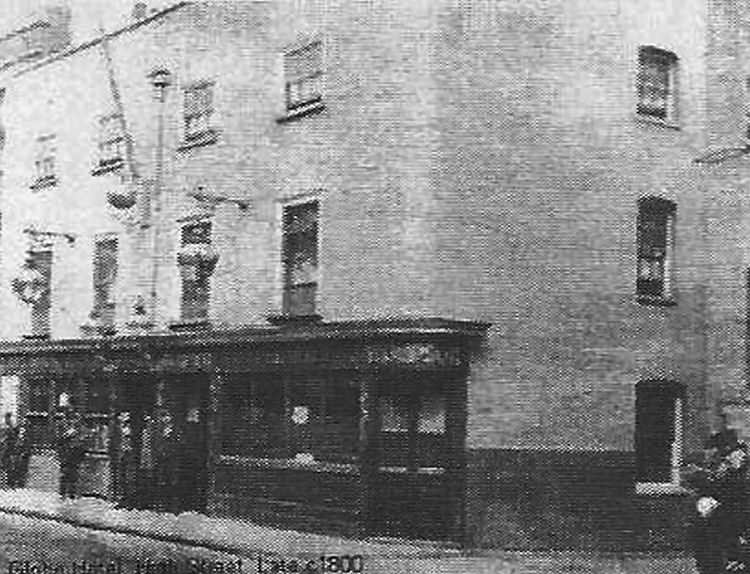
Above image circa late 1800s. |
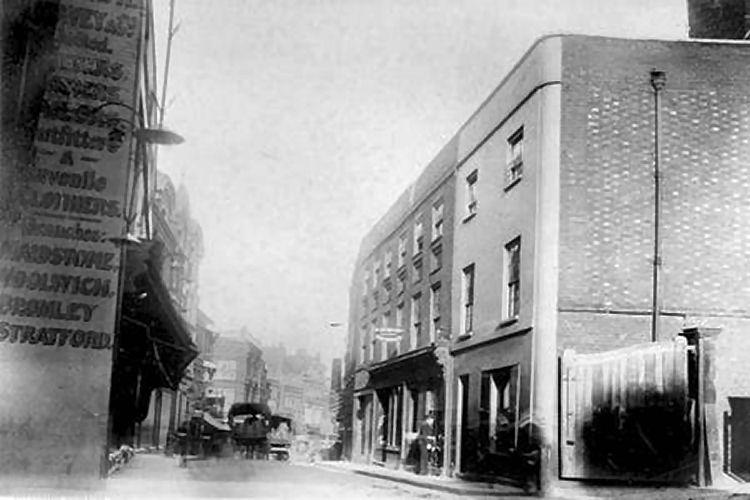
Above photo circa 1898, showing the "Globe Hotel" in the distance. The
gateway on the right being Manor Road. |
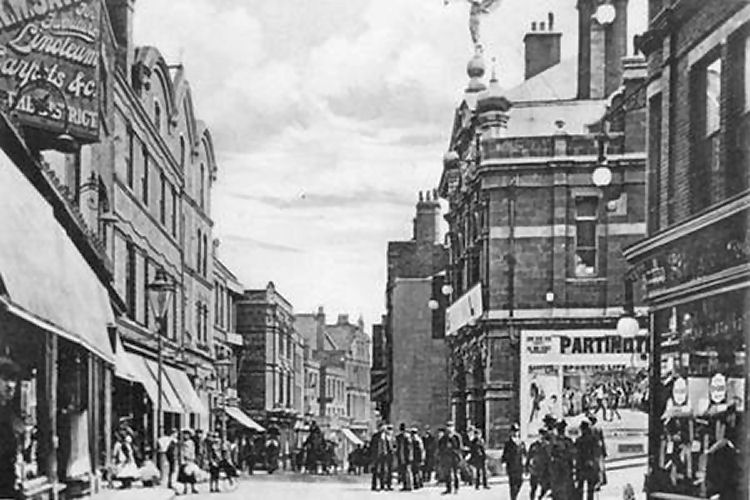
Above photo, circa 1901, showing the "Globe" in the distance. The
Theatre Royal and Manor Road are on the right. |
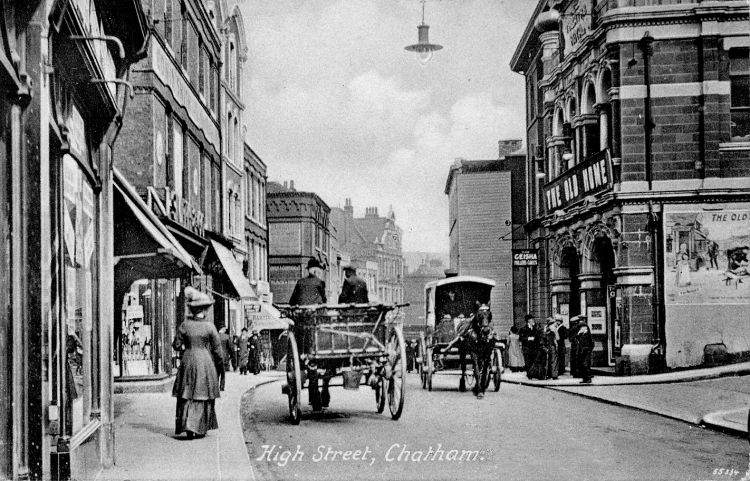
Above postcard, date unknown. |
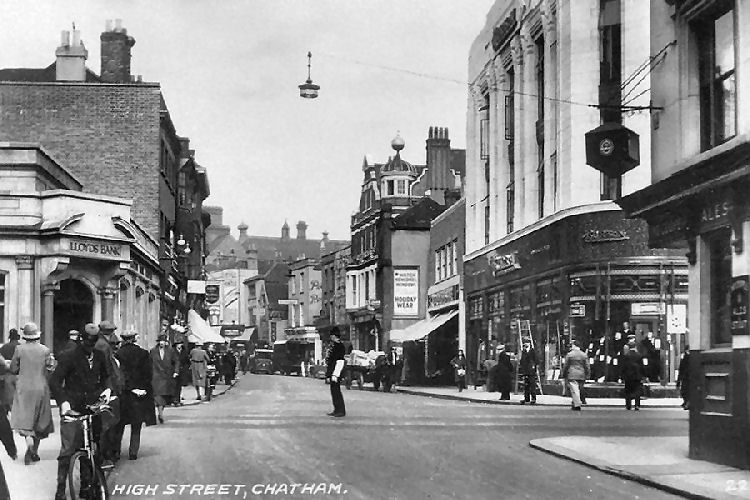
Above photo 1930s. "Red Lion"
extreme right, "Globe" centre of picture. |

Above photo, date unknown. |
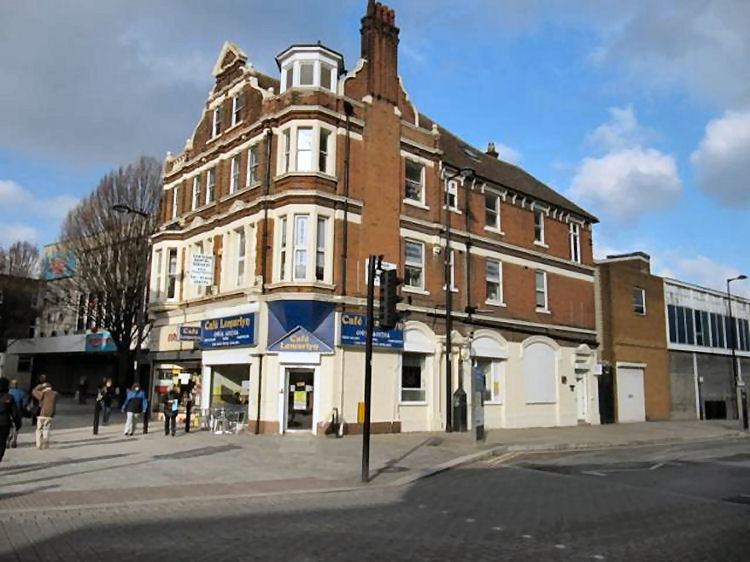
Above photo circa 2017 by Darkstar, showing 131 High Street. |
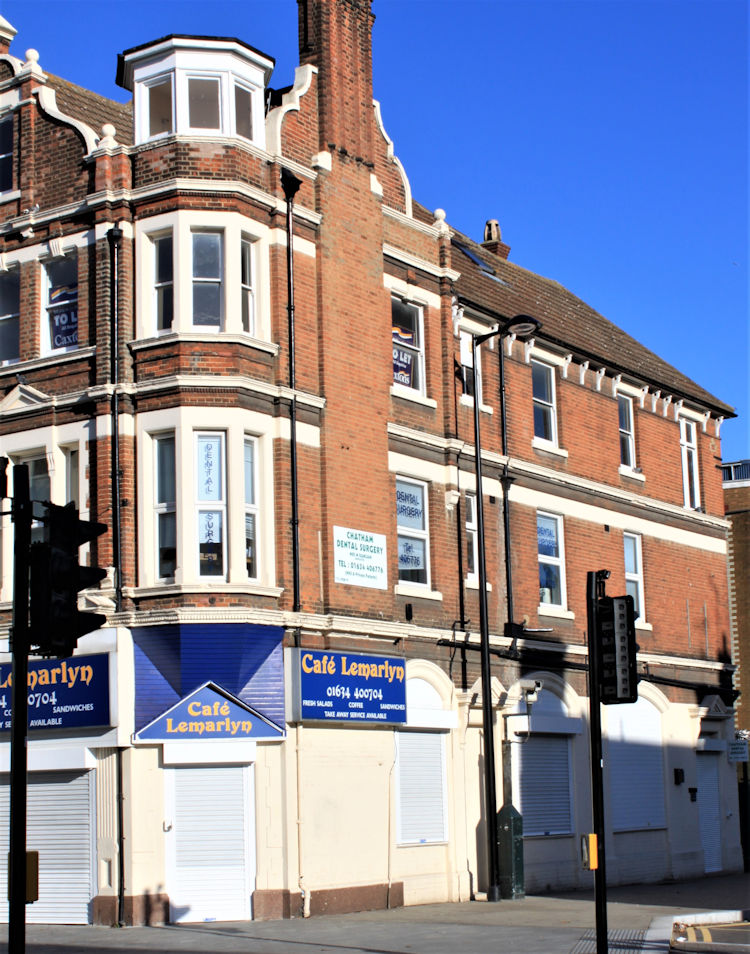
Above photo, 2024. Kindly sent by Philip MacDougall author of 'Lost
Chatham' published in 2024.
https://philipmacdougall.tilda.ws/ |
The Medway Archives and Local Studies Centre has referenced a set of
documents, that I haven't seen yet, and is part of the Watts Charity MSS,
1579-1972.
Reference is made as follows:-
1815-1892
T38. Premises at Chatham, Maidstone and Milton-next-Sittingbourne
[including land next to the "Sun
Tavern;" The "Globe Hotel;" The "United
Service;" The "Criterion" beershop;
the "Red Lion;" and cafe, formerly the "General
Havelock," all in High Street, Chatham; land, part of Room Lane Farm,
Old Maidstone Road, Chatham; Fant Farm, Maidstone; Church Field (29 acres).
Church Farm, Milton next Sittingbourne] (8 docs.)
The Licensing Records of 1872 also give reference to another "Globe"
situated in High Street/Ordnance Place, where a William Lackford was the
holder of the unlicensed premises, but it also indicated that it was a Beer
only license.
This premises in 1872 was owned by Edwards Winch and held a Full License.
Up to and including 1974 the address was given as 100 High Street.
|
Kentish Gazette 22 February 1769.
William Poole, Hat-maker, Next Door to the "Old Globe," in Chatham makes and sells all sorts of
men's and boys hats, ladies riding hats,
etc. Wholesale and retail, on the lowest terms.
N. B. Hats in general cocked in the most neatest and fashionable manner.
|
|
Kentish Gazette, Tuesday 23 January 1770.
STOLEN.
From Mr. JAMES EYRE, out of a Carriage at the "Bull Inn" Yard, Sittingbourn, Five Cotton Counterpanes, Twenty-eight Yards of Crimson
Check, one Flanders and two common Bed-ticks, and two Pair of small
Blankets, and likewise the Door of the Carriage missing.
Whoever will give Information of the Person or Persons who stole the
above Goods, to Mr. Johnson, at the "Globe," Chatham; Mr. Eagleson, at
the "Flour de Luce," Canterbury; or at the "Bull" at Sittingbourn, so
that the above Mr. Eyre may have them again, shall receive One Guinea
Reward.
|
|
Kentish Gazette, Saturday 5 January 1771.
To be LET, and entered upon immediately,
PUBLIC HOUSE, ready Furnished; known by the Sign of the "Thistle and
Crown," nearly opposite the "Kings Head Inn," Rochester.
The House is very complete, and well situated.
For further Particulars, enquire of Mrs. Rebecca Elliot, Brewer, in
Rochester, or of Mr. Lachlen Maclean, at the "Globe," Chatham.
None but Principals will be treated with.
|
|
Manchester Mercury, Tuesday, 1 January 1771.
Edward Johnson, late of Chatham in the County of Kent, Innholder, Dealer
and Chapman.
To appear December 29th, January 2, and February 5, at the "Globe,"
Chatham.
|
|
From the Maidstone Journal, 4 January 1791.
Some time last week, two women, of a gentile appearance, came in a chaise to the
"Globe Inn," Chatham, and took lodgings in the neighbourhood, on a first floor,
pretending to be the daughters of a Mr. Hall, at Dunkirk, but had been cast away
on the coast lately, one of them appeared to be lame, and before they left their
lodgings, they took in several shopkeepers for various articles; it appears
since that they have swindled several persons at Dover, Canterbury, and
Faversham. It is to be hoped they will be detected, and made a public example
of.
|
|
Kentish Chronicles, 26 June, 1795.
Death.
Thursday last died here, Mr. Lauhlan, many years master of the
"Globe Tavern," but had lately retired from business.
|
|
Kentish Gazette, 5 August, 1806.
DEATH.
Saturday, of a dropsy, Mr. George Gould, late master of the tap at
the "Globe Tavern," Chatham.
|
|
Kentish Weekly Post or Canterbury Journal, Tuesday 3 August 1819.
Kentish Gazette 7 July 1819.
Capital Inn, at Chatham, to let.
The "Globe Inn," at Chatham, most desirable situated in the High Street,
at the corner of Globe Lane; which is the principal thoroughfare to the
Dockyard, Barracks, Brompton, &c.
This house has long had a very considerable run of trade, and from its
situation there is no doubt of its continuing to be one of the best
houses in the town.
Particulars may be known by application at the Counting-House of Mr.
Best's Brewery, at Chatham.
|
|
From the Kent Herald, 17 August 1826.
John Miller, "Globe Inn," High Street, Chatham. (Late of the "Fleur-de-Lys,"
Canterbury.)
Respectfully informs his Friends and the Public, that he has taken the "Globe
Inn," Chatham, and hopes by unremitting attention to share a continuance of that
patronage with which the "Globe Inn" has so long been favoured.
Good beds, Genuine Wines, Spirits, &c.
Chatham, August, 1826.
|
|
From the Kent Herald, 30 August 1827.
Horse Stealing.
Henry Fagg, was indicted with stealing one horse, one saddle, and one bridle,
value £21, the property of Jesse Betts at Eastry.
Jesse Betts, is a butcher living at Eastry, the prisoner was in his service on
13th June last, on which day he was sent with the horse and a pound note to
purchase half a hundred of oil cake. Never heard more of him till the 15th, when
he heard that the prisoner had offered the horse the sale at Chatham. Saw the
horse again at Chatham, and is quite sure it is his horse.
James Hurleston, a stable-keeper at Chatham, saw the prisoner at Chatham, on the
13th June last, on a chestnut mare, which he offered for sale for 12 Guinness.
The mare was worth about £24. Prisoner said he came from Sarre and in
consequence of suspicion, witness sent for a constable.
Wright, council of Chatham, apprehended the prisoner at the "Globe Tavern,"
where he told witness the horse was his own. On witness saying he must apprehend
him, the prisoner said, "I'll tell you the truth; I live with a butcher in the
Isle of Thanet, who has broke, and I took the horse for wages." The next morning
he begged witness to write to Mr. Betts, at Eastry, who was the owner of the
horse, saying he had been sent to Dover for oil cake, had met with bad company,
and spent the money.
Guilty. Death recorded.
|
|
From the Kent Herald, 16 October 1828. Death.bmp"
DEATH.
Oct 12, Mr. John Miller, of the "Globe Inn," Chatham, and late of the "Fleur de Lis Inn," Canterbury.
|
|
West Kent Guardian, 2 January 1841.
Globe Inn, Chatham.
The spirited host of this well-known old-established and respectable
tavern gave his annual dinner to his friends and visitors on Thursday,
having the this day of the year, when about 40 respectable tradesmen sat
down I to a very excellent repast, which the worthy landlord provided
gratuitously for his guests. Upon the removal of the cloth, the
chairman, Joseph Ashley, Esq., gave the usual loyal toasts, to which
were responded to most heartily. The party kept up the evening with the
utmost conviviality until New Year's morn, when the company separated
highly delighted with their evening’s entertainment, wishing health,
happiness and prosperity to Mr. Philip Jenner and his highly respected
family.
|
|
From the Kentish Gazette, 7 June 1842.
DEATH.
May 27, aged 38, Mr. P. Jenner, landlord of the "Globe Tavern," Chatham.
|
|
Kentish Gazette, 12 March 1850.
At a meeting of the Chatham Parochial Association, held at the "Globe
Tavern," High-Street, it was unanimously resolved that the
principle of electing unpaid constables for the ensuing year be
maintained by the association.
|
|
South Eastern Gazette, Tuesday 08 April 1856.
Globe Inn, Chatham.
James Birch (Proprietor of the Maidstone Omnibuses,) begs to inform his
friends, and the public generally, that is taken the above house, which
has been subjected to a thorough renovation; and hopes, by strict
attention, and the sale of articles of first-rate quality, to partake of
a share of their patronage.
|
|
From the Southeastern Gazette, 1 May 1866.
Charge of Theft against a Russian Surgeon.
At the Chatham Police Court, yesterday (before the Revs. J. J. Marsham
and W. S. Masters, and T. H. Day, Esq.), a respectably-dressed, tall
man, named Bertrand Ashley, alias Nabskoff, who described himself as an
assistant-surgeon in the Russian army, was charged with stealing two
printed books, of the value of £2, from the “Globe Hotel,” the property
of Mr. Burch, the landlord. Mr. Stephenson appeared for the accused. The
prisoner had been stopping at the “Globe” for several weeks, and had ran
up a heavy score, putting off payment from time to time on the
representation that be had some money coming to him, and that he was
acquainted with several of the naval surgeons at Melville Hospital. On
Sunday it was ascertained that he had carried off two valuable books
from the “Globe,” and deposited them with some other property left at
the “Bull Hotel,” Rochester, until he called for it. On the books being
missed he was given into custody, when he resisted in the most violent
and determined manner, it being ultimately found necessary to strap him
down on the stretcher and convey him to the police-station. After being
taken into custody it was found that he had recently disposed of two
gold watches and some trinkets, which are believed to have been stolen.
Since the accused has been in Chatham he has succeeded in victimising
several tradesmen, among whom are Mr. Naylar and Messrs. Newcomb. He
also appears to have ordered a suit of clothes of Messrs. Hopkins and
Ashby, Hamond-place, but he was not allowed to have them without
payment. On the application of Supt. Everist the accused was remanded
until Wednesday (to-morrow).
|
|
From the Southeastern Gazette, 8 May 1866.
COUNTY PETTY SESSIONS.
Wednesday. (Before Captain H. Savage and W. H. Nicholson, Esq.)
Betram Ashley, alias Nicholas Nabakoff, stated to be an
assistant-surgeon in the Imperial Russian Navy, who stands charged with
stealing two printed books, value £2, from the “Globe Hotel,” was
further examined.
The prisoner, who was defended by Mr. Stephenson, appeared to be very
ill, and he was allowed to be seated daring his examination. His
solicitor stated that he was a gentleman of high attainments, and was
acquainted with six or seven languages.
Mrs. Burch, landlady of the “Globe Hotel,” High-street, said the
prisoner came to the hotel on the 20th March, and remained there until
Sunday, the day of his apprehension. On Sunday the witness missed two
volumes of a work entitled “Old England,” which had been usually kept in
The commercial room. The prisoner made no statement to the witness
respecting the books.
By Mr. Stephenson:— The prisoner twice paid witness money on account of
his bill. On one occasion he paid £1 16s., and on another £4. He
afterwards ran up an account of £6 14s. 7d. The prisoner had for several
days been reading the books which he was now charged with stealing. The
prisoner walked about the house and had access to all the rooms. He
appeared to be a gentleman, and gentlemen from the barracks visited him.
He occasionally read other works in the house, and always returned them.
On Sunday evening, when the prisoner was taken into custody, he told
witness he did not intend to steal the books.
The prisoner, at this stage of the proceedings, went off apparently in a
fit, and fell down on the floor of the dock.
In answer to the magistrates, Supt. Everist said the prisoner had had
several fits, apparently of the same kind, since he had been in custody,
and the police surgeon had visited him twice.
The magistrates ordered the prisoner to be removed, and after an absence
of about half an hour he was again brought into the Court, having in the
interval been supplied with some brandy and water, and his examination
resumed.
William Willson, boots at the “Globe Hotel,” said on the previous
Thursday he saw the prisoner in the commercial-room with a portmanteau
in his hand. The portmanteau produced was the same he then saw. Prisoner
told him to take it to the “Bull Hotel,” Rochester. The witness gave it
to a man, named Fawcett to carry to the “Bull Hotel.”
George Fawcett said he received the portmanteau from the last witness,
and carried it to the “Bull Hotel,” leaving it with a waiter. On witness
returning to Chatham he met the prisoner going towards the “Bull.”
Nothing was said about the witness being paid, and the prisoner had
never given him anything.
Mr. Geo. Willson, landlord of the “Bull Hotel,” said he first saw the
prisoner on Friday morning. On the previous night the prisoner came to
the hotel with a lady, and wished to sleep there. On Friday morning
prisoner came to the hotel and asked if the lady was in No. 4
sitting-room, and on being told that she was prisoner went up to her. On
Friday afternoon the witness saw the portmanteau in one of the
bed-rooms. Neither the prisoner nor the lady returned after they left on
Friday morning, and the witness did not see the prisoner until he was in
custody. On Sunday morning witness examined the portmanteau, which was
unlocked, and there discovered a silk handkerchief, marked with the
named of “Lawrenson, R.N.” one of the surgeons at Melville Hospital.
Some articles of clothing were there, and the two printed books
produced. The prisoner was indebted to witness, on Sunday, in the sum of
18s. 6d., which was still unpaid. Witness delivered the portmanteau and
its contents to the superintendent of police.
Cross-examined by Mr. Stephenson:—When the prisoner and the lady first
came they had no luggage, and it was not the custom of the house to
allow strangers, ladies and gentlemen together, to sleep there without
luggage. The prisoner and the lady were shown a sitting-room and
bed-room, and on being asked respecting their luggage prisoner went out
and the portmanteau came in about an hour afterwards. Mrs. Willson and
the chambermaid both had some communication with the prisoner.
Mr. Stephenson said he must request that both Mrs. Willson and the
chambermaid should be present. He had a complete answer to the case,
which was one of the most extraordinary he had been engaged in for many
years.
The prisoner said he also wished the two waiters to be present, as they
could give most important evidence on the charge of which be was
entirely innocent.
The Bench accordingly ordered the required witnesses to be sent for, and
another considerable adjournment took place.
Edward Petty, waiter at the “Bull Hotel,” said he first saw the
prisoner, with a lady, on the previous Thursday evening. They came to
the bar hotel, and the prisoner asked for a private room and a bed-room.
They objected to a room on the ground floor, as not being good enough,
and they were accordingly shown a room upstairs, which they took
possession of. They had supper, and prisoner afterwards said he would go
out and see that the portmanteau was sent up. Prisoner went out, and
shortly after nine the portmanteau was brought by the witness Fawcett. A
short time afterwards the prisoner returned and asked for the
portmanteau, which he directed to be taken up into the sitting- room.
Prisoner remained about half an hour and then left the house, sleeping
out. On the following morning he came for the lady, and they both left
together, neither of them returning. No money was received from either
of them.
By Mr. Stephenson:— When they first arrived neither had any luggage.
Prisoner said he would go after his portmanteau. Nothing was said to
them about having luggage. Did not hear the prisoner tell the lady he
would bring her some books to make her comfortable.
Mr. Stephenson said he wished the lady who was with the prisoner at the
“Bull” to be examined, but as she was at Birmingham some few days must
elapse before she could be communicated with.
The prisoner said he wished to be remanded for a week, as there must be
no stain on the lady's character.
Mr. Nicholson:— Then let the prisoner be remanded for one week.
|
|
From the Southeastern Gazette, 15 May 1866.
COUNTY PETTY SESSIONS.
Wednesday. (Before Captain H. Savage and W. H. Nicholson, Esq.)
Bertrand Ashley, alias Nabakoff, the Russian surgeon, who stands charged
with stealing two volumes of Old England, value £2, the property of Mr.
Burch, proprietor of the “Globe Hotel,” High-street, was finally
examined. Mr. Stephenson defended the accused.
Supt. Everist, in answer to the bench, stated that he had no farther
evidence to offer on behalf of the prosecution.
The voluminous depositions taken at the former examinations having been
read over by the clerk (Mr. Furrell), the prisoner, who said he should
reserve his defence, was then committed for trial.
|
|
From the Southeastern Gazette, 10 July 1866.
Charge against a Foreigner.
In the course of the day the indictment against Bertrand Ashley, alias
Ashley Nabakoff, 32, a Russian, charged with stealing two books, at
Chatham, on the 26th April, being read over, Mr. Barrow for the
prosecution, applied that the case be sent over to the assizes. There
were other and serious charges against the prisoner of offences
committed at Dover and at Maidstone, and should the prisoner be
convicted on the present charge he would have subsequently to be removed
to Dover for trial, as well as taken before the Maidstone Borough
Sessions. On the other hand, if the trial were postponed to the Assizes,
a fortnight hence, the whole of the cases could be gone into.
The prisoner objected to the application on the ground that he was quite
ready, and he said he should require a jury composed half of foreigners.
Mr. Barrow’s application was, however, acceded to.
|
|
From the Southeastern Gazette, 31 July 1866.
GROWN COURT — FRIDAY. (Before Mr. Baron Channell)Conviction of a Foreign Swindler.
Bertrand Ashley, alias Ashley Nabokoff, 22, remanded from the last West
Kent Sessions, was indicted for stealing two printed books, the property
of James Burch, at Chatham, on the 26th April; also for stealing a gold
watch and other articles, value £20, the property of Esther Carpenter,
in a dwelling-house, at Maidstone, on the 19th March. There were several
other charges against the prisoner beside those above mentioned, one of
which was that of stealing a small gold cross, the property of Thos.
White, at Chatham, on the 13th April.
The prisoner, on his arraignment on Thursday, elected to be tried by a
mixed jury of foreigners and Englishmen, and he also asked that the
Judge would assign him a counsel. Although it was not usual in cases of
felony, his lordship consented, and asked Mr. Poland to take charge of
the defence. Mr. Barrow prosecuted.
The career of the prisoner appeared to have been a most extraordinary
one, and the facts disclosed in the course of the inquiry left no doubt
that he was a most accomplished swindler. The first that seemed to have
been known of him was in 1863, when he made his appearance at Oxford,
and afterwards at Cambridge, where he succeeded, at both places, in
victimising hotel keepers and others to a considerable extent; but his
proceedings were cut short by a conviction for swindling, and he was
sentenced to imprisonment. After this he made his appearance at
Tunbridge Wells, where he represented himself as Count Sobieski, a son
of the late King of Poland, and that he had been exiled on account of
his political opinions by the Russian Government. His appearance was
much in his favour, being young and tall, and his expression of
melancholy and the recital he made of his supposed wrongs and sufferings
in the cause of his country procured for him a great deal of sympathy.
It was his custom to walk on the Parade, and to get the Parade Band to
play the Polish National Anthem, and he would wander gloomily along, as
though absorbed in his melancholy reflections. The consequence of these
proceedings was that he ingratiated himself into the confidence of a
good many respectable persons, from whom he succeeded in obtaining money
and property; and he also appears to have ingratiated himself with some
young ladies, who seemed to be enamoured of the “distinguished young
exile.” He professed to live by money transmitted to him from his Polish
estates by his agent in that country, but the result showed that he got
his living by swindling and fraud; and after a rather long visit at
Tunbridge Wells he suddenly decamped, having victimised almost every one
that came in his way. He then seems to have made his way to Chatham,
where he succeeded in inducing a medical gentleman of great
respectability, to whom he had introduced himself as a Polish exile, to
take an interest in him, and this gentleman introduced him to several
respectable persons with whom he was acquainted, among whom was Mr.
White, a gentleman connected with the military staff at Chatham, and he
constantly visited the latter, and was treated by him with the greatest
kindness. He took the opportunity, upon one of these occasions, to steal
a gold cross, and this was one of the charges that were now preferred
against him. At the time, the prisoner was staying at the “Globe Hotel”
at Chatham, and it appeared that, previously to his going to that place,
he formed an acquaintance with a female who turned out to be a married
woman who had come to Dover to visit her relations, and she had made an
appointment to meet him at Rochester, and they went to the “Bull Hotel”
at that place. The rest of the facts will be gathered from the following
evidence:—
Mr. White said he was in the military service in Chatham in April last,
when prisoner was introduced to him, and came occasionally to his house.
He showed the prisoner a chain with a gold cross upon it on the evening
of the 13th April, and on leaving the room, witness went upstairs to
dress. When he returned prisoner was still there. Next morning witness
discovered that the cross was missing.
Esther Brenchley said her mother lived in High-street, Rochester.
Prisoner was in the habit of coming to her house for a glass of ale. He
offered to make witness a present of the cross in question, and she
received it from him on the 14th April. He asked her to take it as a
keepsake. She afterwards gave it up to the constable.
Supt. Everist said he received the cross in the beginning of May from
the last witness.
In summing up the evidence for the prosecution, Mr. Barrow directed his
arguments to the cross-examination of the witnesses touching the
identity of the cross.
Mr. White, recalled by the Judge, stated that he identified the cross by
a defect in the welding. The chain was attached to a split ring, and no
one had access to the room but the servant and the prisoner.
Mr. Barrow having summed up, Mr. Poland addressed the jury for the
defence. He admitted that there was a certain amount of suspicion
against the prisoner, but no positive proofs of his guilt. The whole
case really turned on the identity of the articles, and he strongly
contended that that had not been satisfactorily established.
The jury, after a rather lengthened consultation, re-turned a verdict of
“Not guilty.”
The charge of stealing books was then proceeded with; the same counsel
being engaged as in the above case.
Mrs. Burch, wife of the landlord of the “Globe Inn,” Chatham, stated
that the prisoner came to their house on the 20th March, and stayed till
the 26th. The books in question were in the commercial room, where she
last saw
them on Thursday evening, the 26th April. She missed them on the
following Sunday.
Cross-examined:— The books were not taken into the commercial room for
his special use, but for the general use of all persons frequenting the
room. Had lent the prisoner several books during his stay, which he
returned.
William Wilson said he received a portmanteau from the prisoner, with
orders to get a man to convey it to the “Globe Inn,” Rochester.
George Faucett received a portmanteau, which he conveyed to the “Bull
Inn,” Rochester.
Edward Petty, waiter at the “Bull,” remembered the prisoner arriving
with a lady. He engaged a private room and a bed room. They had no
luggage with them. They had some tea and cold meat. Prisoner said he
would send a portmanteau up. He afterwards went out, and during his
absence Faucett came with the portmanteau and gave it to witness.
Prisoner returned about half-past ten or eleven, and asked for the
portmanteau. He went out again, and on the following morning he returned
and took the lady away, leaving the portmanteau.
Cross-examined:— When the prisoner came he was asked if he had any
luggage.
Mr. Geo. Wilson, landlord of the “Bull,” deposed that on the Friday
morning prisoner asked for the lady in No. 4 room, and he went upstairs.
The bill was not paid then. When the prisoner returned down stairs he
went away. On the Sunday witness opened the portmanteau and found the
two books (already produced) a pair of slippers, a pocket handkerchief,
and other articles.
Supt. Everist stated that, from information received, he sought for the
prisoner, and found him at the “Globe.” Prisoner asked that Dr. Laurence
might be sent for, but that gentleman refused to see him. He told
prisoner he was “wanted,” and be ran off, and witness had great
difficulty in capturing him.
The jury found the prisoner guilty.
The next charge against the prisoner was for the felony at Maidstone.
Mr. F. J. Smith prosecuted in this case.
Mrs. Esther Carpenter, widow, said she lived at the “Palace,” Maidstone.
On the Sunday evening, 1st March, when she went to bed, she left her
gold watch on the table by the side of the bed. It was attached to a
chain, which held some trinkets also. She missed them next day.
Anne Luckhurst, servant to the last witness, deposed to seeing the watch
on the table.
Mary Ann Surr, another of the servants, said that on the afternoon of
the 19th March prisoner came to the door and asked to see the clergyman?
She told him he was not there, and the prisoner then asked to see “the
curate,” who was also not at the house. The door could be opened from
the outside. Witness then went into the kitchen, and heard some one open
the front door. She went and shut it.
Mr. Benjamin de la Cour, silversmith, at Chatham, said that the prisoner
came to his shop, and said he was attached to the Royal Naval Hospital,
Chatham. He left a watch, upon which witness advanced £4, prisoner
observing that he would have a remittance in a fortnight from his
father.
Mr. P. Hyman, watchmaker, Chatham, deposed that on the 23rd March
prisoner brought a pencil-case to his shop, for repair. Some time after
he brought some trinkets and a watch to witness’s shop.
Supt. Everist said that when he took prisoner into custody, on the
charge of stealing the property from the Palace, he alleged that he had
the articles from France.
The jury returned a verdict of guilty in this case also.
His Lordship observed that prisoner had desired, and he was very glad he
had done so, to have a jury composed partly of foreigners; though for
his own part he did not believe that foreigners showed more good sense
and better judgment in deciding upon a case than an English jury. At the
same time, it was certainly desirable that every appearance of
impartially and justice should be shown to every prisoner, especially in
the case of one, who being a foreigner, was supposed to be without such
friends and assistance as an Englishman might command. Now he had not
the least doubt as to the propriety of the verdict of the jury, and it
was his duty in sentencing the prisoner not to lose sight of the fact of
there being two previous convictions recorded against him. Under these
circumstances, to sentence him to imprisonment for the extreme length of
time the law allowed would not be anything like adequate punishment, and
the sentence of the Court was therefore one of penal servitude, and that
for seven years.
|
|
Maidstone Journal and Kentish Advertiser, Thursday 12 July 1900.
Narrow escape at the Globe Hotel.
The employees at the "Globe Hotel," Chatham, were considerably alarmed
on coming downstairs on Thursday morning at 6 o'clock to find the bar
full of smoke. One of the settees in the lounge bar was on fire, and
needed but a draught of wind to fan it into flames. The fire, which is
supposed to have been caused by a cigar end was extinguished. |
LICENSEE LIST
JOHNSON Mr 1770+
McLEAN John 1793+

LAUHLAN Mr pre 1795
GOULD George to Aug/1806 dec'd (Globe Tap)
 MILLER John Aug/26-12/Oct/28 dec'd
BIRCH Henry 1828+

MILLER Mary 1832+
 (99 High Street)
JENNER Philip 1841-27/May/42 dec'd age 38
BURCH James July/1856-66+ (age 65 in 1861)
MACLEAN Lachlen Mr 1871+
EASTLEY Robert 1872-74+

BURCH James 1879+
THOMPSON Robert 1881+ (age 34 in 1881)
THOMPSON John jun 1882+
MASTERS Richard 1891+ (age 61 in 1891)
TOPLEY Harry 1901-03+ (age 36 in 1901)

WARD Francis Tryram 1911+ (age 31 in 1911)
WARD Frank 1913+
TAYLOR Harry 1922+
JONES Alfred 1930+
JONES S A 1938+
JENNER P 1938+

PHILO G M 1955+
https://pubwiki.co.uk/Globe.shtml
http://www.closedpubs.co.uk/globe.html
Universal
British Directory of Trade 1793
From the Pigot's Directory 1828-29
From the Pigot's Directory 1832-33-34
From the Kelly's Directory 1903
Wright's
Topography 1838
Licensing
Records 1872
Census
|

