|
10 St Johns Hill / St Botolphs heath in 1861
Sevenoaks
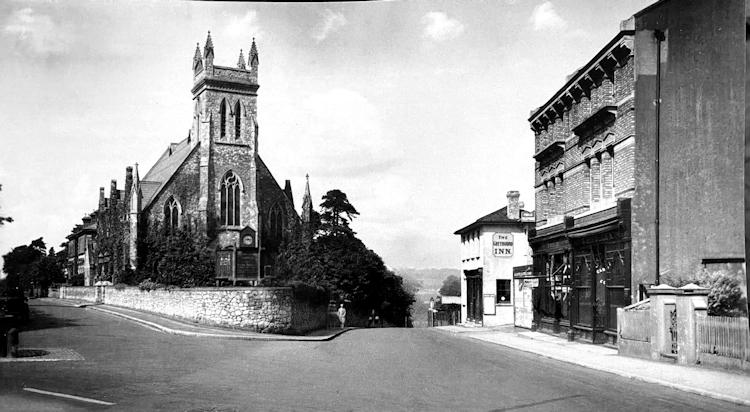
Above photo, date unknown. |
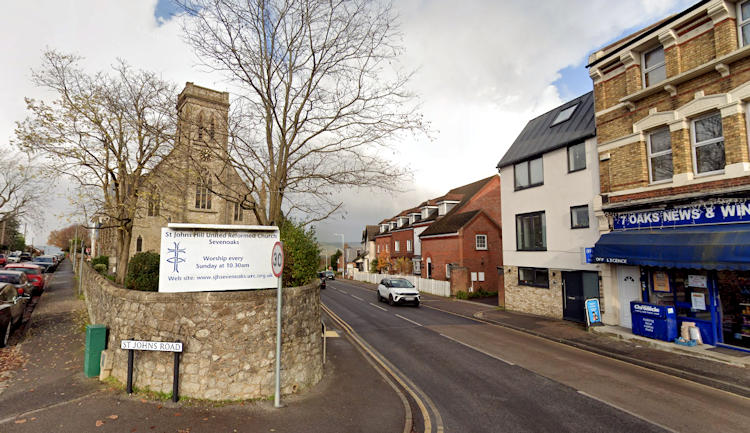
Above Google image, December 2022. |
In 1869-70 the pub was part of a consortium who were advertising their
goods of selling tea in response to grocers' selling beer and wine. (Click
for further details.)
|
From the South Eastern Gazette, Tuesday 1 September, 1857.
APPLICATION FOR ALE-HOUSE LICENSES.
Mr. T. Carnell supported an application made by Mr. Robert Le Bus, of
the "Greyhound" beer-house, St. John's Hill, Sevenoaks, who had
conducted the house for the last five years.
Refused.
|
|
From the Southeastern Gazette, 3 July 1866.
Petty Sessions, Friday. (Before C. J. Colquhoun, Esq:, chairman, the
Hon. and Rev. F. Baring, and C. R. C. Petley, Esq.)
Transfer of Licenses.
The license of the “Greyhound Inn” was transferred from Mr. Lebas to Mr.
Relph, of Leigh.
|
|
From the Southeastern Gazette, 10 July 1866.
Money Stealing.
On Tuesday, at the clerk’s office, before M. Lambarde, Esq., Frederick
Humphries was charged with stealing 30s., belonging to Arthur Sheen, on
the 2nd inst. The parties were lodging at the “Grasshopper” at Westerham,
and slept in the same room. The money was taken from the prosecutor’s
pocket during the night, and when the loss was discovered in the morning
the prisoner bad left the house, but was shortly afterwards apprehended
by Shepperd, 82, K.C.C., at the “General Wolfe.”
Joseph Spring, a labourer, was also charged with a similar offence,
having stolen £8 10s. in gold and silver, the property of Edward Jones.
The prosecutor lodged at the “Greyhound” public-house, St-John’s-hill,
and slept in a room at the back of the house to which access was easy;
other persons also slept in the same room. About one o’clock in the
morning one of the other persons awoke, and seeing the prisoner, whom he
knew, called out to him and asked what he wanted, and he replied that he
had been locked out, and was going to turn in there, which he did not
do. In the morning the prosecutor missed the money which he had placed
the night before in his waistcoat pocket, and put it under his pillow.
He was apprehended by Sergeant Tye, K.C.C., to whom he said he was at
his lodgings at eleven o’clock at night, but it appeared that he did not
reach his lodgings until three o’clock. Both prisoners were remanded for
a week.
|
|
From the Southeastern Gazette, 17 July 1866.
A Bold Thief.
On Monday, at the Clerk’s office, before M. Lambarde, Esq., Joseph
Spring was brought up on remand, charged with stealing £8 10s., on the
1st inst., the property of Edward Jones. The prosecutor is a gardener at
Brasted, but on the night in question he took a lodging at Mr. Relf’s,
“Greyhound Inn,” St. John’s-hill. About eleven o’clock the potman showed
him his bed, which was in a large room at the rear of the house. When he
went to bed he had £8 10s. in gold, in a small box in his waistcoat
pocket, and 18s. 6d. in silver loose in his pocket; and he put the
waistcoat under his pillow. When he awoke in the morning he found that
his waistcoat had been disturbed during the night, and that all the gold
had been taken from the box, and about eight shillings of the loose
silver from his pocket. It appeared that two other persons, the potman
and a carpenter named John Cooley, had slept together in a bed in the
same room, and the latter said that he awoke in the night and saw the
prisoner, to whom he could swear, in the room. He took hold of the
potman's legs and shook him, and asked him whether he could lodge there,
as he had been locked out of his own lodgings; but as he failed to wake
him he put a similar question to Cooley, who made no reply. This witness
did not see the prisoner leave the room, as he expected that he would
occupy a bed there. The prosecutor, on missing his money, gave
information to the police, and Matthews, 7 K.C.C., saw the prisoner that
morning, and, in reply to questions put to him, he said that he got to
his lodgings about eleven o’clock that night, but Thomas King, an engine
driver, with whom he lodged, said that he admitted him into the house at
three o’clock in the morning of the 2nd inst. When he was searched the
constable found upon him only a half-sovereign and 11s. in silver. He
denied knowing anything about the affair, but was committed to take his
trial at the next Assizes.
Frederick Humphries, similarly charged on remand, the money being
alleged to have been stolen from a bed-room at the “Grasshopper”
public-house at Westerham, was discharged, no witnesses appearing to
support the case.
|
|
From the Southeastern Gazette, 31 July 1866.
Charge of Felony at Sevenoaks.
Joseph Spring, 26, labourer, was indicted for stealing 2s. 6d. and a
tobacco-box, the property of Edward Shoebridge, from his person, at
Sevenoaks, on the 2nd July. The Hon. E. Stanhope prosecuted; Mr. Lilley
for the defence.
Prosecutor stated that on the day in question he went to the
“Greyhound,” Sevenoaks, when a man named Walker asked him for some
tobacco, and he handed him his box, which, when he returned it, witness
put into his pocket, It contained 2s. 6d. at the time. As he was.
returning to his lodgings, prisoner stopped him, and took the
tobacco-box out of his pocket. His friend came to the rescue. Prisoner
told his friend he was going to pick him up, and take him home.
Cross-examined:— There were several water-tables in the road. Witness
walked along the middle of the highway, and did not knock his foot
against a stone. His friend found the box empty in the water-table.
George Walker corroborated prosecutor’s evidence. He added that he heard
the prosecutor calling for help, when he went to the rescue. Never saw
any matches struck. Prosecutor was “none the worse for drink.”
The prisoner was acquitted on this charge. He was then indicted for
stealing £8 10s., the moneys of Edward Jones, at Sevenoaks, on the 2nd
July.
Edward Jones, a gardener, residing at Brasted, but who on the day in
question was lodging at Mr. Relf’s, the “Greyhound,” St. John’s-hill,
said he went to bed in a large room at the rear of the house, at about a
quarter to eleven o’clock. The potman and a carpenter named John Cooley
slept in the same room. Prosecutor had £8 10s, in gold in a small box in
his waistcoat, and 18s. 6d. in silver loose in his pocket; and he put
the waistcoat under his pillow when he went to bed. When he awoke, about
half-past eight in the morning, he found that his waistcoat had been
disturbed during the night, and all the gold taken away, and about 8s.
from his pocket. He gave information to the landlord, and a policeman
was sent for.
John Cooley deposed that he went to bed about eleven o’clock. After some
time he awoke, and saw a man in the room, whom he had since identified
as the prisoner. Prisoner said he was locked out of his lodgings, and
asked the potboy, who was sleeping there, if there was a spare bed. The
potboy made no answer. Did not see the prisoner go away. Witness knew
there was an empty bed, and expected that prisoner had gone to lie down.
Cross-examined:— Prisoner tried to pull the potboy’s legs, but could not
wake him. He spoke to witness afterwards, but he made no answer.
By his Lordship:— The entrance to the room is from a ladder, and the
door is latched, but can be opened from the outside.
Frederick Relf, the landlord, said the prisoner had no business in the
room. He knew no harm of the prisoner. He had since discharged the
potboy, but that was not for any dishonest act.
P.C. Matthews said he saw the prisoner at his lodgings at about eleven
o’clock next morning. Prisoner asked, “Is anything stolen? If anything
is, I know nothing about it.” Witness was then told by Thomas King that
he let him in at three o’clock that morning. He then took the prisoner
into custody, and found on him half a sovereign, four half-crowns, a
shilling, sixpence, and a penny. He denied knowing anything about the
theft.
Thomas King said he was an engine-driver, and lodged in the same house
with the prisoner. Remembered the night of the 9th June. He went home at
eleven o’clock, and bolted the door about twelve. He then went to sleep
in his chair, and at three o’clock let the prisoner in. They then went
to bed together.
The prisoner was acquitted on this charge also.
|
|
Kent & Sussex Courier, Friday 18 September 1908.
Sevenoaks woman's suicide. The inquest.
Mr. T. Buss (West Kent Coroner) held an inquest at the "Greyhound Inn,"
St. John's, Sevenoaks, on Friday evening, on the body of Mrs. Emily
Sarah Peacock, aged 48, who committed suicide by cutting her throat with
a butcher's knife on Thursday, 10th instant.
Mr. William Martin was chosen foreman of the jury.
William Peacock, a general labourer, living at 2, Providence Villas,
Bradbourne Road, Sevenoaks, said the deceased was his wife, and was 48
years of age. She have been ailing with her throat for the past 7 or 8
weeks, and had had medical attendance. Her general health was good, but
of light she had seemed rather depressed. She had no domestic troubles,
and they lived very comfortably. On Monday previous to her death she
appeared to be strange in her manner, but eventually brightened up
again, and on Wednesday the day before her death, she went about her
duties in a happy mood. They retired to bed at night about 10:30, and at
3 o'clock next morning witness awoke and found his wife standing looking
out of the window. He told her to get back into bed, which she did, and
he then fell asleep again. At 3:30 Beal, the young man lodger, called
him and said, "Peacock, do you know your wife is in the backyard."
Witness immediately went downstairs and found his wife who was only
dressed in her night attire, lying on her side in a pool of blood. She
was not quite dead, and looked up at him and groaned. A butcher's knife
(produced and covered with blood) was lying by her side. He then sent
for the police and a doctor.
By the Coroner:- She had complained of her throat a good deal, being
under the impression that a cancer was forming.
Replying to the Foreman:- Witness said on the previous night she was
quite in her normal state, they had been discussing about having a
holiday that weekend. At times, however, she seemed very strange, her
eyes seeming to bolt out of her head.
By a Juryman.:- She had been to a London Hospital. Her work was not
hard. She did a little laundry work, and generally finished that in
three days, having a young girl to help her.
Another Juror:- How long have you been married?
Witness:- 22 years.
Leonard Beal, a painter, said he had lodged with the deceased for the
last 15 months. About 3:30 on the morning in question, he was awakened
by the noise of some water splashing in the water-butt beneath his
window. At first, he paid little attention to it, but it kept on, and
witness then got out of bed, and looked out of the window. It was quite
dark, but he could see the deceased lying on the ground in a white
night-dress. He immediately aroused her husband who went downstairs.
Witness meanwhile slipped on his clothes, and on going down met Peacock,
who said, "She has done it." Witness answered "What?" and he said, "Cut
her throat." Witness then ran for Dr. Dick.
By the Coroner:- He distinctly heard something strike the hoop of the
water-butt, and fall to the ground. She was groaning a good deal when he
looked out of the window. She was an exceedingly quiet woman, and he had
noticed that since her visit to the hospital a fortnight ago, she seemed
to be more quiet, and did not speak unless spoken to.
By the Foreman:- She complained of her throat a good deal, but as far as
he knew she had no other trouble. She lived very comfortably with her
husband.
A Juryman:- What do you think was the cause of the water splashing?
Witness:- I should think it was blood running into the water. The water
appeared very crimson when he looked the next morning.
P.S. Stolton said he received information of the tragedy about 4:30 a.m.
and immediately preceded to Bradbourne Road. On arrival he saw the
deceased, who was dressed in a night attire, lying on her left side face
downwards in a pool of blood in the yard and adjoining the house. She
was quite dead. The knife produced was lying by her side. There was a
large water butt, three parts full of water, and near to which a chair
has been placed. There was a quantity of blood in the butt and on the
chair.
Witness then handed to the Coroner the following letter in deceased's
handwriting, written in pencil, which he found on the kitchen table:-
Dear May:- Stay with a governor, and keep on the work. Perhaps Laura
would like to come home to take care of her father, and the work would
pay you two, or if she would not come, it would be something for you
with a woman to help you, and you could look after him. Take care of the
dog, for my sake... Goodbye... Comfort my dear mother. It is hard to
leave them all. I should like to go out with your P., but I'm too
wicked.
Written across the lines in right angles were the words. My dear
husband, I love you, and on the back of the envelope in which the letter
was enclosed was "Dear husband, I love you."
Dr. R. J. Dick, in practice at Sevenoaks, said he had attended the
deceased professionally for the last 3 years. It was only recently that
she had suffered with her throat. He last attended her on Monday the 7th
instant, when she then seemed very much depressed. She imagined that she
had cancer forming, but it was not so, and he tried his best to get her
out of that frame of mind. He was called to the scene at 3:40 on
Thursday morning. When he arrived she was quite dead. There was a large
jagged wound extending right across the throat. The cause of death was
haemorrhage.
In reply to the Forman, witness said a good many people did not have the
ability to cope with trouble. They seem to magnify things. He knew that
some kind friend has suggested to the deceased that she had cancer, but
the witness could detect no sign.
The Coroner, having summed up, the Jury returned a verdict of "Suicide
during temporary insanity caused through ill health," and expressed a
vote of condolence with the husband which sentiment was endorsed by the
Coroner.
|
This pub is one in the list of my "Project 2014."
As such I haven't found a picture of the pub, and to date have no other
information of substance. Local knowledge, further pictures, and licensee information
would be appreciated.
I will be adding the historical information when I find or are sent it,
but this project is a very big one, and I do not know when or where the
information will come from.
All emails are answered.
LICENSEE LIST
LEBAS Robert 1852-58+
BASS Robert L 1861+ (age 46 in 1861)
LABAS to July/1866
RALPH T July/1866-70+
RELF Frederick 1874-81+ (age 56 in 1881)
RELF James 1891-1903+

NEWNHAM Caleb
 1913+
1913+
BILBEE William 1918+
SULLIVAN Arthur 1922-30+
QUICK Sydney H 1938+
TURNER James H 1939+ (age 23 in 1939)
???? Peter & Joyce 1970+
https://pubwiki.co.uk/GreyhoundInn.shtml
From the Kelly's Directory 1903
Census
|

