|
16 High Street
Rochester
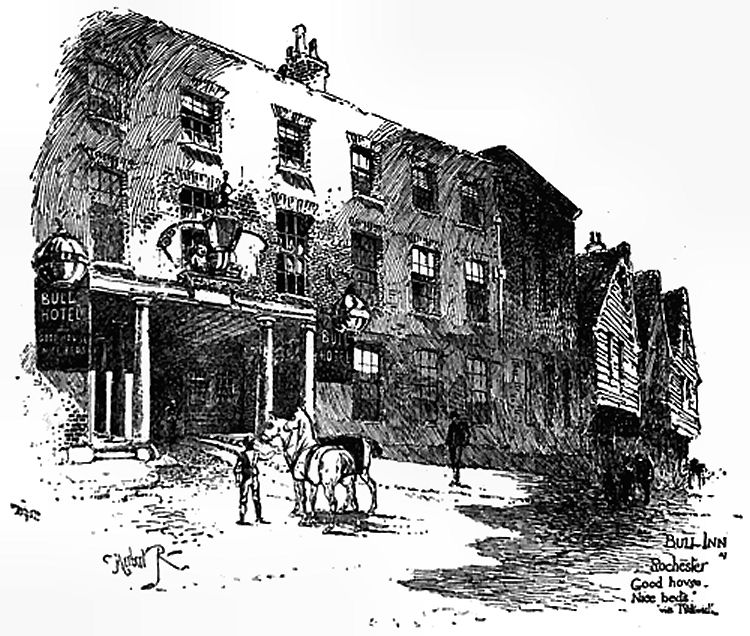
Above drawing, date unknown. |
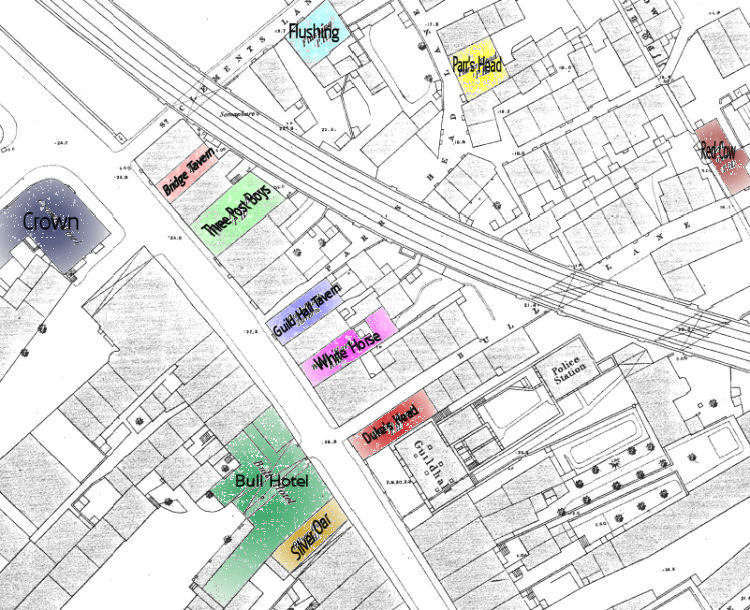
Identified on the 1866 map above as the dark green building, bottom. |
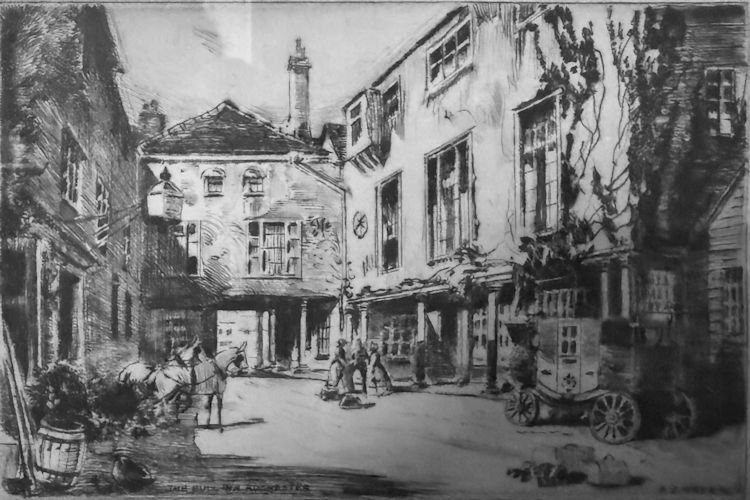
Above painting, date unknown. |
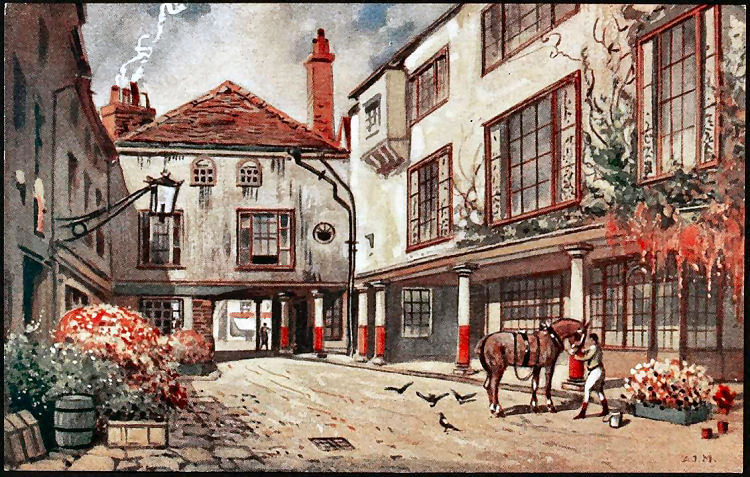
Above postcard, date unknown, kindly sent by Dave Lambert. |
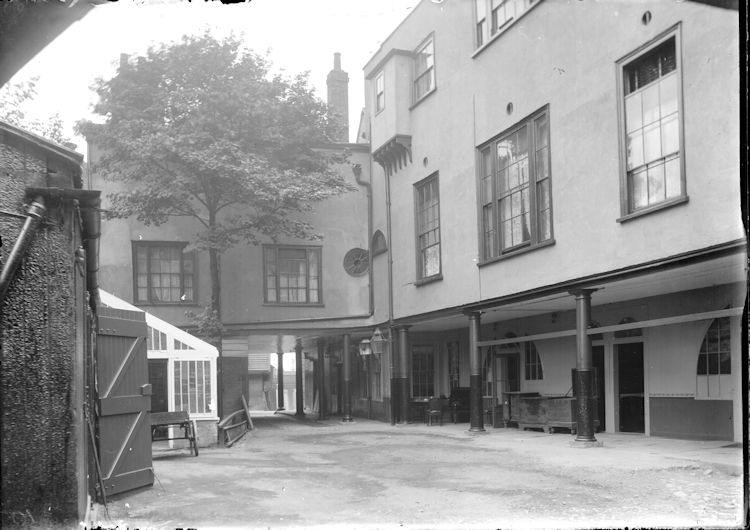
Above photo, date unknown. |
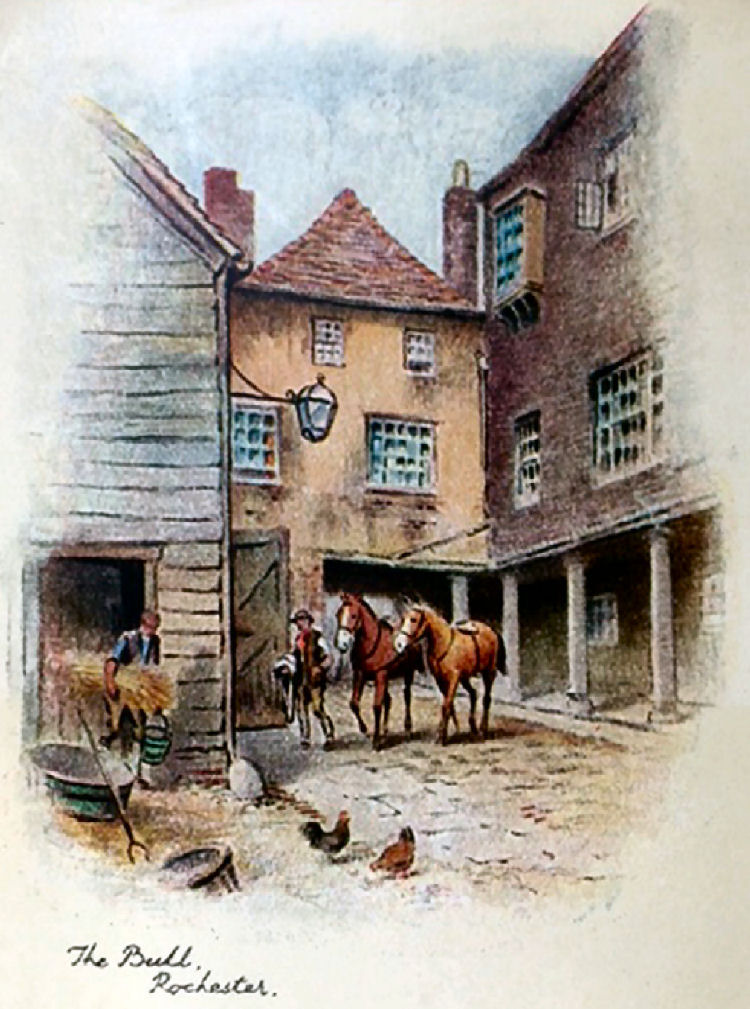
Above painting, date unknown, kindly sent by Alison Duxbury. |
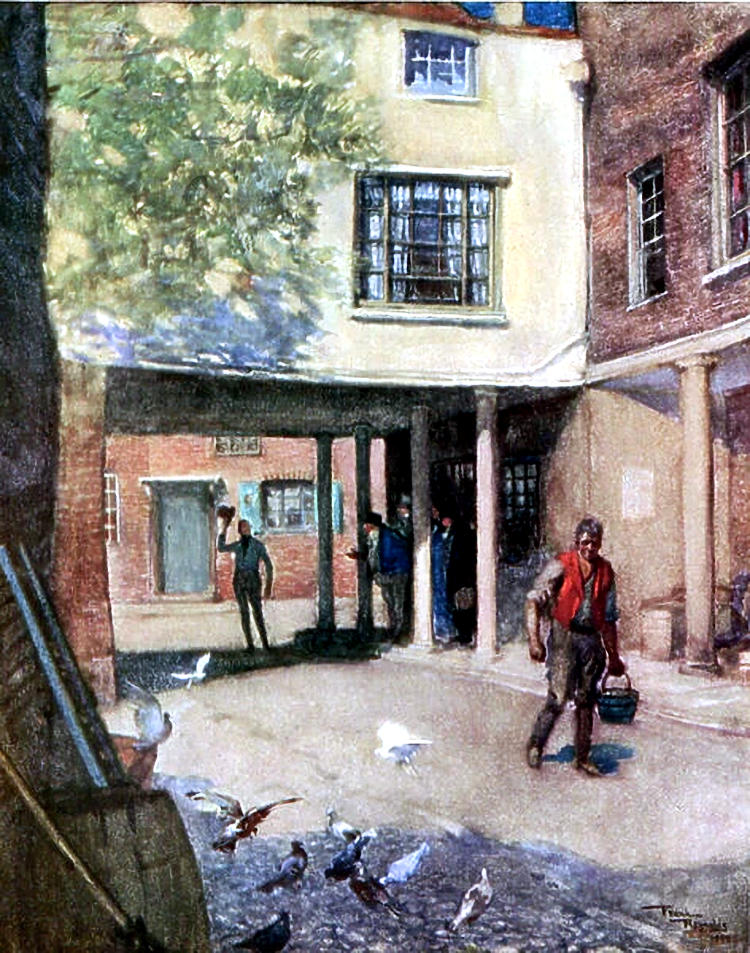
Above painting by Frank Reynolds (1876-1953), date unknown. |
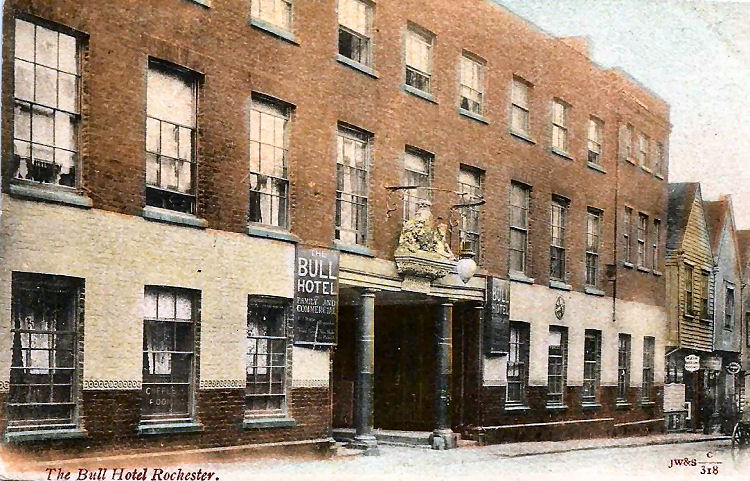
Above postcard, date unknown. |
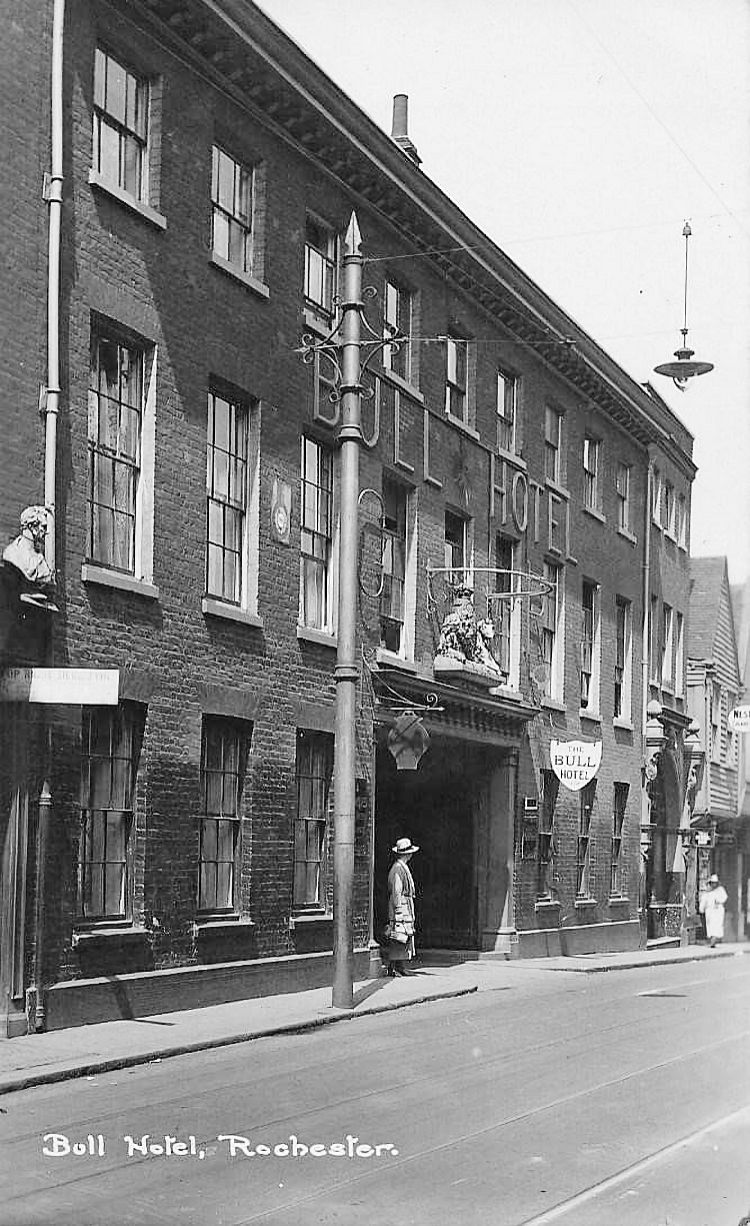
Above photo, date unknown. |
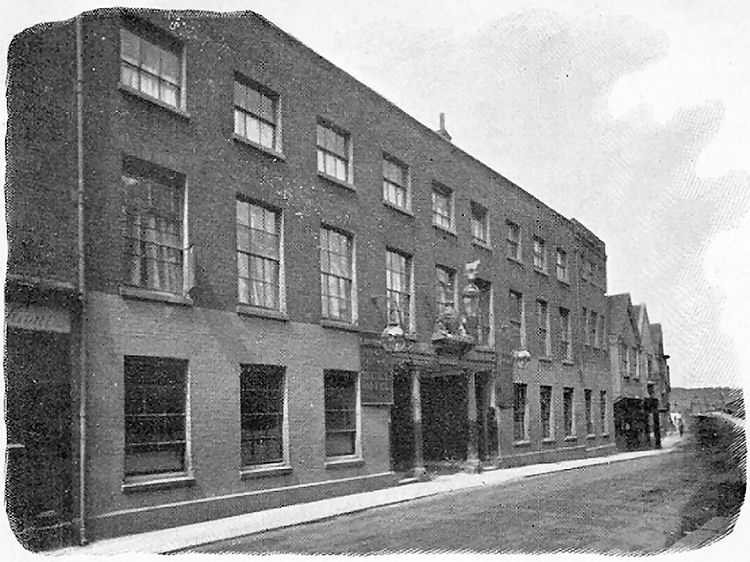
Above card, circa 1890, that advertised "Good house, nice beds" - Vide
(see) Pickwick. Pickwick refers to
the time when Charles Pickwick and his townie mates took horses and
carts, from the Bull, into the Kent countryside, with unfortunate
consequences! Pickwick Papers by Charles Dickens. Kindly sent by Rory Kehoe. |
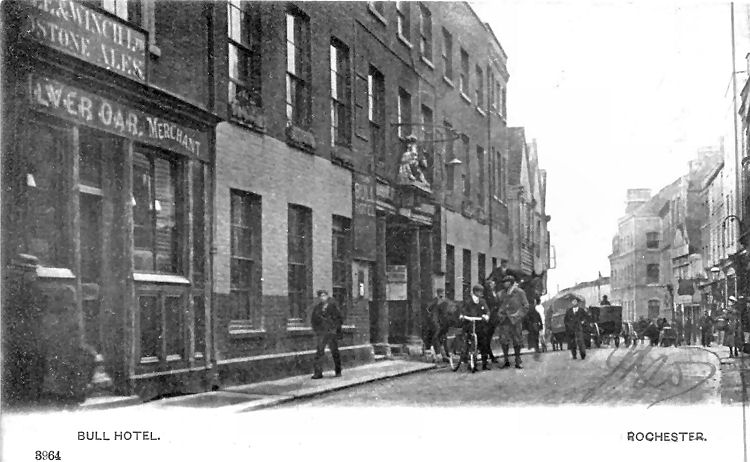
Above postcard, dated 1903, also showing the "Silver
Oar."
Kindly sent by Debi Birkin. |
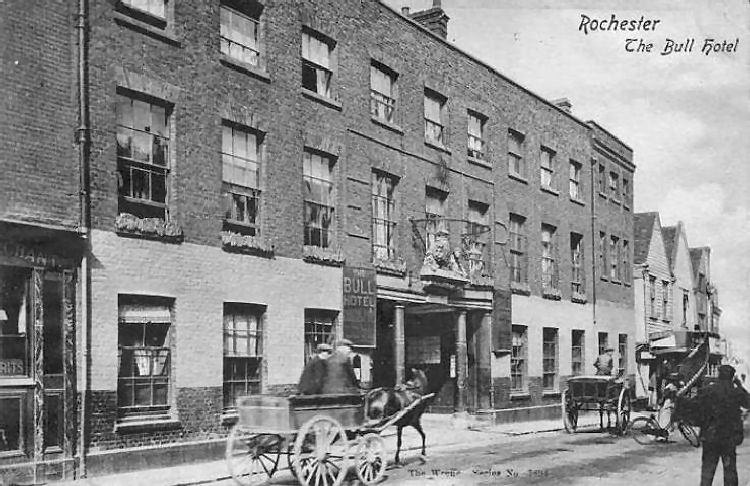
Above postcard, date 1906, kindly sent by Mark Jennings. |
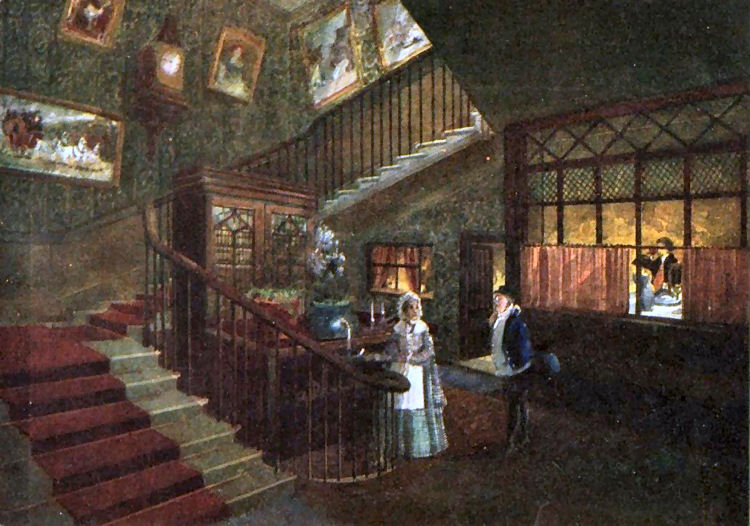
Above postcard, circa 1904, kindly sent by Mark Jennings.
Postcard titled "In Dicken's Room, Staircase" |
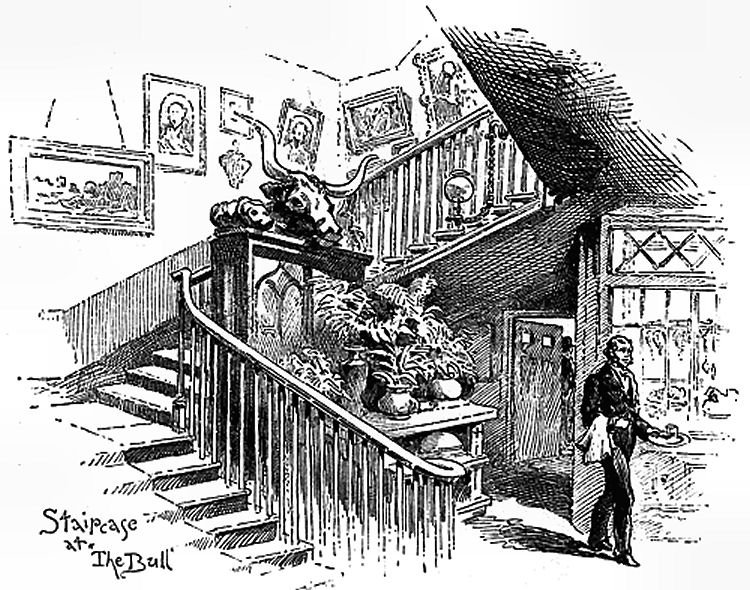
Above drawing date unknown. |
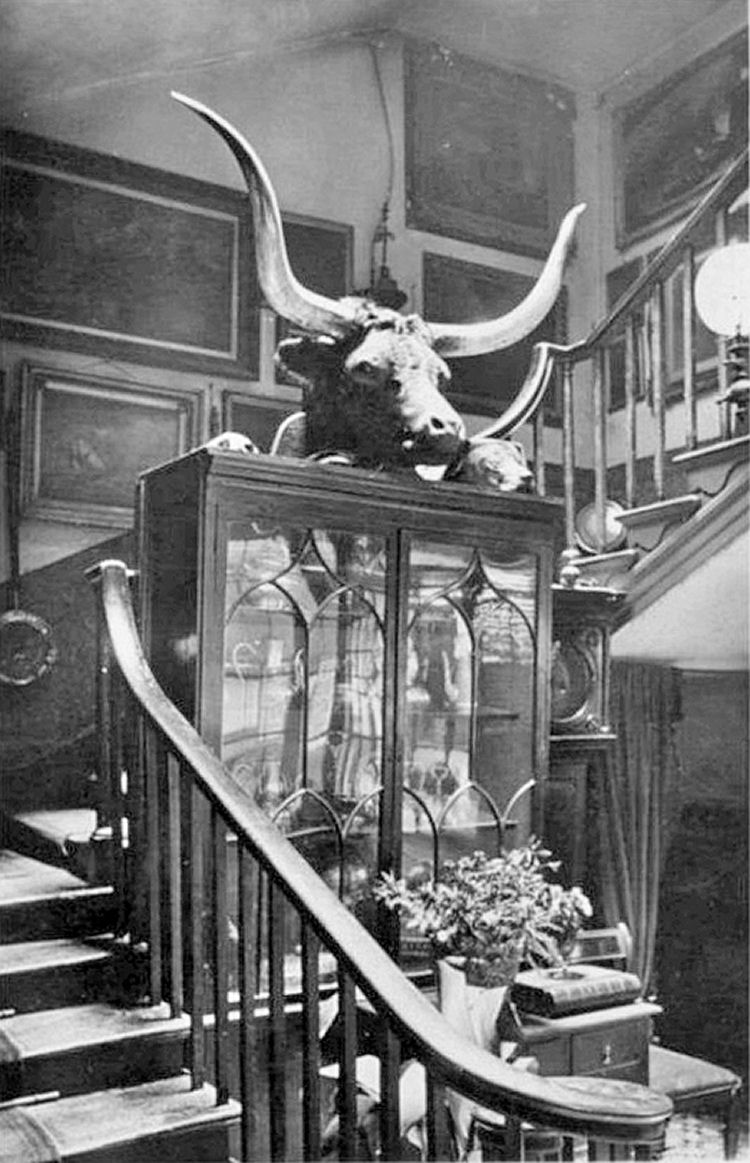
Above postcard showing the Main Staircase, kindly sent by Debi Birkin. |
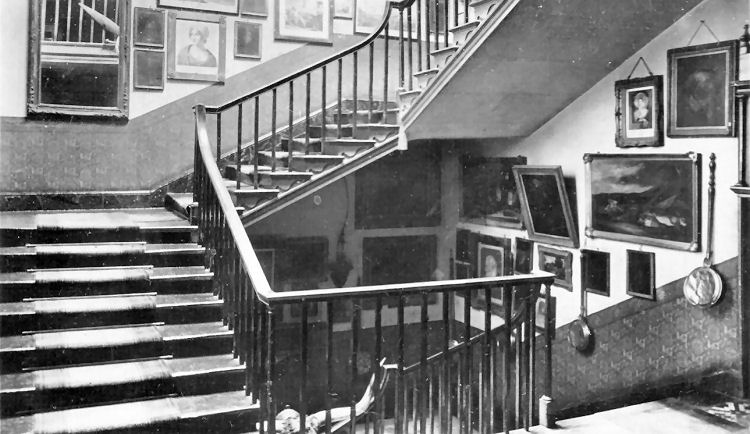
Above postcard showing the main staircase, kindly sent by Debi Birkin. |
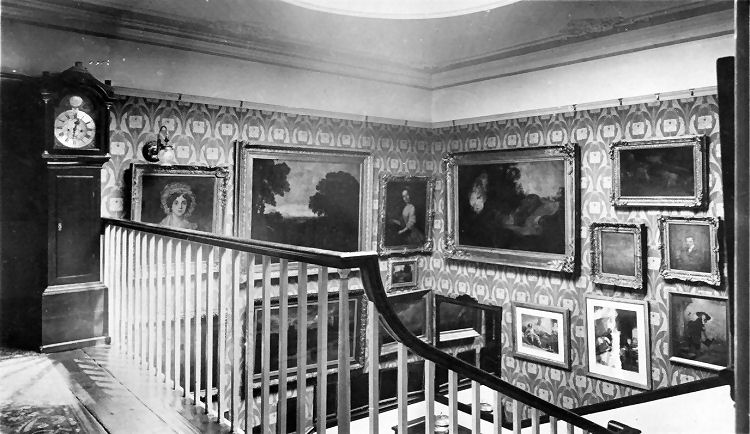
Above postcard showing the top corridor and staircase, kindly sent by
Debi Birkin. |
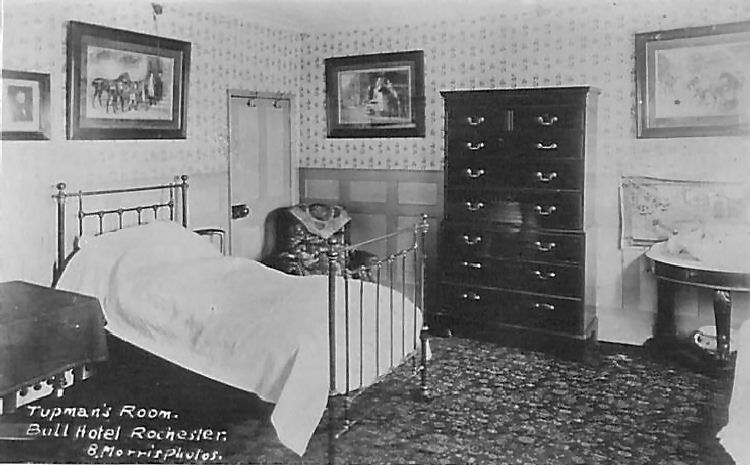
Above postcard, date unknown, showing the inside of the Tupman's Room. Kindly sent by Mark Jennings. |
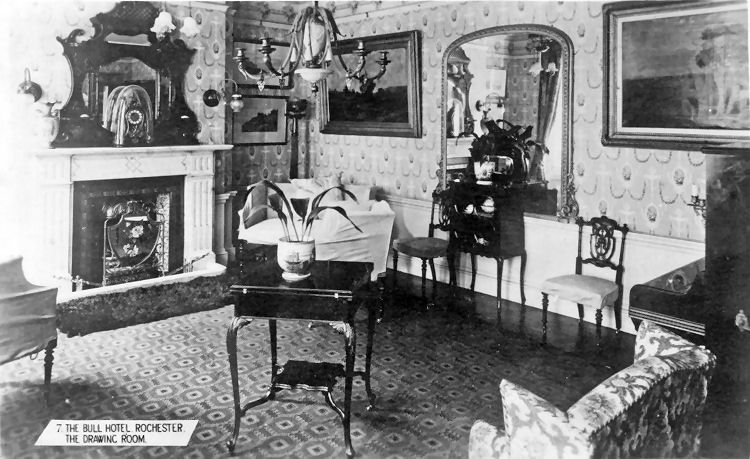
Above postcard showing the Drawing Room, kindly sent by Debi Birkin. |
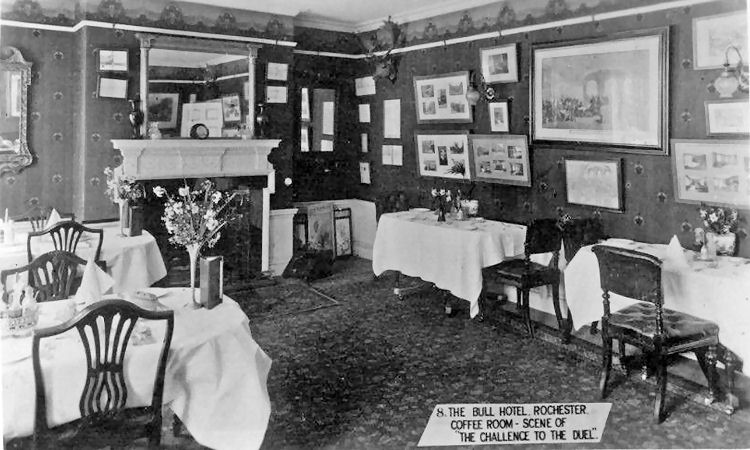
Above postcard showing the Coffee Room - scene of the Challenge to the
Duel, kindly sent by Debi Birkin. |
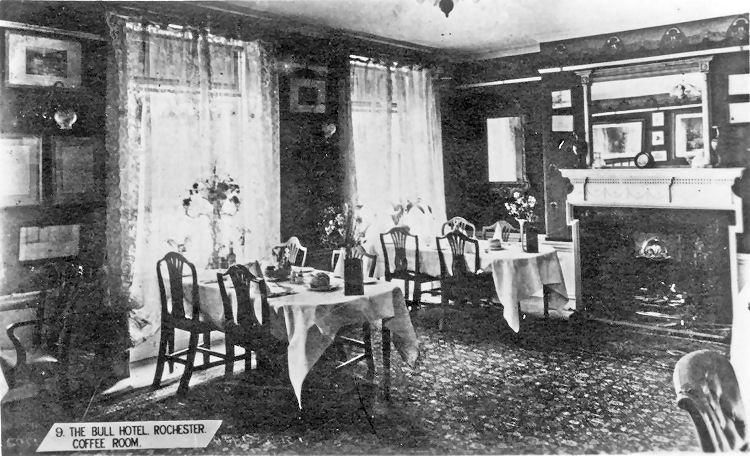
Above postcard showing the Coffee Room, kindly sent by Debi Birkin. |
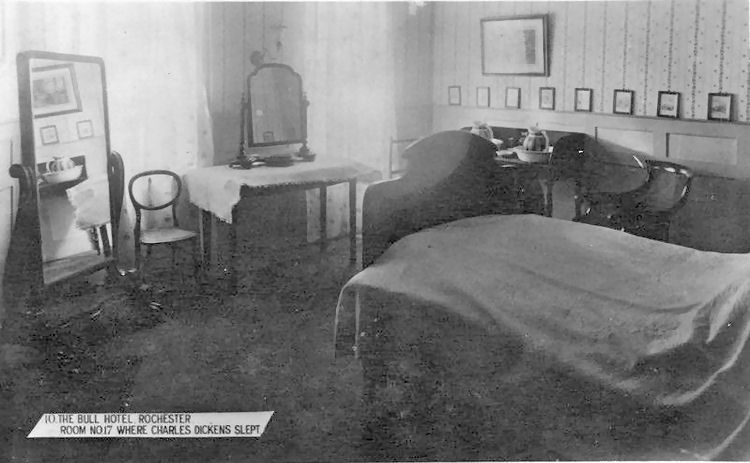
Above postcard showing the Room 17, where Charles Dickens spelt, kindly
sent by Debi Birkin. |
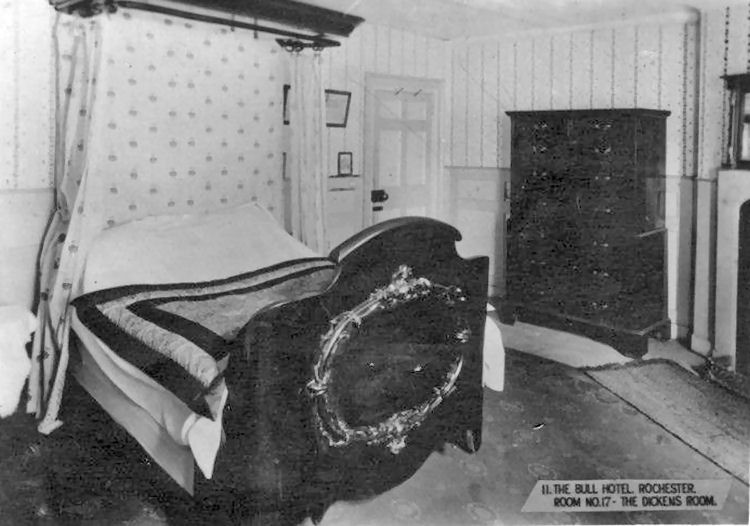
Above postcard showing the Room No 17. The Dicken's Room, kindly sent by
Debi Birkin. |
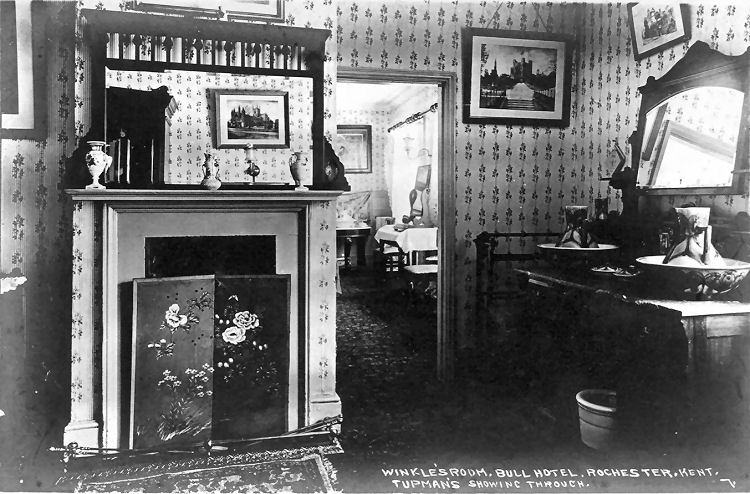
Above postcard showing Winkles Room, kindly sent by Debi Birkin. |
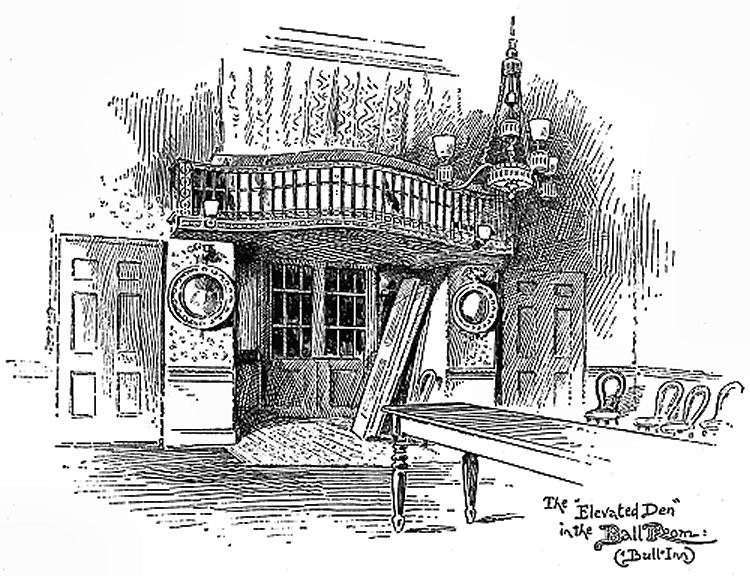
Above drawing of the Elevated Den, date unknown. |
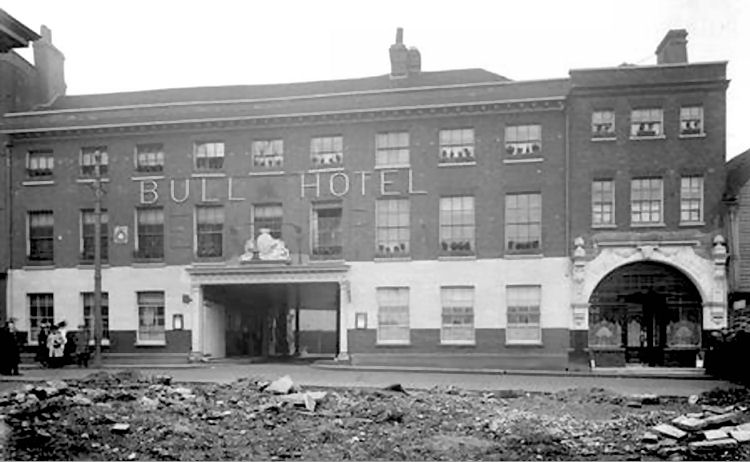
Above photo 1909, kindly sent by Debi Birkin. |
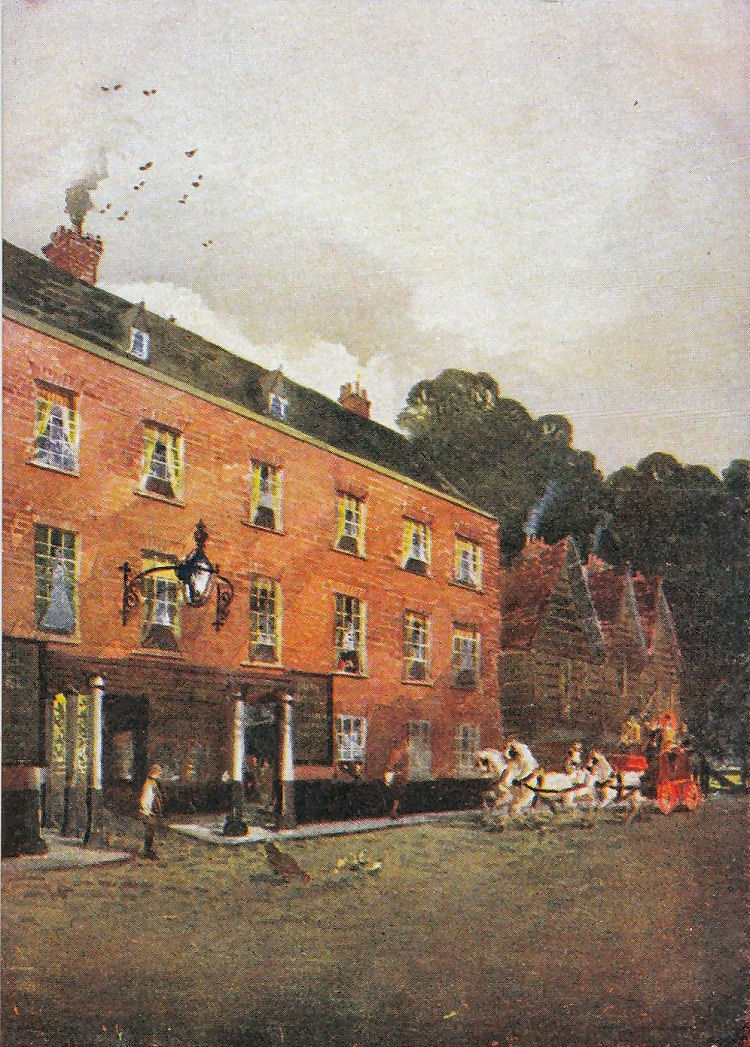
Above postcard, date unknown. |
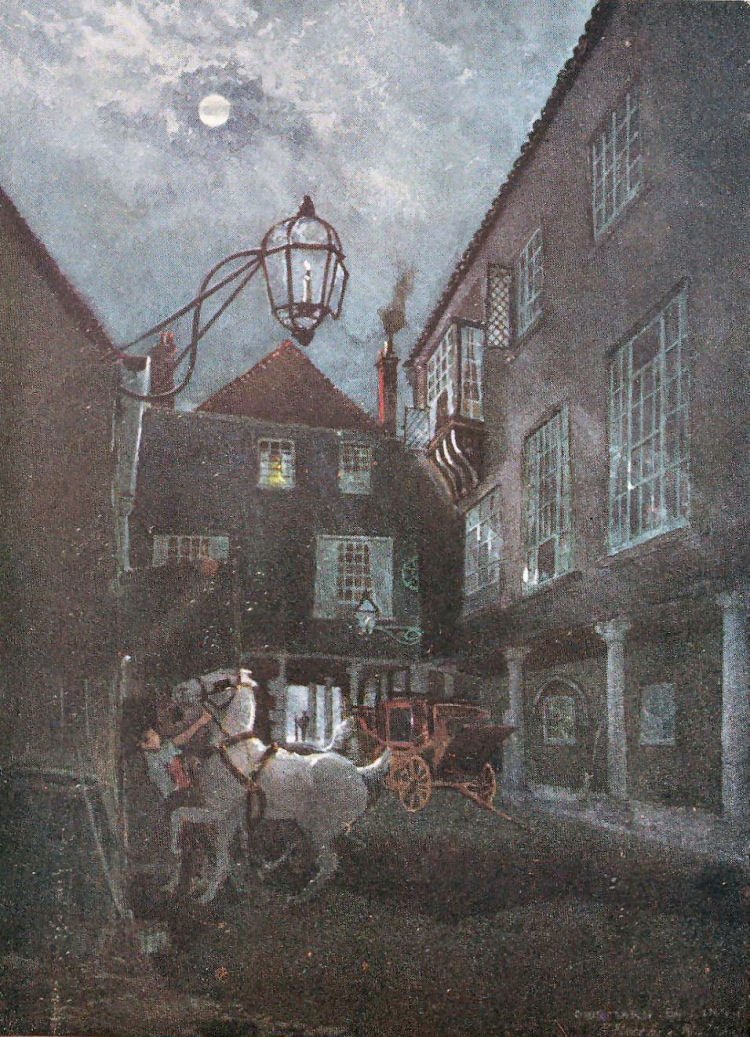
Above postcard showing the courtyard of the "Bull Inn" date unknown. |
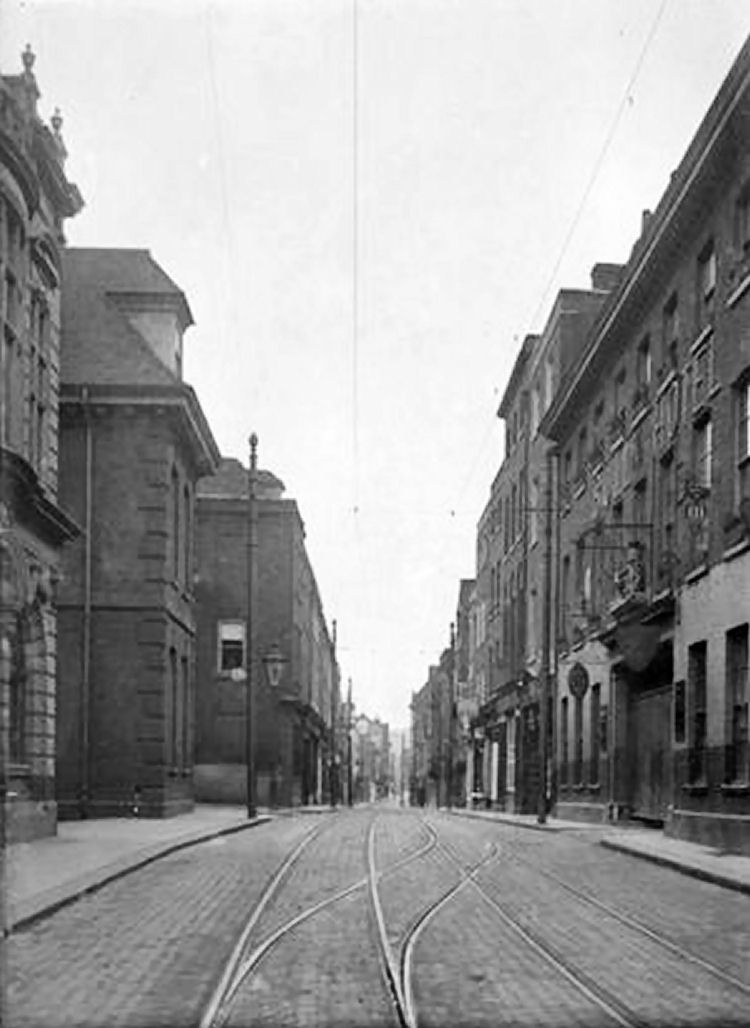
Above photo 1920s. |
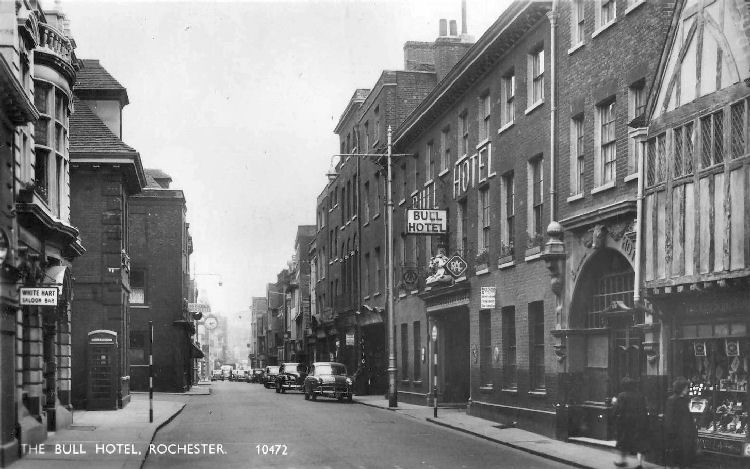
Above postcard, date unknown, kindly sent by Mark Jennings. Also
showing the "White Hart" on the
left. |
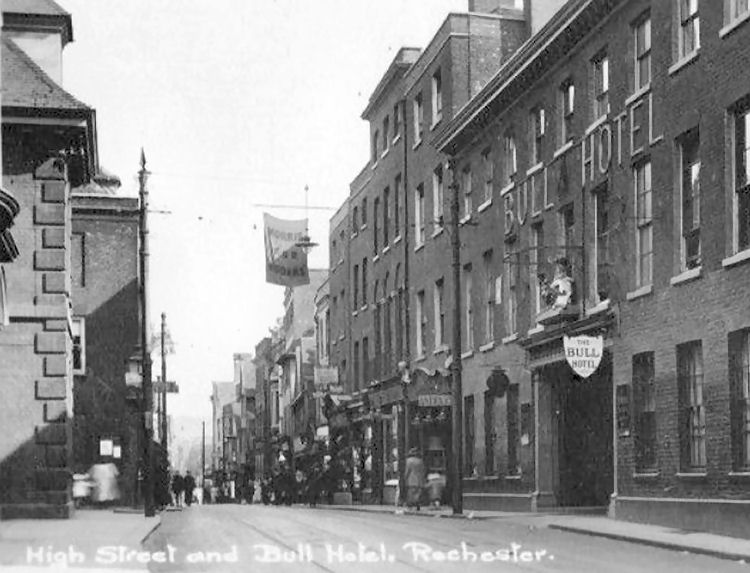
Above postcard, date unknown, kindly sent my Garth Wyver. |
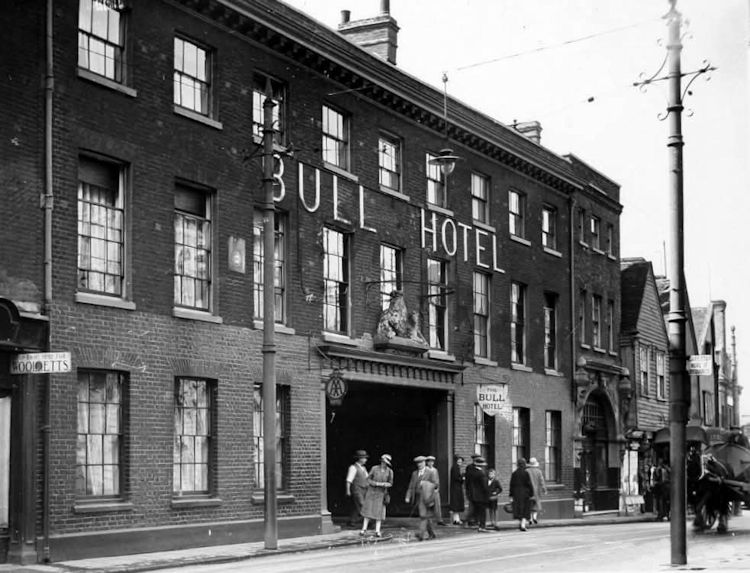
Above photo, circa 1920s. |
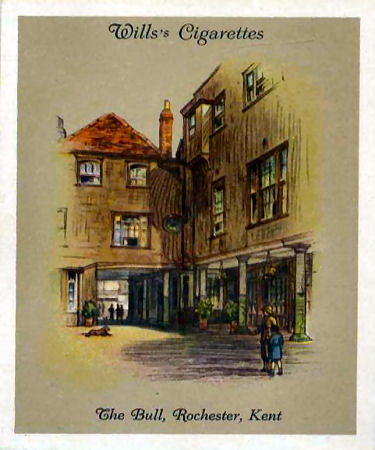 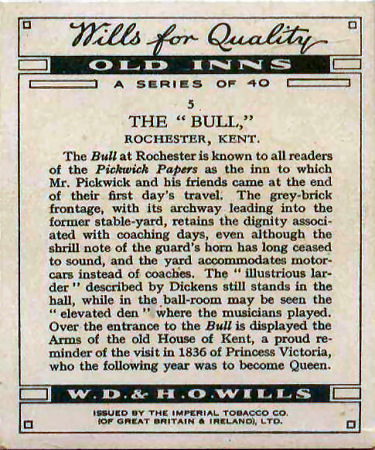
Above image showing the back and front of the Will cigarette cards, Old
Inns series. |
Situated next to the "Silver Oar."
The "Bull Hotel," became the "Bull and Royal Victoria Hotel" after the
death of Queen Victoria, she had stayed there twice in 1836 and 1855.
Charles Dickens also stayed there and mentions it in two of his novels,
“Great Expectations” as the "Blue
Boar" and by its own name in “Pickwick Papers”.
|
From the Kentish Gazette or Canterbury Chronicle,
Wednesday 31 May to Saturday 3 June, 1769. Price 2½d.
ROCHESTER PAVEMENTS AND NEW ROAD
The Commissioners for Paving Rochester and Strood, and making a new Road
from the “Star” in Eastgate to Chatham Hill, are earnestly requested to
observe that Thursday the 8th of June is the Day appointed for them to
meet at the “Bull Inn” in Rochester, to receive Proposals, and to
contract for carrying the desired Plan into immediate Execution. George Taylor, Clerk. |
|
From the Kentish Gazette or Canterbury Chronicle, Wednesday 31 May to
Saturday 3 June, 1769. Price 2½d.
ROCHESTER NEW ROAD AND STREET PAVEMENTS
Notice is hereby given, that a meeting of the Commissioners, for paving
the High Street and Lanes of the City of Rochester and Parish of Strood,
in the County of Kent; and for making a Road through Star Lane across
certain Fields adjoining thereto, to Chatham Hill, in the said County;
is appointed to be held at the “Bull Inn” in Rochester, on Thursday the
eighth Day of June next, at ten o'clock in the Forenoon; when they will
receive Proposals from any Persons, who shall be desirous to contract
with them for making a new Road from the “Star” in Eastgate across
certain Fields adjoining thereto, to Chatham Hill aforesaid. And also for paving the Carriageway of a High Street of the City of
Rochester, from a Lane called Bridge Lane, to the School-house in
Eastgate, with Scots, North Ferry, Wynn, Quarry Stone, Nine Inches deep,
from Five to Three Inches at Top, and the Bottom Five-sevenths of its
Thickness, and Nine inches in Length. Also for paving the Carriage way from the Pump in Strood to the Foot of
Rochester Bridge, with Scots, North-Ferry, Wynn, Quarry Stone, Nine
Inches deep, from Five to Three inches at Top, and the Bottom
Five-sevenths of its Thickness, and Nine inches in length. And also for paving the Carriage-way from the School-house aforesaid to
the “Star” in Eastgate, with Kentish Blue Stone, scabbed and squared,
Nine Inches deep, from Five to Three Inches at Top, and the Bottom
Five-seventh of its Thickest, and Nine Inches in Length. And also for paving a new-making a Foot-way from Bridge Lane aforesaid
to the “Star” in Eastgate, with Moor Stone Kirb, Seven Inches thick by
Twelve Inches in Width, the same to be completed and finished with
Yorkshire Ealing Hedge, of Two Inches and a half thick. And also for paving and making a Foot-way, from the Pump in Strood to
the Foot of Rochester Bridge aforesaid, with moor Stone Kirb, Seven
Inches thick by Twelve Inches in Width, the same to be finished and
completed with Yorkshire Ealing Hedge of Two Inches and a half thick. The Contractor or Contractors to be at all Charges in pulling up and
carrying away the old Materials to such places as the Commissioners or
their Surveyor shall direct or appoint; and to raise the Ground to such
a Level as shall be directed and formed; and to be at all other
incidental Charges whatsoever; and each Contractor is to produce a
Sample of Stone at the said meeting. Any Persons, willing to contract as above, are desired to deliver their
proposals for that Purpose, to Mr. George Taylor, Attorney, at Chatham,
in Writing, sealed up, at any Time on or before the said Eighth of June. By Order of the Commissioners. George Taylor, Clerk. |
|
From Kentish Gazette 15 June 1771.
NINE PENCE per MILE.
Whereas a Report has been industriously propagated, that Hester Heath,
of the "Bull Inn" in the city of Rochester, has made a Charge of One
Shilling per Mile, for her Post chaises; which Report she has been
credibly inform'd, has already tended to her Prejudice. She therefore
begs Leave to assure the Public, that she never has charged as reported,
but that her Chaises do and will continue Running at the usual Price of
Nine Pence per Mile, at which Price, those of the Nobility and Gentry,
who shall please to honour her with their Company, will have easy
Carriages, with
able Horses and careful Drivers, and the best Accommodations of every
Kind, will be supply'd on the lowest Terms, By their most obedient humble Servant, HESTER HEATH. |
|
Kentish Gazette 04 August 1786.
ROCHESTER, AUGUST 1, 1786. LAMP-LIGHTING.
Notice is hereby Given, That the Commissioners for executing an Act of
Parliament, passed in the Ninth Year of his present Majesty's Reign for
paving, etc. the High Streets and Lanes in the Parish of Saint Nicholas,
within the City of Rochester and Parish of Strood in the County of Kent,
and other Purposes, will be ready at their next Meeting, to be held at
the "Bull Inn," in the City of Rochester, on Tuesday the 22d Day of
August instant, at Eleven o'Clock in the Forenoon, to receive Proposals
for contracting with any Person or Persons for the providing Oil,
Cotton, and all Materials necessary, and for the cleansing and lighting
the lamps. Repairs, etc.
|
|
From the Maidstone Journal, 9 November 1790.
Extract of a letter from Rochester, Nov. 9.
Early on Friday morning last a dreadful fire broke out at the "Silver Oar," in
this City, which burning with astonishing rapidity, soon consumed the same, with
a house of E. Pilcher, Esq. and Mr. A. V. Sturt, linen-draper, adjoining. The
furniture of Mr. Sturt and the "Silver Oar" was nearly all preserved, but
scarcely anything was saved from Mr. Pilcher's. Two shipwrights who slept over
the room where the fire first broke out, unfortunately lost their lives. Their
bodies were taken out of the ruins miserably scorched. The fire was occasion by
two travellers leaving a candle too near the bed-curtains which caught the
flames. By the spirited exertions of the inhabitants, sided by a party of
soldiers from the Maidstone barracks, and a timely supply of water, it
was got under about 8 o'clock. Providentially there was no wind, or the
consequences would inevitably have been more dreadful. The "Bull Inn," adjoining
the "Silver Oar", was partly demolished, and the house of joining Mr. Sturt's
was much damage.
|
|
Kentish Gazette, 23 March, 1792.
"Bull Inn," Rochester.
Hester Heath and Son leave to acquaint the public, that in
rebuilding their house (lately destroyed by fire) the
greatest regards has been paid so to arrange the apartments as to
render it most conveniently adapted to the
accommodation of families, and fitted in a style of neatness that
they trust will be much appreciated.
They most respectfully hope they may mentioned to the Gentlemen of
the County, that Mr. Ayres, of the "Crown
Inn," has let his house, and solicits a portion of that patronage he
so long enjoyed; and are, with the utmost
gratitude and respect, the public's most obedient humble servants.
Hester and Matthew Heath.
|
|
Kentish Gazette, 17 August, 1792.
Rochester.
Last week died at Rochester, much missed Mrs. Hester Heath, mistress
of the "Bull Inn" in this city.
|
|
From the Maidstone Journal, 6 August 1793.
Bull Inn, Rochester.
To be sold by auction, by Mr. J. Batten, by order of the Assignees of the estate
and effects of Matthew Heath, a Bankrupt, on the premises, on Tuesday the 20th
day of August instant, between the hours of four and six o'clock in the
afternoon (unless disposed of in the meantime by private contract, of which
notice will be given) subject to such conditions as will be then and there
produced.
The Lease of all that newly-erected and well accustomed Inn and Tavern, known by
the sign of the "Bull Inn," at Rochester.
The premises are held for a term of 21 years from Christmas last, at a very low
rent, and comprise three elegant drawing rooms, 5 parlors, a coffee room, a
large assembly room capable of dining 100 persons commodiously, 17 best bed
Chambers, all fitted up in the most modern state; attached to the main building
are a number of apartments distinctly appropriated for gentleman's servants; the
yard is enclosed by numerous lockup coach houses and excellent stalling; and for
its greatest content extent, and every possible convenience may be justly
considered one of the most desirable situations for business in the kingdom.
Rochester is a city in which much local business is transferred, and is the
direct road to those favorite Watering Places Margate and Ramsgate, as well as
to the Continent.
For particulars apply to Mr. Bristow, Rochester, or Mr. Lawton, King's Bench
Walks, Inner Temple, London, Solicitors to the Assignees; or to the Auctioneer,
St. Margaret's Bank, Rochester.
Rochester, August 5 comments 1793.
|
|
From the Maidstone Journal, 13 August 1793.
"Bull-Inn," Rochester.
The lease of this Inn and Tavern, advertised to be sold by auction, on Tuesday
the 20th of August instant, is disposed of by private contract.
Rochester August 7, 1793.
|
|
From the Maidstone Journal, 15 October 1793.
"Bull Inn," Rochester.
Notice. The partnership subsisting between William Paternoster, and Stephen
Rayner, was this day dissolved by mutual consent. Witness are hands, this eighth
day of October, 1793.
J. Simmons; R. Bristow; William Patternoster; Stephen Rayner.
William Paternoster, begs leave very respectfully to inform the public, that he
intends continuing in the "Bull Inn" Rochester, where he hopes his endeavours to
give them the best accommodations, will ensue to him their protection and
support, and to return his most grateful thanks for the favours already
received.
|
|
From Newcastle Courant 18 October 1800.
On Sunday afternoon a post-chaise and four drove into the "Bull Inn" at
Rochester, which was immediately followed by a custom-house officer.
Upon searching, contraband lace a goods were found concealed in the
lining of the chaise, to the amount of £4000 which were seized. The
chaise and horses are of course forfeited. |
|
From the Kentish Gazette, 3 January 1804. Price 6d.
FREEHOLD MESSUAGES.—ROCHESTER, KENT.
TO be Sold by Auction, by Mr. BATTEN, on Friday the 13th day of January,
1804, at twelve o'clock at noon, at the “BULL INN,” Rochester,
All those two substantial Brick Dwelling-houses,
adjoining together, situate in the High Street of Rochester, with the
appurtenances; one late in the occupation of Mr. William Francis, at the
yearly rent of £42, but now of Mr. Edward Manclark, and the owner of Mr.
William Phillips, at the yearly rent of £42. These houses are freehold, but the back parts of the premises are held,
as Castle Ditch, at £3, per annual rent. To he viewed by applying to the tenants. Further particulars may
be known of Messrs. TWOPENNY, Rochester. |
|
From the Maidstone Gazette and West Kent Courier, 5 June, 1827.
Mr. Green the aeronaut has announced his intention of ascending from the
"Bull Inn" yard, Rochester, in his balloon on Wednesday next.
|
|
From the Kent Herald, 25 July 1833
Rochester
On Sunday last as one of the express boys, belonging to Mr. Ballard, of
the "Bull Inn," was exercising a very valuable horse on the Maidstone
Road the animal took fright and ran off at the top of his speed.
On turning the corner at the Vines, it's head came in contact with a
brick wall, when the boy was thrown off and the horse fell violently
upon him. The boy lies in a very dangerous state, and the horse upon its
arrival at the stable died.
|
|
From the Kent Herald, 22 August 1833
Marriage
Aug. 19, at St. Nicholas, Rochester, Mr. Edward Winch, of Sheerness, to
Eliza, youngest daughter of Mrs. Ballard, "Bull Hotel," Rochester.
|
|
From The Essex Standard, and Colchester, Chelmsford, Maldon, Harwich,
and General County Advertiser (Colchester, England ), Friday, March 20, 1835.
DIED.
11 inst. after a short illness, aged 74, Mr. John Witham, of the "Lion
Inn," Rayleigh, deeply lamented by his large family and numerous circle
of friends, as a tender and affectionate father and husband, and as a
sincerely esteemed neighbour for his ready generous acts of liberality
and kindness, his loss will be sincerely regretted by many persons who
knew him. Forty Years Since he was the highly respectable Landlord of
the "Bull Inn," Rochester, Kent.
|
|
South Eastern Gazette, Tuesday 8 June 1841.
INSOLVENT DEBTORS.
To be heard at Maidstone, in the county of Kent, on the 30th day of
June, 1841, at the hour of ten in the forenoon precisely.
EDWARD BIRCH.
Formerly of the city of Rochester, in the county of Kent,
attorney-at-law and solicitor in Chancery; then of the city of Rochester
and Maidstone, in the said county of Kent, attorney-at-law and solicitor
in Chancery; and last residing at the "Bull Inn," city of Rochester,
aforesaid, attorney-at-law and solicitor in Chancery.
|
|
From the Kentish Gazette, 1 February 1842.
ROCHESTER AND CHATHAM.
At a public meeting in the Guildhall, Rochester, on Friday, the Mayor in
the chair, it was determined to celebrate the day of the royal baptism
by a public dinner, a subscription (at which £150 had been raised) to
supply the poor with bread, meat, and beer, a closing of shops, and a
general suspension of business. A ball took place at the "Bull Inn,"
Rochester, on Tuesday evening, to honour of the event, at which all the
gentlemen belonging to the subscription assemblies acted as stewards.
|
|
Kentish Gazette, 4 September 1849.
DEATH.
Birch. Aug 25, after a few hours' illness, Mr. Henry Birch, of the "Bull
Inn," Rochester, aged 72 years.
|
|
Kentish Gazette, 14 May 1850.
ROCHESTER. Melancholy Accident.
On Friday morning se’n-night Mr. Lockyer, the old and respected waiter
at the "Bull Inn," Rochester, was found dead at the bottom of some steps
leading to a cellar in the inn yard. It appeared it the inquest holden
at the "Bull tap," before Mr. James Lewis, coroner, that the usual
monthly ball had been held at the inn on the previous night, and that
Lockyer was in attendance till nearly three o'clock the following
morning, when he was last seen. Between ten and eleven next day, one of
the persona employed about the establishment discovered his body at the
foot of the steps, before alluded to, about nine or ten deep, quite
dead, he had fallen backwards, his head resting against the cellar door,
the arms bent and the knees up, quite stiff. From all the circumstances,
the jury had no doubt that he had been to a closet close by, and had
mistaken his way. The surgeon was of opinion that he had been dead some
hours. The deceased was 64 years of age.
Verdict:— Accidental death.
|
|
From the Maidstone Journal and Kentish Advertiser, Tuesday 5 August 1856.
Good house. Nice beds. - Pickwick. p. 10.
The "Royal Victoria and Bull Hotel," Rochester.
Facing the Town Hall, in addition to the coffee and commercial, has
various sized rooms for large and small parties, on reasonable terms.
Post horses and carriages as usual.
The Cathedral, Castle, and surrounding Scenery are replete with
interest.
|
|
From the Southeastern Gazette, 1 May 1866.
Charge of Theft against a Russian Surgeon.
At the Chatham Police Court, yesterday (before the Revs. J. J. Marsham
and W. S. Masters, and T. H. Day, Esq.), a respectably-dressed, tall
man, named Bertrand Ashley, alias Nabskoff, who described himself as an
assistant-surgeon in the Russian army, was charged with stealing two
printed books, of the value of £2, from the “Globe Hotel,” the property
of Mr. Burch, the landlord. Mr. Stephenson appeared for the accused. The
prisoner had been stopping at the “Globe” for several weeks, and had ran
up a heavy score, putting off payment from time to time on the
representation that be had some money coming to him, and that he was
acquainted with several of the naval surgeons at Melville Hospital. On
Sunday it was ascertained that he had carried off two valuable books
from the “Globe,” and deposited them with some other property left at
the “Bull Hotel,” Rochester, until he called for it. On the books being
missed he was given into custody, when he resisted in the most violent
and determined manner, it being ultimately found necessary to strap him
down on the stretcher and convey him to the police-station. After being
taken into custody it was found that he had recently disposed of two
gold watches and some trinkets, which are believed to have been stolen.
Since the accused has been in Chatham he has succeeded in victimising
several tradesmen, among whom are Mr. Naylar and Messrs. Newcomb. He
also appears to have ordered a suit of clothes of Messrs. Hopkins and
Ashby, Hamond-place, but he was not allowed to have them without
payment. On the application of Supt. Everist the accused was remanded
until Wednesday (to-morrow).
|
|
From the Southeastern Gazette, 8 May 1866.
COUNTY PETTY SESSIONS.
Wednesday. (Before Captain H. Savage and W. H. Nicholson, Esq.)
Betram Ashley, alias Nicholas Nabakoff, stated to be an
assistant-surgeon in the Imperial Russian Navy, who stands charged with
stealing two printed books, value £2, from the “Globe Hotel,” was
further examined.
The prisoner, who was defended by Mr. Stephenson, appeared to be very
ill, and he was allowed to be seated daring his examination. His
solicitor stated that he was a gentleman of high attainments, and was
acquainted with six or seven languages.
Mrs. Burch, landlady of the “Globe Hotel,” High-street, said the
prisoner came to the hotel on the 20th March, and remained there until
Sunday, the day of his apprehension. On Sunday the witness missed two
volumes of a work entitled “Old England,” which had been usually kept in
The commercial room. The prisoner made no statement to the witness
respecting the books.
By Mr. Stephenson:— The prisoner twice paid witness money on account of
his bill. On one occasion he paid £1 16s., and on another £4. He
afterwards ran up an account of £6 14s. 7d. The prisoner had for several
days been reading the books which he was now charged with stealing. The
prisoner walked about the house and had access to all the rooms. He
appeared to be a gentleman, and gentlemen from the barracks visited him.
He occasionally read other works in the house, and always returned them.
On Sunday evening, when the prisoner was taken into custody, he told
witness he did not intend to steal the books.
The prisoner, at this stage of the proceedings, went off apparently in a
fit, and fell down on the floor of the dock.
In answer to the magistrates, Supt. Everist said the prisoner had had
several fits, apparently of the same kind, since he had been in custody,
and the police surgeon had visited him twice.
The magistrates ordered the prisoner to be removed, and after an absence
of about half an hour he was again brought into the Court, having in the
interval been supplied with some brandy and water, and his examination
resumed.
William Willson, boots at the “Globe Hotel,” said on the previous
Thursday he saw the prisoner in the commercial-room with a portmanteau
in his hand. The portmanteau produced was the same he then saw. Prisoner
told him to take it to the “Bull Hotel,” Rochester. The witness gave it
to a man, named Fawcett to carry to the “Bull Hotel.”
George Fawcett said he received the portmanteau from the last witness,
and carried it to the “Bull Hotel,” leaving it with a waiter. On witness
returning to Chatham he met the prisoner going towards the “Bull.”
Nothing was said about the witness being paid, and the prisoner had
never given him anything.
Mr. Geo. Willson, landlord of the “Bull Hotel,” said he first saw the
prisoner on Friday morning. On the previous night the prisoner came to
the hotel with a lady, and wished to sleep there. On Friday morning
prisoner came to the hotel and asked if the lady was in No. 4
sitting-room, and on being told that she was prisoner went up to her. On
Friday afternoon the witness saw the portmanteau in one of the
bed-rooms. Neither the prisoner nor the lady returned after they left on
Friday morning, and the witness did not see the prisoner until he was in
custody. On Sunday morning witness examined the portmanteau, which was
unlocked, and there discovered a silk handkerchief, marked with the
named of “Lawrenson, R.N.” one of the surgeons at Melville Hospital.
Some articles of clothing were there, and the two printed books
produced. The prisoner was indebted to witness, on Sunday, in the sum of
18s. 6d., which was still unpaid. Witness delivered the portmanteau and
its contents to the superintendent of police.
Cross-examined by Mr. Stephenson:—When the prisoner and the lady first
came they had no luggage, and it was not the custom of the house to
allow strangers, ladies and gentlemen together, to sleep there without
luggage. The prisoner and the lady were shown a sitting-room and
bed-room, and on being asked respecting their luggage prisoner went out
and the portmanteau came in about an hour afterwards. Mrs. Willson and
the chambermaid both had some communication with the prisoner.
Mr. Stephenson said he must request that both Mrs. Willson and the
chambermaid should be present. He had a complete answer to the case,
which was one of the most extraordinary he had been engaged in for many
years.
The prisoner said he also wished the two waiters to be present, as they
could give most important evidence on the charge of which be was
entirely innocent.
The Bench accordingly ordered the required witnesses to be sent for, and
another considerable adjournment took place.
Edward Petty, waiter at the “Bull Hotel,” said he first saw the
prisoner, with a lady, on the previous Thursday evening. They came to
the bar hotel, and the prisoner asked for a private room and a bed-room.
They objected to a room on the ground floor, as not being good enough,
and they were accordingly shown a room upstairs, which they took
possession of. They had supper, and prisoner afterwards said he would go
out and see that the portmanteau was sent up. Prisoner went out, and
shortly after nine the portmanteau was brought by the witness Fawcett. A
short time afterwards the prisoner returned and asked for the
portmanteau, which he directed to be taken up into the sitting- room.
Prisoner remained about half an hour and then left the house, sleeping
out. On the following morning he came for the lady, and they both left
together, neither of them returning. No money was received from either
of them.
By Mr. Stephenson:— When they first arrived neither had any luggage.
Prisoner said he would go after his portmanteau. Nothing was said to
them about having luggage. Did not hear the prisoner tell the lady he
would bring her some books to make her comfortable.
Mr. Stephenson said he wished the lady who was with the prisoner at the
“Bull” to be examined, but as she was at Birmingham some few days must
elapse before she could be communicated with.
The prisoner said he wished to be remanded for a week, as there must be
no stain on the lady's character.
Mr. Nicholson:— Then let the prisoner be remanded for one week.
|
|
From the Southeastern Gazette, 5 June 1866.
Hotel Robbery.
During Friday afternoon last two respectably dressed men entered the
“Bull Hotel,” Rochester, and having been supplied with some refreshment,
succeeded in carrying off from one of the upstair rooms £10 in money, a
gold watch, and some trifling articles belonging to one of the servants,
together with a portmanteau and its contents from a gentleman staying in
the house, with, the whole of which they got off. After the robbery they
proceeded in the direction of Gravesend, and were seen, crossing
Rochester-bridge, with the portmanteau in their possession.
|
|
From the Southeastern Gazette, 31 July 1866.
GROWN COURT — FRIDAY. (Before Mr. Baron Channell)Conviction of a Foreign Swindler.
Bertrand Ashley, alias Ashley Nabokoff, 22, remanded from the last West
Kent Sessions, was indicted for stealing two printed books, the property
of James Burch, at Chatham, on the 26th April; also for stealing a gold
watch and other articles, value £20, the property of Esther Carpenter,
in a dwelling-house, at Maidstone, on the 19th March. There were several
other charges against the prisoner beside those above mentioned, one of
which was that of stealing a small gold cross, the property of Thos.
White, at Chatham, on the 13th April.
The prisoner, on his arraignment on Thursday, elected to be tried by a
mixed jury of foreigners and Englishmen, and he also asked that the
Judge would assign him a counsel. Although it was not usual in cases of
felony, his lordship consented, and asked Mr. Poland to take charge of
the defence. Mr. Barrow prosecuted.
The career of the prisoner appeared to have been a most extraordinary
one, and the facts disclosed in the course of the inquiry left no doubt
that he was a most accomplished swindler. The first that seemed to have
been known of him was in 1863, when he made his appearance at Oxford,
and afterwards at Cambridge, where he succeeded, at both places, in
victimising hotel keepers and others to a considerable extent; but his
proceedings were cut short by a conviction for swindling, and he was
sentenced to imprisonment. After this he made his appearance at
Tunbridge Wells, where he represented himself as Count Sobieski, a son
of the late King of Poland, and that he had been exiled on account of
his political opinions by the Russian Government. His appearance was
much in his favour, being young and tall, and his expression of
melancholy and the recital he made of his supposed wrongs and sufferings
in the cause of his country procured for him a great deal of sympathy.
It was his custom to walk on the Parade, and to get the Parade Band to
play the Polish National Anthem, and he would wander gloomily along, as
though absorbed in his melancholy reflections. The consequence of these
proceedings was that he ingratiated himself into the confidence of a
good many respectable persons, from whom he succeeded in obtaining money
and property; and he also appears to have ingratiated himself with some
young ladies, who seemed to be enamoured of the “distinguished young
exile.” He professed to live by money transmitted to him from his Polish
estates by his agent in that country, but the result showed that he got
his living by swindling and fraud; and after a rather long visit at
Tunbridge Wells he suddenly decamped, having victimised almost every one
that came in his way. He then seems to have made his way to Chatham,
where he succeeded in inducing a medical gentleman of great
respectability, to whom he had introduced himself as a Polish exile, to
take an interest in him, and this gentleman introduced him to several
respectable persons with whom he was acquainted, among whom was Mr.
White, a gentleman connected with the military staff at Chatham, and he
constantly visited the latter, and was treated by him with the greatest
kindness. He took the opportunity, upon one of these occasions, to steal
a gold cross, and this was one of the charges that were now preferred
against him. At the time, the prisoner was staying at the “Globe Hotel”
at Chatham, and it appeared that, previously to his going to that place,
he formed an acquaintance with a female who turned out to be a married
woman who had come to Dover to visit her relations, and she had made an
appointment to meet him at Rochester, and they went to the “Bull Hotel”
at that place. The rest of the facts will be gathered from the following
evidence:—
Mr. White said he was in the military service in Chatham in April last,
when prisoner was introduced to him, and came occasionally to his house.
He showed the prisoner a chain with a gold cross upon it on the evening
of the 13th April, and on leaving the room, witness went upstairs to
dress. When he returned prisoner was still there. Next morning witness
discovered that the cross was missing.
Esther Brenchley said her mother lived in High-street, Rochester.
Prisoner was in the habit of coming to her house for a glass of ale. He
offered to make witness a present of the cross in question, and she
received it from him on the 14th April. He asked her to take it as a
keepsake. She afterwards gave it up to the constable.
Supt. Everist said he received the cross in the beginning of May from
the last witness.
In summing up the evidence for the prosecution, Mr. Barrow directed his
arguments to the cross-examination of the witnesses touching the
identity of the cross.
Mr. White, recalled by the Judge, stated that he identified the cross by
a defect in the welding. The chain was attached to a split ring, and no
one had access to the room but the servant and the prisoner.
Mr. Barrow having summed up, Mr. Poland addressed the jury for the
defence. He admitted that there was a certain amount of suspicion
against the prisoner, but no positive proofs of his guilt. The whole
case really turned on the identity of the articles, and he strongly
contended that that had not been satisfactorily established.
The jury, after a rather lengthened consultation, re-turned a verdict of
“Not guilty.”
The charge of stealing books was then proceeded with; the same counsel
being engaged as in the above case.
Mrs. Burch, wife of the landlord of the “Globe Inn,” Chatham, stated
that the prisoner came to their house on the 20th March, and stayed till
the 26th. The books in question were in the commercial room, where she
last saw
them on Thursday evening, the 26th April. She missed them on the
following Sunday.
Cross-examined:— The books were not taken into the commercial room for
his special use, but for the general use of all persons frequenting the
room. Had lent the prisoner several books during his stay, which he
returned.
William Wilson said he received a portmanteau from the prisoner, with
orders to get a man to convey it to the “Globe Inn,” Rochester.
George Faucett received a portmanteau, which he conveyed to the “Bull
Inn,” Rochester.
Edward Petty, waiter at the “Bull,” remembered the prisoner arriving
with a lady. He engaged a private room and a bed room. They had no
luggage with them. They had some tea and cold meat. Prisoner said he
would send a portmanteau up. He afterwards went out, and during his
absence Faucett came with the portmanteau and gave it to witness.
Prisoner returned about half-past ten or eleven, and asked for the
portmanteau. He went out again, and on the following morning he returned
and took the lady away, leaving the portmanteau.
Cross-examined:— When the prisoner came he was asked if he had any
luggage.
Mr. Geo. Wilson, landlord of the “Bull,” deposed that on the Friday
morning prisoner asked for the lady in No. 4 room, and he went upstairs.
The bill was not paid then. When the prisoner returned down stairs he
went away. On the Sunday witness opened the portmanteau and found the
two books (already produced) a pair of slippers, a pocket handkerchief,
and other articles.
Supt. Everist stated that, from information received, he sought for the
prisoner, and found him at the “Globe.” Prisoner asked that Dr. Laurence
might be sent for, but that gentleman refused to see him. He told
prisoner he was “wanted,” and be ran off, and witness had great
difficulty in capturing him.
The jury found the prisoner guilty.
The next charge against the prisoner was for the felony at Maidstone.
Mr. F. J. Smith prosecuted in this case.
Mrs. Esther Carpenter, widow, said she lived at the “Palace,” Maidstone.
On the Sunday evening, 1st March, when she went to bed, she left her
gold watch on the table by the side of the bed. It was attached to a
chain, which held some trinkets also. She missed them next day.
Anne Luckhurst, servant to the last witness, deposed to seeing the watch
on the table.
Mary Ann Surr, another of the servants, said that on the afternoon of
the 19th March prisoner came to the door and asked to see the clergyman?
She told him he was not there, and the prisoner then asked to see “the
curate,” who was also not at the house. The door could be opened from
the outside. Witness then went into the kitchen, and heard some one open
the front door. She went and shut it.
Mr. Benjamin de la Cour, silversmith, at Chatham, said that the prisoner
came to his shop, and said he was attached to the Royal Naval Hospital,
Chatham. He left a watch, upon which witness advanced £4, prisoner
observing that he would have a remittance in a fortnight from his
father.
Mr. P. Hyman, watchmaker, Chatham, deposed that on the 23rd March
prisoner brought a pencil-case to his shop, for repair. Some time after
he brought some trinkets and a watch to witness’s shop.
Supt. Everist said that when he took prisoner into custody, on the
charge of stealing the property from the Palace, he alleged that he had
the articles from France.
The jury returned a verdict of guilty in this case also.
His Lordship observed that prisoner had desired, and he was very glad he
had done so, to have a jury composed partly of foreigners; though for
his own part he did not believe that foreigners showed more good sense
and better judgment in deciding upon a case than an English jury. At the
same time, it was certainly desirable that every appearance of
impartially and justice should be shown to every prisoner, especially in
the case of one, who being a foreigner, was supposed to be without such
friends and assistance as an Englishman might command. Now he had not
the least doubt as to the propriety of the verdict of the jury, and it
was his duty in sentencing the prisoner not to lose sight of the fact of
there being two previous convictions recorded against him. Under these
circumstances, to sentence him to imprisonment for the extreme length of
time the law allowed would not be anything like adequate punishment, and
the sentence of the Court was therefore one of penal servitude, and that
for seven years.
|
|
From the Whitstable Times and Herne Bay Herald. 9 March 1901. Price 1d.
FIRE AT THE BULL HOTEL.
On Saturday morning shortly before two o'clock, the police discovered to
be on fire the famous hostelry, the “Bull and Royal Victoria Hotel,” at
which the late Queen Victoria stayed on more then one occasion daring
the time of the Crimean War when visiting the sick and wounded soldiers
invalided to this military station. The house has also been immortalised
by Dickens in “Pickwick Papers.” At 1.55 River-Police-Sergeant Hill,
when crossing the bridge, noticed smoke issuing from the cellar and the
commercial room and gave the alarm at the Guildhall fire station
opposite, and very quickly there was a strong muster of the Fire
Brigade, under Captain C. D. Levy and Lieutenants E. Dobson and E.
Lynch, and also of police, under Inspector Brooks. The inmates of the
large establishment had been aroused at the earliest moment after the
discovery, and were assisted to a place of safety by the police and
others. In the meantime the Fire Brigade had succeeded in staying the
progress of the outbreak and confining it to the commercial rooms,
lavatories, and basement, and the old room known as the “Owl” parlour,
the headquarters of a celebrated club, which at one time included among
its members many distinguished Americans who had visited the historic
city. The damage was considerable, notwithstanding the extraordinary
success of the firemen in extinguishing the conflagration as they did.
Smoke and water spoilt much valuable property where the fire had not
reached; but fortunately the old staircase and chief apartments of the
hotel are uninjured. The building and furniture are insured by the
proprietor (Mr. Briggs) in the Royal Exchange office. The cause of the
outbreak is unknown. Fortunately, there were very few visitors staying
at the hotel at the time, and most of the commercial travellers had gone
back to London for the week-end. |
I will be adding the historical information when I find or are sent it,
but this project is a very big one, and I do not know when or where the
information will come from.
All emails are answered.
LICENSEE LIST
HEATH Hester 1771+
HEATH Hester & Matthew 1792+
KING John
 to Aug/1786
 WITHAM John 1788-95+
RAYNER Stephen to 8/Oct/1793 & PATERNOSTER William 1793-1815+

BALLARD Mary 1828-33+
 
BIRCH Henry 1847-25/Aug/49 dec'd
BLUCK S H 1852+
FRY Sarah Jane Miss 1858+
TAYLOR Godfrey 1862+
SPONG Henry Summerfield 1870-74+
LAWRENCE Joseph 1891+
SNELL John Thomas 1911+
BURROWS Bernard B 1913+
OLIVER W H 1918-30+
Exors of OLIVER W H 1938+
OLIVER N E 1955+
https://pubwiki.co.uk/RoyalVictoriaBull.shtml
Kentish
Chronicle
From the Pigot's Directory 1828-29
From the Pigot's Directory 1832-33-34
|

