|
198 High Street
Chatham
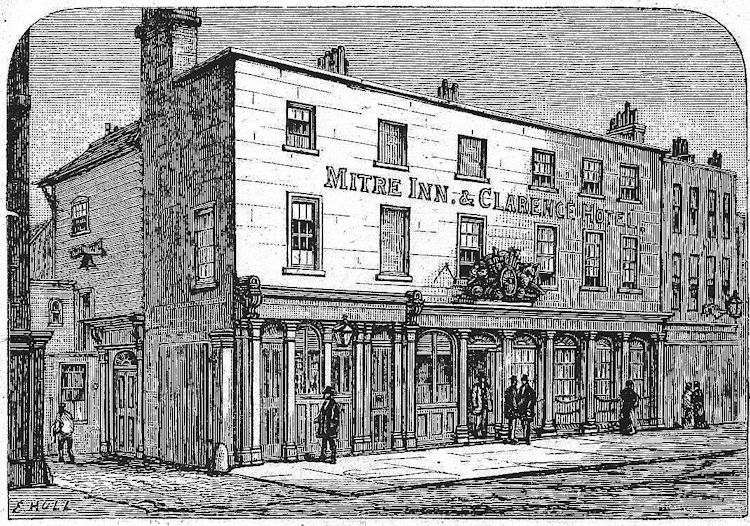
Above drawing, by E. Hull, 1879. |
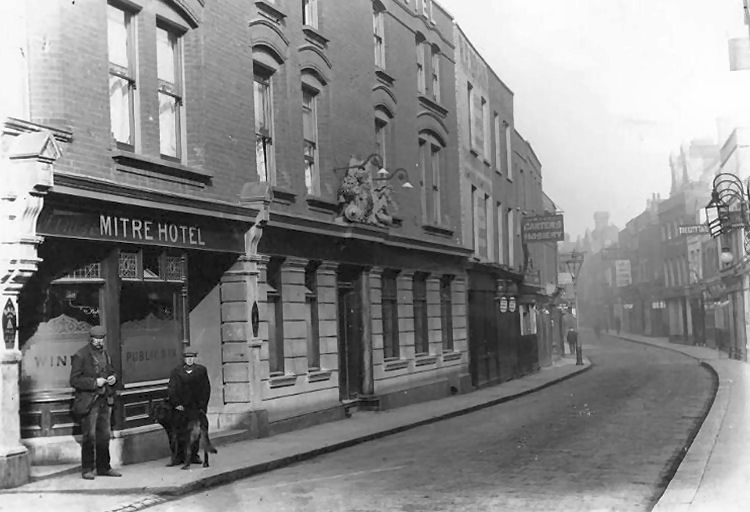
Above photo, circa 1920. |
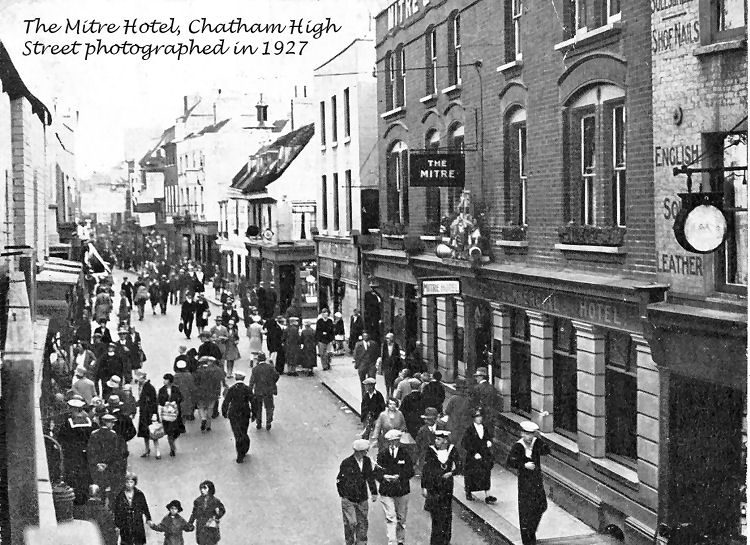
Above photo 1927. |
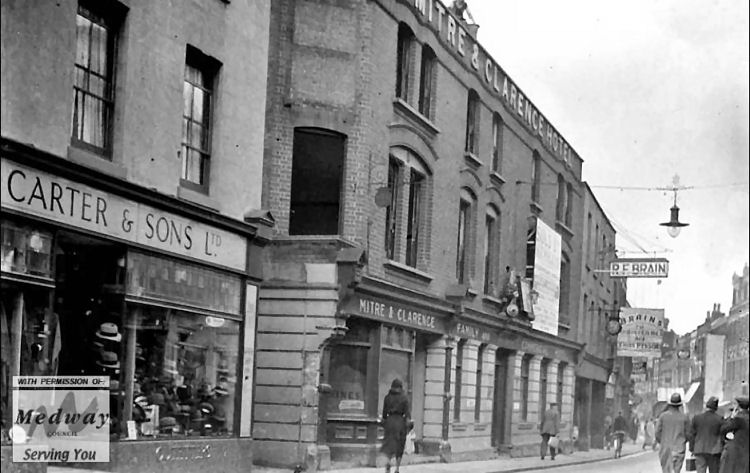
Above photo, date unknown, by kind permission Roy Moore,
http://www.kentphotoarchive.com. |
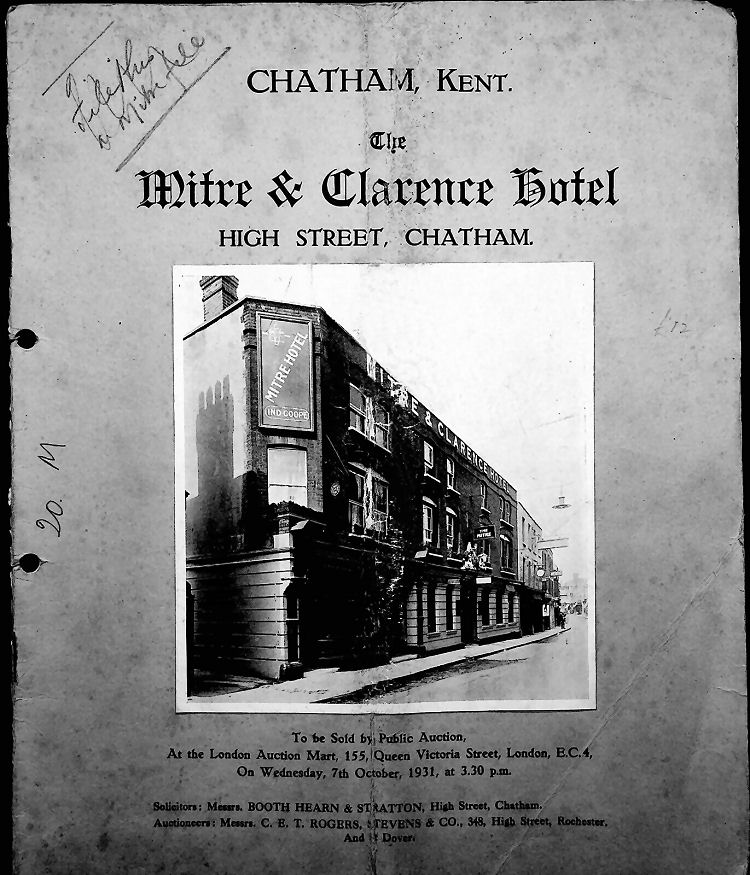
Above sale advertisement, 1931, kindly sent by Debi Birkin. |
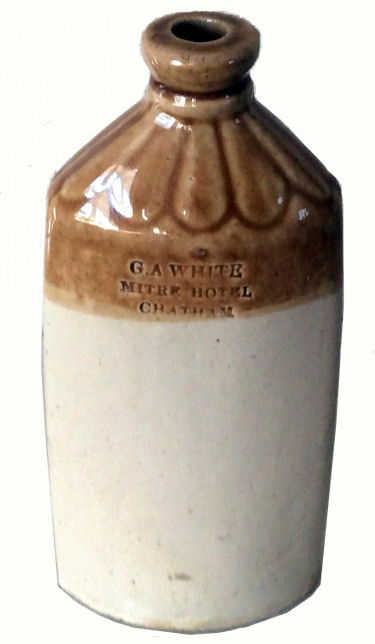
Above jug showing J. A. White, date unknown, kindly sent by Debi Birkin. |
Classed as a tavern in 1793. The Licensing
Records of 1872 stated the premises held a Full License and was owned by
John Tribe of High Street, Chatham.
The Medway Archives and Local Studies Centre has referenced a set of
documents, that I haven't seen yet, and is part of the Watts Charity MSS,
1579-1972.
Reference is made as follows:-
1903-1908
The "Mitre Tavern" and The "Clarence Hotel," High Street; and 3 messuages
In Boundary Road (2 docs.)
Up to and including 1881 the address was given as number 286.
I have reference to this pub from the Kentish Gazette or Canterbury
Chronicle September 1768, when the paper advertised the sale of household
furniture at Minster Abbey, on the Isle of Sheppey. It was stated that
catalogues could be obtained from this public house.
See Notes of 1768.
The Mitre had a splendid bowling green in the rear of its premises.
It is said that the Duke of Clarence (son of King George III) who later
became King William IV (1830-37) stayed here on his visits to Chatham.
|
Information below taken from
https://medwaytownsheritage.wordpress.com/
The lease of the manor house and grounds held by Phineas Pett terminated in 1621, and the
estate was divided up and sold for building purposes, the old manor
house was demolished and a posting house erected on the old foundations,
later known as the Mitre Hotel, at this time with breaking up of the
Manor house grounds, what was the drive leading to the manor house
became a though road and was the first time the high street could be
followed all the way from Rochester to the foot of Chatham Hill and on
to Canterbury. Before the railway, the main coaching, posting house in Chatham was the
"Mitre Inn and Clarence Hotel," where the coach called the Blue-eyed Maid,
belonging to a Mr Simpson, left on a five hour journey to London. The Mitre kept by Mr John Tribe, a High Constable of the Court Leet of
Chatham in 1819. Mr and Mrs Dickens were on visiting terms with the landlord of this fine
old hostelry, and a young Charles Dickens, at evening parties held
there, often sang songs of the sea whilst mounted on the dining table
for a stage, at the Mitre Lord Nelson used to reside when on duty at
Chatham a room he occupied being known as “Nelsons Cabin”. 1805, Lord Nelson, on his way to join the fleet, wishing to inspect the
ships in the Dockyard stayed for the night at the Mitre Inn, contenting
himself with a little cold boiled beef and then retired for the night,
this was Nelsons last visits to these streets. Nelsons Naval career began in Chatham in 1771 when, as a young boy, he
joined HMS Raisonable as a Midshipsman. In 1793, Nelson returned to the naval service after five years on half
pay, when he was appointed Captain of the Agamemnon and joined the ship
at Chatham. Ten years later in 1805 he joined HMS Victory as Rear Admiral. The Mitre Hotel, now Primark, (British Home Stores) was also visited by
Samuel Peeps in 1667. Originally just “The Mitre” it became “The Mitre and Clarence”,
following a visit in 1827 by the Duke of Clarence, Later King William
VI. He came to inspect the dockyard in his capacity as Lord High Admiral and
was quoted as saying of the Mitre it had beautiful gardens that he
called “a surprise and delight to the stranger”. The Chatham Bowling Club now in Parmerston Road was
originally formed and
run from the Mitre. It was pulled down in 1934. |
|
Kentish Gazette, Tuesday 1 May 1770.
To be sold by auction, by Mr. Francis Pyner, on Saturday the 19th day of
May, 1770, at the "Mitre Inn," at Chatham, in Kent, between 3 and 5 in
the afternoon, in separate lots.
Lot 1. A Valuable Leasehold Estate, situate opposite the "Mitre"
aforesaid, in the occupation of Mr. Lock, Upholsterer, consisting of a
substantial brick built house, and good old accustomed shop commodiously
fitted up, and a Range of Warehouses; and also a Large Piece of Ground
enclosed, adjoining the above, known by the Name of Fairfield, where Two
Fairs are nearly kept. There are six long Ranges of Stalls in the same,
with proper Stall Boards, Trestles, &c. and a Garden adjoining. There
are upwards of 65 years unexpired, at the small ground rent of £42. The
whole is esteemed worth, per Annum, £100.
Lot 2. One third part of one other leasehold Estate, consisting of Seven
substantially built Messuages, in Fair Row and High Street; and also a
Piece of Meadow Land behind the same; and likewise a Hop Ground in
Listmas Lane, now let to several Tenants at, per Annum £69. 10s. There
were 78 years and a half unexpired at Lady day last, ground Rent, per
annum, £16.
Particulars, with conditions of sale, to be had at the "George and
Bull" at Dartford; "White Hart" at Gravesend; "Angel" at Strood;
"Crown" and "Kings Head," Rochester; "Golden Lion" at Brompton,; "Star"
at Maidstone; "Green Dragon" at Rainham; "Bull" at Newington; "Rose" at
Sittingbourne; "Ship" at Faversham; "King's Head," Canterbury; at the
Place of Sale; and of the Broker, No. 37, Lombard Street, London.
N.B. To be viewed on Saturday, 12th of May, and till the sale, by
applying to the several Tenants.
|
|
From the Dover Telegraph, 23 January, 1787.
Monday was married at our church, by the Rev. Mr. Jones, Samuel Sherwood,
shopkeeper, to Miss Thompson, daughter to the late Leonard Thompson, formerly
master of the "Mitre Inn," at this place.
|
|
From the Maidstone Journal, 5 August 1788.
On Thursday last was married Mr. Daniel Richardson, master of the "Mitre Inn,"
in Chatham, to Mrs. Taylor, late of Aylesford, widow.
|
|
From the Maidstone Journal, 25 August 1789.
To Innkeepers.
To be let, and entered upon immediately. That well-known Tavern and Inn, the
"Mitre," in Chatham, most desirably situate opposite the marketplace.
The aforesaid Inn is very commodiously situated all of conveniences which can be
situated within a large and useful garden adjoining thereto. The Furniture,
Stock, &c to be taken at a fair Appraisement.
For further particulars apply to Messrs. W. and E. Twopenny, Attorneys at Law,
Rochester; or of J. Simmons, Attorney, Saint Margaret's Bank. Rochester.
|
|
Kentish Gazette, Friday 2 October 1789.
To Innkeeper's.
To be let and entered upon immediately, that well-known Tavern and Inn,
the "Mitre," in Chatham, most desirable situated opposite the Market
Place.
The aforesaid Inn is very commodious, consisting of all the conveniences
which can be required; with a very large useful garden adjoining
thereto.
The Furniture, Stock, &c, to be taken at a fair appraisement.
For further particulars apply to Messrs. W. and E. Towpennys, Attorneys
at Law, Rochester, or of J. Simmons, Attorney-at-law, St. Margaret's
Bank, Rochester.
|
|
From the Maidstone Journal, 10 November 1789.
Mitre Inn and Tavern, Opposite the Market, Chatham.
James Elliott having taken the above Inn, and laid in a Capital Stock of the
best Wines, &c, humbly solicits the Favours of his Friends, and the Public in
general; where they may depend on being accommodated with a good Larder, and
Beds well-aired, and may depend on every attention being paid to give
Satisfaction.
N.B. Neat Post Chaises to any part of England.
|
|
Kentish Gazette, Tuesday 10 November 1789.
Mitre Inn and Tavern, opposite the Market, Chatham.
James Elliott respectfully acquaints his friends and the public, that he
has taking the above Inn, and tidied it up in the most commodious and
genteel manner for reception of company; and being well convinced the
public hostelry can only be attained by unremitted attendion to deserve
as its determining to use every exertion to give satisfaction, flatters
himself that this Tavern will be found in no respect lacking to any
other in the county, both for reception of of visitors and Gentleman
travelling, and for the accommodation of friends in Chatham, Rochester,
Strood and its neighbourhood.
A good larder, the best of wines, and Beds kept continually.
Neat post chaise to any part of England.
|
|
From the Maidstone Journal, 31 May 1791.
Notice.
The Assignees of Daniel Richardson, late of the "Mitre Tavern," at Chatham, in
Kent, Inn holder, a Bankrupt, intending very shortly to make a first and Final
Dividend of the Money arising from the said Bankrupt's Effects, all persons
indebted to the said Bankrupt's Estate, are desired immediately to pay their
respective debts, without any further notice, to J. Simmons, Attorney at Law,
Rochester, he having full power from the said Assignees to receive the same.
May 23, 1791.
|
|
Kentish Gazette, 25 September, 1792. and
From the Kentish Gazette, Friday 19 October 1792.
MITRE TAVERN, CHATHAM.
James Elliott, duly sensible of many favours he has received from a
generous public, takes this opportunity of returning his sincere thanks,
and informs them he has taken, and now fitting up in an elegant and
general manner, the "Three Kings Inn," Deal, where he hopes to meet with
a continuation of that patronage his exertions may merit, being
determined to spare no expense for the accommodation of those whose
business or pleasure may call them to Deal.
A new suit of elegant Rooms will be immediately built facing the sea,
which will command the most extensive and fine prospect on the sea
coast.
|
|
From the Maidstone Journal, 15 January 1793.
Extract of a letter from Chatham, Jan. 14.
Monday and Tuesday last the Coroner's inquest sat at the "Mitre Tavern," on the
body of a seaman belonging to a merchant ship, who died from wounds in the head
which he received on Christmas evening, from a soldier belonging to the upper
Barracks, and gave a verdict of manslaughter.
The soldier is committed to take his trial.
|
|
Kentish Gazette 7 January 1800.
NOTICE IS HEREBY GIVEN,
THAT if the Bay Gelding, left at the "Mitre Inn," Chatham, on
Sunday, the 8th of December, 1799, is not taken away in fourteen
days from this date, it will be fold to pay the expenses.
JANUARY 4, 1800.
|
|
From the Kentish Gazette, 5 October 1810.
Accidents.
One day last week, as Mr. William Tribe, assistant surgeon of the 6th
regiment foot, and son of Mr. Tribe, of the "Mitre Tavern," Chatham,
was bathing in the Cove of Cork, he got beyond his depth and was
unfortunately drowned. A letter from the Colonel announced the
melancholy catastrophe to Mr. Trite, which was much softened by the
very high testimony it contained of the excellent conduct and
character of the deceased, who is represented as being most
seriously and justly lamented by the whole regiment, and whose
talents promised to be highly valuable to his country. |
|
From the Kentish Gazette, 5 October 1810.
One day last week as Mr. Wm. Tribe Assistant Surgeon of the 6th,
regt. of foot and son of Mr. Tribe of the "Mitre Tavern" Chatham was
bathing in the Cove of Cork he got beyond his depth and was
unfortunately drowned.
|
|
Early reference in 1818.
The middle borough took in all properties east of Globe Lane and
Rome Lane, up to the boundaries of the East Borough. Its register
commenced at the east side of Globe Lane in which was situated...
along the north side of the High Street... "White Lion." With only the
"Crown and Thistle," "Mitre Tavern,"
"Navy Arms," "Brewers Arms," The
"Woolpack," "Darmouth Arms," The
"Fountain" and the "White Hart" on
the south side.
(1818)
|
|
From the Kent Herald, 29 March 1827.
DEATH.
At Chatham, March 21, Mrs. Tribe, relict of the late Mr. Tribe, of the "Mitre
Inn" and "Clarence Hotel," Chatham, age 70 years.
|
|
From the Kent Herald, 15 August 1833
Chatham
Mr. Tribe, of the "Mitre Hotel," Chatham, has expressed his attention of
starting two steam omnibuses to run between Chatham and Gravesend. It is
calculated they will travel at the rate of 16 miles per hour. We
understand a trial will take place in a few days, and they are expected
to commence running early in September.
|
|
From the Kentish Gazette, 14 January 1834. Price 7d.
POSTING REDUCED.
Posting from Tribe's “Mitre Inn” and “Clarence Hotel,” Chatham, at One
Shilling per Mile.
|
|
From the Kentish Gazette, 11 February 1840.
ROCHESTER.
Prince Albert and his retinue arrived in Chatham on Saturday about one
o’clock. The Prince avoided the town by passing over the road, which
greatly chagrined the Radicals. The Queen's posting-house, alias the
"Mitre Inn," was dressed up with the Royal Standard floating across the
road, and the staircase was lined with scarlet cloth. It was certainly
very annoying to the gentry who had fagged hard, and who were about to
pay Radical adoration to royalty at the Inn in question, to be thus
disappointed. The announcement of the approach of the Royal personage
was made by a discharge of artillery from the batteries. A guard of
Honour with an excellent band attended, and played martial airs. Upon the
Prince’s arriving opposite the Queen’s Colour, borne by Ensign Noble,
the whole of the Radical gentry made a sudden rush to the carriage, and
the Prince was therefore obliged to hear the Address, which, we
understand, Lord Torrington said should not be received. It was observed
that come Radical dissenters took the opportunity of throwing letters
into the carriage — no doubt praying for the abolition of church rates.
Mr Pring, of Newport Radical notoriety, read the Address to the Prince,
who briefly replied that he was obliged to them. The cavalcade in
defending Star Hill into Rochester, the horses drawing the fourth
carriage not being fit for the service, being Cobs about 14 hands, had a
narrow escape of an accident; the two leaders fell, one of them rolling
over the other. In the carriage with the Prince were his brother and
Lord Torrington; the second carriage contained the Prince's father and
Col. Grey.
|
|
From the Kentish Gazette, 25 June 1844.
Marriage.
June 10, at Chatham, Mr. J. P. Catt, to Miss Randall, niece of Mr.
Randall of the “Mitre Tavern,” Chatham.
|
|
Kent Herald, 18 September 1845.
Rochester and Chatham.
John Williams was placed at the bar on a charge for stealing a saddle, from
the "Mitre" stables at Chatham, the property of Mr. Collard, of Little Barton,
near Canterbury, who had come to Chatham to witness the races.
Committed four trial.
|
|
Kentish Gazette, 9 November 1847.
On Wednesday week the Court Leet for the Hundred and Manor of Chatham
was held at the "Mitre Hotel," for the purpose of appointing a high
constable, borsholders, and other officers for the year ensuing. Mr. W.
Weekes was elected high constable. The members of the leet and about
fifty gentlemen dined at the "Sun Hotel," in the evening. Mr, Thomas
Hills, solicitor, on retiring from the office of high constable, gave a
public breakfast at the "Mitre Hotel," to upwards of seventy of his
friends.
|
|
From the Kentish Gazette, 15 February 1848.
Robbery at Chatham.
On Sunday evening, while Mr. Pike, a draughtsman in the dockyard, was
gone to chapel with his wife, some person entered the house by means of
picklock keys, and after having picked the whole of the locks, scattered
the contents of the drawers about the rooms, and decamped with upwards
of £20 worth of property, and as yet have not been heard of. This is the
fourth Sunday evening that houses have been robbed in this neighbourhood
during the absence of parties at a place of worship.
In consequence of the frequent robberies in Chatham and its
neighbourhood, a public meeting took place on Saturday, at the "Mitre
Inn," the High Constable in the chair, when it was resolved that a night
patrol (twelve in number for each night) should be formed by the
inhabitants, and be distributed into different districts.
|
|
Kentish Gazette, 6 February 1849.
DEATH.
Randall:— Jan. 26, Henry, second son of Mr. Randall, of the "Mitre
Hotel," Chatham, aged 15 years.
|
|
South Eastern Gazette, 31 January, 1860.
Enlargement of the Marine Barracks.
The demolition of the "Navy and Army Hotel," the "Queen’s Head," and
other property adjoining the Marine barracks, will be shortly
commenced, the owners and occupiers having had their respective
claims satisfied by the Board of Admiralty. The friends of Mr. Manser, landlord of the "Navy and Army Hotel," will be glad to hear
that he is about to take the "Mitre Hotel" where he will succeed Mr.
Randall, who has so satisfactorily conducted that establishment for
a great number of years. The enlargement of the Marine barracks will
be commenced as soon as the site has been cleared.
|
|
South Eastern Gazette, 20 March, 1860.
MITRE HOTEL, CHATHAM.
ROBERT RANDALL offers his best thanks for the kind patronage and
support be has received during the nineteen years he has kept the
"Mitre Hotel," at Chatham.
Having disposed of the above Hotel, and Business of Wine and Spirit
Merchant, to Mr. Frederick. Manser, who for many years past has
conducted the "Army and Navy Hotel," Chatham, R. R. has much
pleasure in soliciting for him a continuance of their favours.
FREDERICK MANSER, having taken the above old-established and
well-conducted Hotel, and the Wine, Spirit, and Porter Business
attached thereto, assures his friends that he will endeavour to
conduct the business in such manner as cannot fail to give
satisfaction to those who have kindly and liberally patronised him
whilst at the "Army and Navy Hotel," and to whom he begs leave to
offer his sincere and warmest thanks.
March 20th, 1860.
|
|
From the Southeastern Gazette, 19 June 1866.
CHATHAM.
About 250 Dozens of genuine WINES, including choice parcels of Old
Bottled Ports, Dinner and Desert Sherries and Clarets, in pints, quarts,
&c. &c.
Messrs. KIDWELL & SON (Having Let the Hotel) ARE instructed from Mr. J.
Knight, of the “Mitre Hotel,” Chatham, to SELL by AUCTION, on Monday,
June 25th, 1866, at One for Two o'clock in the afternoon, on the
premises as above mentioned, the very CHOICE and WELL-SELECTED STOCK of
WINES, guaranteed to be the genuine stock for which this hotel has been
for many years celebrated; sold in consequence of a change of tenancy,
and reduction of stock necessary.
The above offers an excellent opportunity to consumers and others
requiring a few dozen of good sound wine, and will be arranged in lots
from one dozen to three dozen each,
Catalogues may be had three days prior, at the place of sale, and at the
Auctioneers and Valuers, Banks, Rochester.
|
|
London Evening Standard, Thursday 21 May, 1885.
Valuable freehold business property, 227, High Street Chatham.
Messrs. Jesse Thomas and Barnes are instructed by the Devisees in trust
to sell by auction, on Thursday, May 28th, at the "Mitre Hotel,"
Chatham, at 7 precisely, the valuable Estate, consisting of large shop
and modern built dwelling house, containing 13 rooms and 3 cellars.
There is a large frontage to the High Street, with paved entrance to the
back premises, which are unusually extensive. This property constitutes
one of the most desirable sites for any business requiring space, and is
situated in the busiest part of the high street of Chatham, being such
as very rarely occurs for investment or occupation, and is of the
estimated value of £120 per annum, with possession on completion.
Further particulars and conditions of sale, with plan of the estate, can
be had of Messr's. M. S. Stephens and Sons Solicitors, 33, Railway
Street, Chatham; of Mr. Drake, architect, Rochester; or of the
Auctioneers, Messrs. Jessie Thomas and Barnes, Chatham.
|
|
From auction sale brochure, 1931.
By order of the Executors of A. Booth Herne, deceased.
CHATHAM, Kent.
To Brewers, Hotel Proprietors, Cinema Syndicates, Amusement Caterers,
Restaurateurs and others
PARTICULARS AND CONDITIONS OF SALE Of THAT Valuable and Extensive
FREEHOLD FULLY LICENSED PROPERTY KNOWN AS The Mitre & Clarence Family
and Commercial Hotel, HIGH STREET, CHATHAM, together with the Extensive
Grounds in the Rear. Having a considerable frontage to the main
thoroughfare in the centre of the busiest shopping area in the Medway
Towns with a district population of about 150,000, also return frontages
to a side street thus forming A Most Advantageous Site for Development
having a Total Area of about 32,300 Square Feet which includes Two
Freehold Cottages Nos. 5 & 6, Meeting House Lane, Chatham.
Which will be sold by Auction by Messrs. C. E. T. ROGERS STEVENS &
CO. At the London Auction Mart, 155, Queen Victoria Street, E.C.4, On
WEDNESDAY, 7th OCTOBER, 1931, At 3.30 p.m.
Solicitors: Messrs. BOOTH HEARN & STRATTON, High Street, Chatham.
General Notes.
This sale affords an opportunity of securing one of the largest and most
important Sites available in the centre of the Medway Towns. The position is such to render it suitable for development in many
directions in addition to utilising the imposing structure of the Hotel,
which is fully licensed. There are two important Return Frontages to the ajacent side street, one
of which is represented by the Two Cottages offered in Lot 2. The fully licensed Hotel is an important feature. being one of the
oldest established Family and Commercial Hotels in the County, enjoying
a very lucrative business both in the Bars and in the Hotel. The "Mitre and Clarence Hotel" stands on the site of the old Manor Mouse
which was known as "Greetings" where the Court Leet of the Manor of
Chatham were held. This continued until 1600, when the house was let on
a 21 years' Lease to the famous Phineas Pett, a "Master Shipwright and
Commissioner for H. M. Dockyard." The old Manor House was partially
pulled down and the "Mitre Hotel" came into being with a priviso that
the Courts Leet should continue to be held there. Documents still extant
tell of the hospitable board supplied to the Yeoman of the Leet. With
the opening of the then carriage drive, now the High Street, as a public
road, the Hotel became a well-known Post-chaise Inn and stopping place
for Mail Coach. In 1805 Lord nelson stayed at the Hotel on his way to join the Fleet
when he wished to inspect the ships in the Dockyard. In 1827 the Hotel was visited by the Duke of Clarence (afterwards
William IV), who came as Lord High Admiral to inspect the Dockyard. To
commemorate this visit the additional name of Clarence was added to the
Hotel with the Royal Coat or Arms still in situ. The property comprising Lot 1 is free of Land Tax, which has been
redeemed, and both lots are believed to be Tithe free as none has been
demanded or paid by the Vendors or their known predecessors in title.
Lot 2 is subject to Land Tax of 11s. 4d. per annum. PARTICULARS. LOT 1 (As coloured Red and Blue on Plan).
All that VALUABLE AND EXTENSIVE Freehold Fully Licensed Property KNOWN AS THE Mitle & Clarence Hotel, No. 198, HIGH STREET, CHATHAM TOGETHER WITH THE Extensive Grounds in the Rear
Comprising:— ON THE SECOND FLOOR.— Ten Bed Rooms, One Stall Room, store cupboard. ON THE FIRST FLOOR.— Private Sitting Room, Six Bed Rooms, Bath Room, Two
W.C’s. Staff Wing comprising: Five Staff Bed Rooms, linen cupboard, Housemaid’s
Pantry. ON THE GROUND FLOOR. Coffee Room and Lounge communicating, 68ft. 6in. by
21ft. 4in., with large bay overlooking Garden with French windows,
Commercial Room, Stock Room, Lounge Bar, Large Saloon Bar, Office,
Public Bar in three compartments, Service Room, Kitchen, Scullery,
Bottle Store, Hotel Entrance and Corridor (separate entrance to Public
Bars). BASEMENT.— Beer, Wine and Spirit Cellars. OUTSIDE.— Timber-built Wash-up and Lavatories, Garden, Tennis Lawn,
Timber-built Pavilion, Large Greenhouse and Potting Shed. There is a double-gate entrance with right of use of roadway to the
public road known as The Paddock. Off Meeting House Lane there is a large partly cemented Yard with Four
Lock-up Brick-built Garages with Open Lean-to. |
The pub closed in 1934 and was demolished in 1937 and a BHS was built on
the site.
LICENSEE LIST
THOMPSON Leonard pre 1787
RICHARDSON Daniel 1788+
ELLIOT James 1789-Oct/1792


TRIBE John 1810-38+
   (76 High Street)
RANDALL Robert 1841-60 (age 43 in 1841 ) )
 MANCER Frederick 1860+
SCOVIER Auguste 1872-74+

LEWIS Joseph F 1881-91+ (age 43 in 1881)
WOOLEY Mary A 1891+ (age 58 in 1891)
MORGAN Emily 1901+
GILES Alice Mrs 1913+
COLWELL Alice Mrs 1930+
https://pubwiki.co.uk/MitreHotell.shtml
Universal
British Directory of Trade 1793
From the Pigot's Directory 1828-29
From the Pigot's Directory 1832-33-34
Wright's
Topography 1838
Licensing
Records 1872
Census
|

