|
Oak Street (1858)
41 Middle Street
Deal
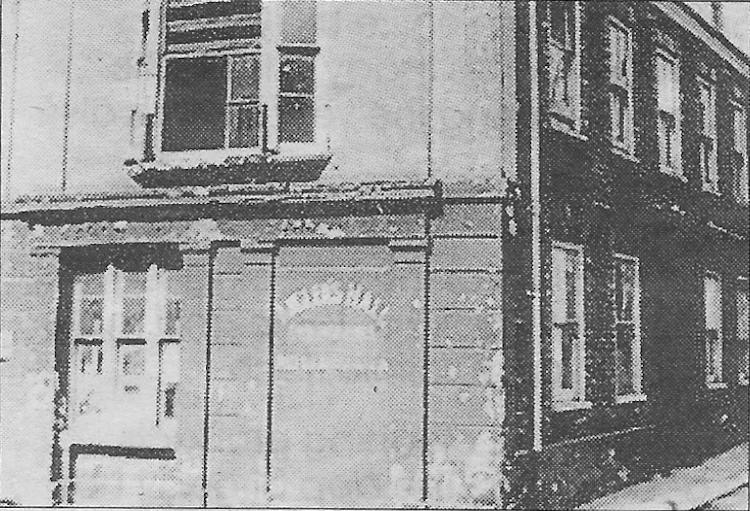
Above photo, date unknown. |
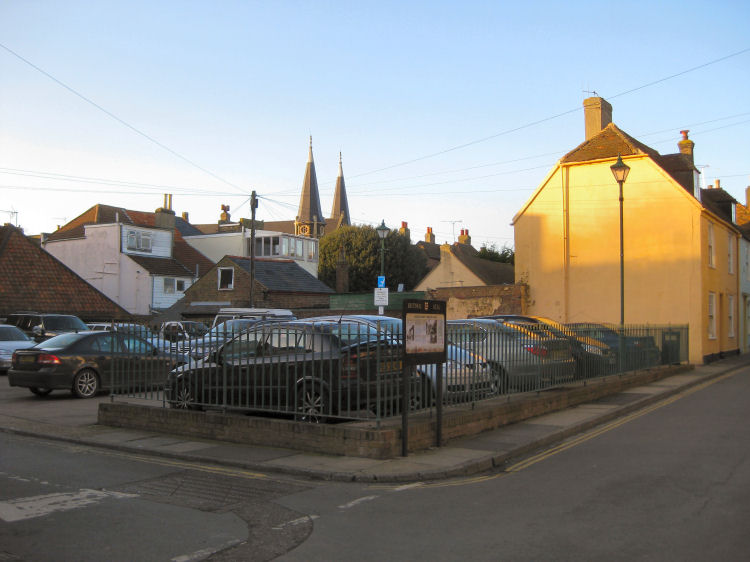
Above picture kindly supplied by Patricia Streater, 12 February 2011.
Oak Street is the turning on the left of the photo and Middle Street
towards the right and with the row of houses. The twin spires in the
background are from the Landmark Centre in Deal's High Street. |
According to my records this pub was originally called the "Blewbore"
and I am wondering whether the pub was renamed when Oak Street was built.
The change of name happened sometime before 1786.
However, the Sandwich Borough Records shows Licensed Victuallers who paid for new
Inn signs, 6s. 8d, and Sureties of £5 on 12th September, 1662, and again,
further reference to a "Royal Oak in 1737. No address given for this
one, but I am assuming it to be one and the same as this. Richard Bridger of
the "Blewbore" died in 1668, the house
could have changed name after his death.
Further research tells me that the house was used in 1794 to celebrate
the Mayoral election of John Hollams.
|
Kentish Chronicles, 9 December, 1794.
Death.
On Friday last died, Mr. Thomas Waite, of the "Royal Oak Inn,"
Deal.
|
|
Kentish Gazette, 15 March 1803.
ROYAL OAK INN, DEAL.
THOMAS BARHAM takes the opportunity of returning his warmest thanks
to the numerous friends who have so liberally honoured him with
their favours, and be should be wanting in gratitude not
particularly to notice the distinguished partiality that has been
shown him by the Gentlemen Travellers, to whom, he trusts, every
attention in his power has been paid. In quitting the public line of
life, he has the pleasing satisfaction to recommend to the notice of
those friends, and the public in general, Mr. Thomas Rickman, who
succeeds him in the business, not doubting they will find a
continuation of the like attention, and the same wish to please, that
he trusts has hitherto marked his public conduct.
N. B. All persons to whom T. Barham stands indebted, are requested
to tend in their accounts to him at the "Royal Oak," that they may
be discharged.
THOMAS RICKMAN
Having taken the above Inn, humbly solicits a continuance of that
patronage that his predecessor has received, and if the most
unremitting attention and assiduous desire to please, will entitle
him to the favour of the public, he trusts hit endeavours will merit
that support which he flatters himself he shall receive.
Gentlemen Travellers will find good accommodation and reasonable
charges, with wines and liquor of the best quality — the beds
constantly well aired, and every attention paid to the convenience
and comfort of those persons who may please to favour him with their
company.
Deal, March 7, 1803.
|
|
From the Maidstone Gazette and East Kent Courier, 17 July, 1827.
On Tuesday a man of the name of Pain, several years oster at the "Royal
Oak Inn," Deal, put a period to his existence by hanging himself in the
stable; no cause can be assigned for the rash act, as the deceased was
remarkable for his steady and industrious habits. He has unhappily left
a wife and 5 children to deplore his fate.
|
|
From the Kentish Gazette, 3 April 1838.
DEATHS.
Last week, at Dover, at an advanced age, Mr. Thomas Rickman, many years a
respected innkeeper at Deal.
|
|
From the Kentish Gazette, 14 January 1840.
DEAL.
The acceptance of the invitation by the two members to dine with the
Radical Club, infused some spirit into our townsmen last week. The
members after having dined at Sandwich came over to Deal, and having
partaken of Capt. Boys’ hospitality, met their constituents in the
evening at the "Royal Oak." A large party assembled, but they were
greatly disappointed at the very little information their members were
able to give of the state of affairs. The evening was dull until the
potent liquor of mine host began to operate—there was then noise and
confusion enough. Coming events cast their shadows before, and if we are
able to judge by the result of the preliminary visit of the
representatives to their constituency, whig prospects are very
lugubrious.
|
|
From the Kentish Gazette, 7 April 1840.
DEAL. Catch Club.
The last concert of the Catch Club took place at the "Oak" on Tuesday
the 31st ult. The room was very full; the number of visitors larger than
on any preceding evening, being increased by the members of the Dover
club.
|
|
Maidstone Journal and Kentish Advertiser, Tuesday 12 June 1849.
Canterbury.
Important sale of the extensive Brewery of Messr's Flint, including 30
old established Inns and Public Houses, and other valuable property.
Mr. V. J., has received instructions to sell by auction, at the
"Fountain Hotel," Canterbury, on Tuesday and Wednesday, 26th and 27th of
June, at 12 o'clock each day, (in consequence of the death of the senior
acting partner and the retirement of the surviving partners,) the
valuable property known as Messrs. Flint's Brewery, in Stour Street,
Canterbury, and the Inns, Public Houses, and other valuable property
connected with theirwith. The first day sale on Tuesday, 26th June,
1849, will comprise the following property in and near the city.
Public houses.
Lot 1. The "City of Canterbury," situate on the road to Whitstable.
Freehold.
Lot 2. The "George and Dragon," Westgate without, leasehold under Hind's
charity for 17 years unexpired.
Lot 3. The "Three Compasses," Westgate
within. Freehold.
Lot 4. The "Bell Inn" and Coach Office, in the High Street. Freehold.
Lot 5. The "Prince of Wales," St. Alphege Lane,. Freehold.
Lot 6. The "Weavers Arms," Broad Street, freehold and partly leasehold.
Lot 7. The "White Swan," Northgate. Leasehold under St. John's Hospital
for a short term, at a ground rent.
Lot 8. The "Kings Head," Northgate.
Freehold.
Lot 9. The "Swan Inn," at Sturry (close to the railway station).
Freehold.
Lot 10. The "Ship," St. Martins Hill, freehold.
Lots 12. The "Star Commercial Inn and Tap," St George's, close to the
Cattle market and Dane John. Freehold.
Lot 13. The "Blue Anchor," Old Dover Lane, near the Cattle market.
Freehold.
Lot 14. The "Fleece Inn," High Street, opposite to the Corn market.
Freehold.
Lot 28. Three neat Cottages opposite the Brewery, with large gardens
extending to the river.
Lot 29. The "Two Brewers" public house and Spirit Warehouse, adjoining
the last lot.
Lot 31. The "Black Dog" public house, Castle Street.
Lot 34. The "Duke's Head" Public House, Wincheap Street.
Lot 35. The "King's Head," Public House, Wincheap Street.
Lot 37. The "Royal Exchange," public house, Stour Street.
Lot 38. The "Kentish Arms," public house, and 5 cottages in Jewry Lane.
Leasehold for a short term at a low rent.
Lot 40. The "Duke William," at Ickham, abiout five miles from
Canterbury. Freehold.
Lot 41. The "Royal Oak Inn," at Deal. Freehold except a small portion.
Lot 42. The "King's Arms," Beach Street, Deal, and Cottage in the rear.
leasehold for a short term, at a Ground rent.
Lot 43. The "Fleur De Lis," near the Railway Station, Dover. Leasehold
for a term of 6 years, at a Ground rent of £3.
Lot 44. The "Two Brewers," Limekiln Street, Dover. leasehold for a term
of 46 years, at a ground rent of £3.
Lot 45. The "Fountain Inn, adjoining the Market place at Dover.
Freehold.
Lot 46. The "Lord Nelson," Radnor Street, near the harbour, Folkestone.
Freehold.
Lot 47. The "Bricklayers Arms," Fancy Street, Folkestone. Freehold.
Lot 48. The "Castle Inn," at Sandgate. Leasehold for a short term, at a
ground rent of 7s. 6d.
Lot 49. The "King's Head Hotel and Tap," at Margate. Freehold.
Lot 50. The "New Inn," at Elham, on the road to Hythe. Freehold.
Lot 51. The "King's Arms," at Milton near Sittingbourne. Freehold.
The Public Houses are for the most part in the occupation of
unexceptionable tenants, and the majority of them are doing trades, both
in beer and spirits, considerably above the average run of Country
houses. (None of them have been beer shops; they're all old Licence
Houses, with connections of long standing, thereby affording ample
security for the permanency of the trade). The Premises generally are in
a superior state of repair.
Particulars and Plans, price 1s. each, may be had of Messr's. Furleys
and Mercer, Solicitors, Canterbury; at the "Fountain Hotel;" and of Mr.
V. J. Collins, 3, Moorgate Street, London.
|
|
Kentish Gazette, 2 October 1849.
To Inn Keepers and Others.
To be let, with immediate possession, and on very advantageous terms.
"ROYAL OAK INN," DEAL, an old-established house, with good stabling, and
well situated for business.
Apply to Messrs. Flint, Stour Street, Canterbury.
|
|
From the Kentish Gazette, 21 July 1857.
Kent v. Drew.
This was an action brought by Mr. Kent, the landlord of the "Royal
Oak," Deal, against the defendant, an attorney practising there.
Mr. Towne appeared for the plaintiff and said, that in January last,
Mr. Drew had speculated on a horse, which had nearly broken his
neck, and having resolved that he had better decline further
equestrian amusement, he determined to sell his animal for what he
could get if only for dogs meat, rather than endanger society by the
loss of one of its useful members — so he spoke to his bosom friend
the plaintiff, and expressed his willingness to part with his steed
at any price — it seems that the plaintiff re-assured him and gave
him to understand that the defendant’s steed might probably on due
recommendation, realise much more than defendant contemplated. Mr.
Drew said he might then have the horse for £20 himself, but Mr. Kent
was not a purchaser — however, observed the latter, if I introduce
you to a purchaser at £25 will you give me £5? which was agreed.
Ensign Blakemore happened to come into the plaintiff’s billiard room
soon after, and the plaintiff introduced him to Mr. Drew as the
owner of an enviable charger probably disposed to sell — the horse
was seen — the bargain completed, the juvenile warrior agreed to pay
£30 for its price and £5 for securing the purchase money in the
shape of a warrant of attorney. Mr. Towne suggested that this was
not exactly the transaction in which he was proved to see a member
of his honourable profession engaged — it was by such artful and
imprudent dealings that young gentlemen like the ensign, who was
still an infant in law, were entangled and precipitated into
disgrace, and the hopes of their fond parents too frequently
destroyed, but as the defendant had either by menaces to the father
or threatened applications, to the Horse Guards, ultimately obtained
£35 for his horse, through the introduction of the plaintiff, he
considered it was not grateful in him to withhold the £5. commission
he had promised.
Mr. Frederick Kent, the plaintiff, and several other witnesses,
confirmed the statement of his Advocate, and proved repeated
promises of defendant to pay when he received the money.
Mr. Edward Drew, the defendant, denied the promises altogether, but
admitted that he had received £35 from Ensign Blakemore, but the
latter he said was to give plaintiff something for the trouble he
had taken. He then called Ensign Blakemore, who said be remembered
at the sale that Mr. Drew said Mr. Kent would expect witness to pay
him a trifle for his trouble.
Cross-examined by Mr. Towne:— But you did not I think pay Mr. Kent
anything?
Ensign Blakemore:— No.
Mr. Towne:— You paid Drew £10 in cash I think?
Ensign Blakemore:— Yes.
Mr. Towne:— And your papa afterwards paid £25 balance.
Ensign Blakemore:— My father! did.
His Honour expressed an opinion that there ought not to have been
any necessity for the action, and gave judgment for plaintiff with
costs.
|
|
Kentish Gazette, Tuesday 2 April 1867.
Mr. Brassey and the Liberal Electors.
A meeting of the Liberal electors of Deal and Walmer was held at the
"Royal Oak Inn," Middle Street, on Wednesday evening, R. Hazel, Esq., in
the chair. Mr. Brassey was present and addressed the meeting at
considerable length. He was most enthusiastically received by the
numerous company assembled. Several of the electors expressed their
satisfaction with the address of Mr. Brassey and his clear and lucid
enunciation of his political opinions, and at the close, of the motion
of Mr. Lush, seconded by Alderman Brown, a vote of confidence and
promised support in the event of an election was unanimous accorded to
Mr. Brassey. A vote of thanks having been presented to the Chairman for
his conduct in the chair, the meeting separated.
|
|
From Laker 1917, P. 201
On August 6th, 1794, John
Hollams, lieutenant, Deay Coy. (Deal Castle Coy. of Volunteers) was
chosen Mayor of Deal. In the voting the company assembled and fired
three volleys in honour of the event. They then marched to the "Royal
Oak Inn" where the Mayor and Corporation were banqueted and there
mounted a Sergeant's Guard.
|
|
From an email received 17 November 2013. I worked
for most of my career in HM Customs & Excise always in London. About 8
years ago, we bought a flat in Deal and have greatly enjoyed staying
there. We came at the end of September and happened to look in the new "antigue/house
clearance" shop behind the Co-op. I was amazed to find an 1823
Commission given to Henry Epps by the Commissioners of Excise. It seems
to be the original, with stamped paper seals.
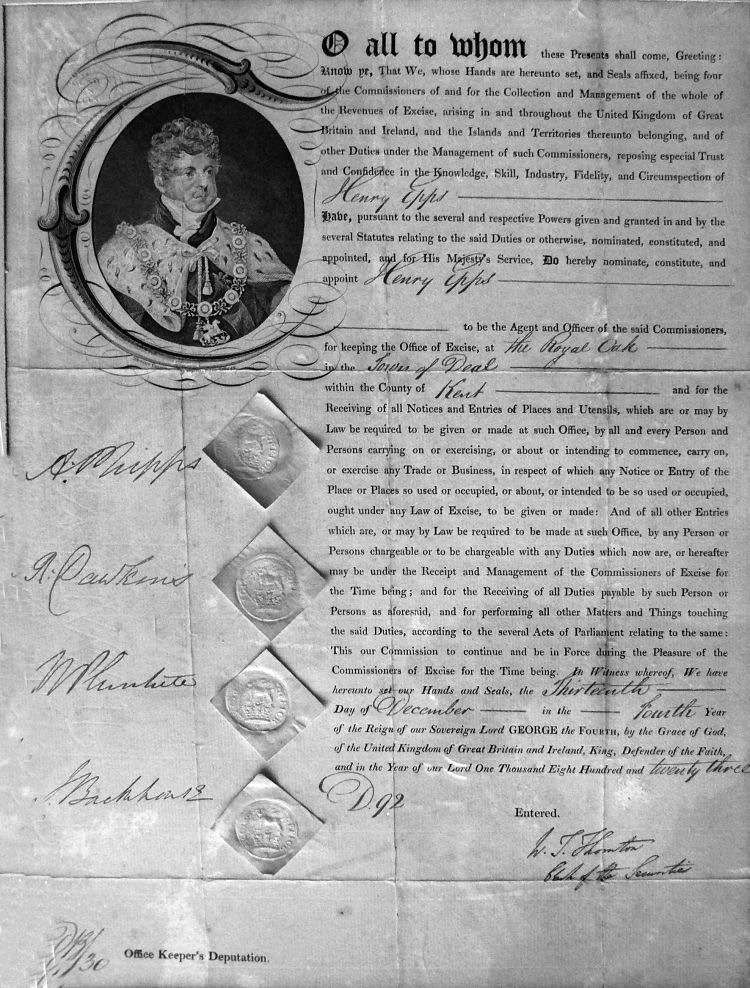
A wonderful piece of history. I have no idea where it came from.
Best wishes,
Richard Allen.
|
|
From the Dover Telegraph and Cinque Ports General
Advertiser, Saturday 23 November, 1833. Price 7d.
The Catch and Glee Club, at the "Royal Oak," has commenced for the
seventh season, with a very considerable increase of patronage; and Epps
continues his usual urbanity. The third evening was on Tuesday last,
when as on the former meetings, there was a very crowded room; and the
overtures, Sophonisha, Italian in Algiers, William Tell, and Sargino,
were delightfully performed. The leader, Mr. Harrison, will have his
concert on Tuesday, the 10th December, until when, the Club do not again
meet; every member wishing to shew that encouragement due to the service
of so deserving a young man, and on which occasion the usual beauty and
fashion will doubtless grace the room.
A Glee club is a musical group, historically
of male voices but also of female or mixed voices, which traditionally
specializes in the singing of short songs—glees—by trios or quartets.
The first named Glee Club was founded in Harrow School, in London,
England, in 1787.
|
Pigot's directory 1840 situates it in Middle Street, while the Deal,
Walmer & Sandwich Telegram of 1858 shows an advert that states the
following:- "ROYAL OAK" Tavern and Hotel, Oak Street, (opposite the pier)
Deal. I. Hicks, proprietor, Billiards &c.
This is a pub and not to be confused with the "Royal
Hotel" in Deal. The "Royal
Hotel," is of course in Beach Street.
|
From Almanack 1865.
John Pain, ostler at the "Royal Oak," Deal, hanged
himself in July, 1827.
|
|
From the Dover Telegraph, Saturday 23 November 1833.
DEAL
Our Catch and Glee Club, at the Royal Oak, has commenced for the
seventh season, with a very considerable increase of patronages; and
Epps continues his usual urbanity. The third evening was on Tuesday
last, when as on the former meetings, there was a very crowded room; and
overtures, Sophonisha, Italien in Algiers, William Tell, and Sargino
were delightfully performed. The leader, Mr Harrisson, will have his
Concert on Tuesday, the 10th December, until when, the Club do not again
meet; every member wishing to shew that encouragement due to the
services of so deserving young men, and on which occasion the usual
beauty and fashion will doubtless grace the room. |
|
From New Handbook to Deal. 1852.
"At the corner of Oak Street is the "Royal Oak Inn," which has
Concert Room, where the celebrated Catch Club hold their meetings and
Balls occasionally take place."
|
(The Hibernian Catch Club is a male-only Catch musical club founded
c.1680 in Dublin, Ireland by the vicars-choral; it claims to be the oldest
surviving musical society in Europe. Membership was historically exclusive,
restricted until 1770 to members of the vicars-choral. When participation
was expanded in the late eighteenth century members still had to be
appointed by committee, and included many prominent members of the Irish
nobility, gentry, and professions. Info by Wikipedia.)
|
From the Deal, Walmer & District and Kingsdown
Telegram. 25 July, 1863.
Annual Dinner of 3rd (Deal and Walmer) Cinque Port Volunteers at
"Royal Oak Hotel."
|
|
From the Southeastern Gazette, 16 January 1866.
THE BANKRUPTCY ACT, 1861.
NOTICE OF THE GRANTING OP AN ORDER OF DISCHARGE.
AN Order of Discharge has been granted as hereinafter mentioned by the
Court of Bankruptcy in London, and such Order will be delivered out
unless an appeal be duly entered against the judgment of the Court, and
notice thereof given.
JOHN BURCH, late of Deal, in the county of Kent, victualler, adjudicated
Bankrupt the 21st day of November, 1861. Order of Discharge granted on
the 24th day of December, 1862.
P. H. PEPYS, Registrar,
|
|
From the Deal, Walmer, and Sandwich Mercury,
28 September, 1872. 1d.
DRUNK AND DISORDERLY
Frederick Davis, a respectable-looking young man, belonging to Upper
Walmer, was brought up charged with being drunk and disorderly at Deal
on the previous evening.
P.C. Pettet deposed: I was on duty last night at eleven o'clock, and
was called to the "Royal Oak," public-house. I went there, and found the
prisoner, Frederick Davis, in the tap-room with others. They said he had
offered another out to fight, and a man named John Ashington had his
garment off. I told the prisoner he had better go home, and he then left
the house. About ten minutes afterwards I heard a noise in Lower Street.
I went there, and saw the prisoner stopping another man, and said he
would knock him down with his umbrella. I found he was very drunk, and I
took him into custody. He did not make any noise then, but he had been
making a great noise in Lower Street.
The Magistrates fined the prisoner 10s., including costs, or in
default seven days' imprisonment.
The money was paid.
|
1875 and some time thereafter the Deal Licensing Register reported that
the house hadn't applied for a licence.
Balls and concerts were frequently held at the inn although closed many
years before the building was damaged by shell-fire on 21 June 1944.
LICENSEE LIST
WAITE Thomas to Dec/1794 dec'd
FENNER & FLINT Brewers (owners) 1786
SOLE Edward 1786+
BARHAM Thomas to Mar/1803
RICKMAN Thomas Mar/1803-04+
EPPS Henry 1820-23+
 ( ( 1828)
1828)
EPPS John 1826-39
 ( (  & excise office)
LOWIN Henry Holt 1839-47+ (age 40 in 1841 ) )
 
GAMBRELL Thomas 1850-52+ (age 49 in 1851)

KENT Frederick 1855-57+
HICKS John to Sept/1858+

LINNETT Thomas Sept/1858+
BURCH John 1861+ (age 35 in 1861)
FINNIS William 1861+ (age 50 in 1861)
BROOKS W 1865+
LANGLEY ???? 1873+
From the Pigot's Directory 1823
From the Pigot's Directory 1828-29
From the Pigot's Directory 1832-33-34
From the Pigot's Directory 1839
From the Pigot's Directory 1840
From Bagshaw Directory 1847
From the Dover Telegraph
From the Deal Telegram
Deal Licensing Register
Census
|

